
By David Lorehound
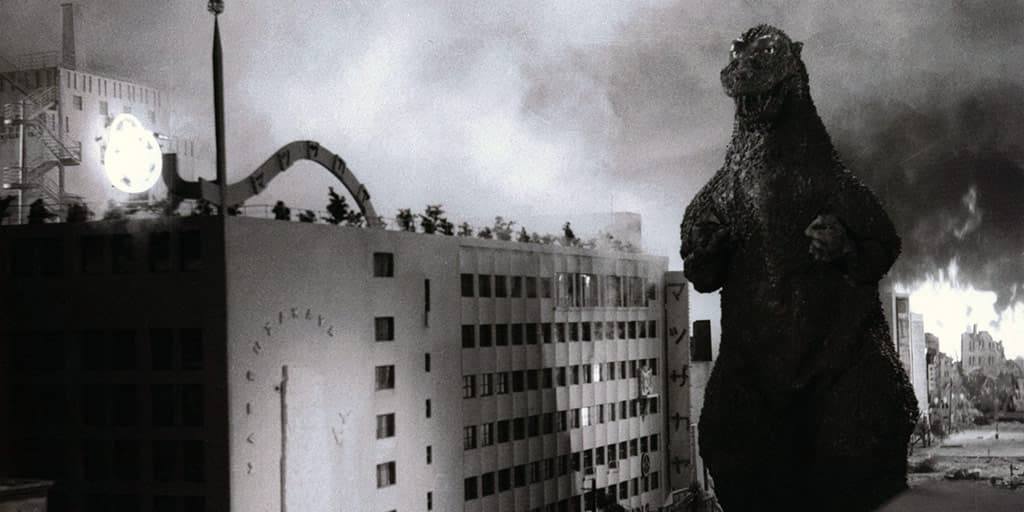
When I first saw Legendary's MonsterVerse version of Godzilla in 2014, my immediate reaction to the monster's design was to think of a professional wrestler or bodybuilder, a figure with bulging neck muscles. It was not the Godzilla I remembered from childhood, fighting Mothra on a black-and-white television on a Saturday afternoon. That earlier creature was a product of its moment, shaped by the production technology of the time and by what Godzilla had become by then, a lovable, somewhat goofy monster befitting an afternoon matinee. The new one felt different and distinctly modern, an avatar of masculinity rather than a monster with a history. Looking back, I had just met the semiotics of Godzilla without knowing the name for it.
My reaction was a form of "reader response theory," and I unconsciously decoded and ascribed meaning to what I saw on screen. The silhouette is the same in both versions, yet the bodies say different things, and I could feel the difference before I could say what it was. And that's what I wanted to address in this post: his design keeps changing because his body is where each production inscribes what it fears, admires, or wants to believe about power.
With Godzilla Minus Zero arriving in theaters in November, Lorehounds Community Co-host NateL and I are recording a three-part podcast series: the background and history of Godzilla, Gojira (1954) against Godzilla Minus One (2023), and a review of the new film once it's released. Together with those episodes, this post asks a single question: when you look at Godzilla's body, what do you decode?
As I started to dig into this topic, I came across images from the 2016 Shin Godzilla, which I have yet to see, and I was struck again by how different the design was from the original films and even the MonsterVerse films. That added richness to the idea of systematically decoding these versions, and it led me to develop a kind of "back of the napkin" methodology for asking that question of any Godzilla. We will go over it, and then I will compare three bodies: the original Gojira of 1954, the 2016 Shin Godzilla, and Legendary's 2014 MonsterVerse version. Near the end, I'll set out some of my own readings, including a critique of the Legendary design that readers are welcome to dispute, of course.
How Do You Read a Monster's Body?
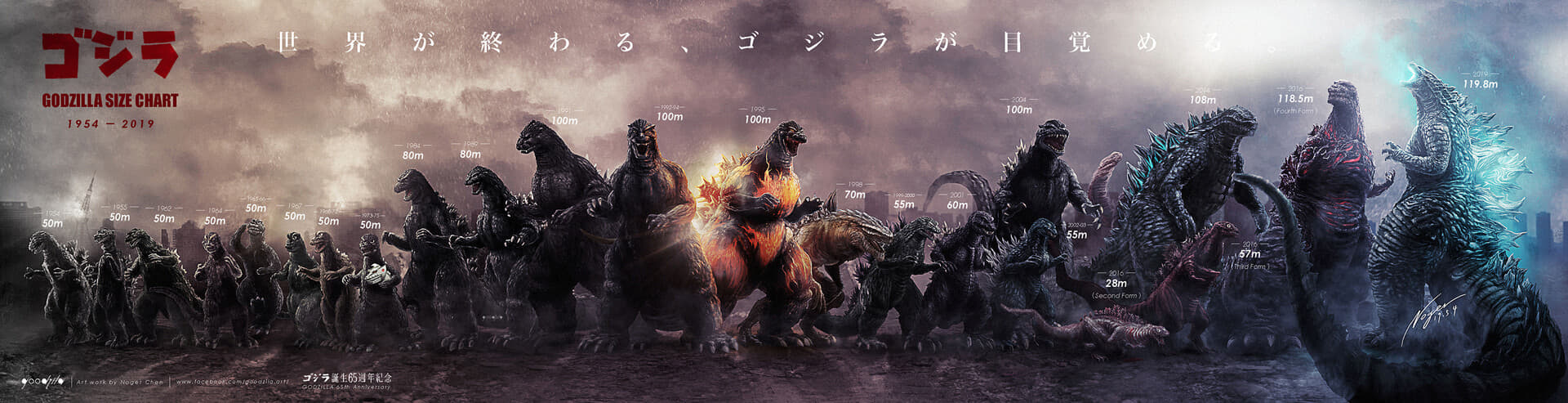
Godzilla size chart, 1954 to 2019. Artwork by Noget Chen
You read it the way you read any body, by taking in size, texture, expression, and movement and judging within moments whether it is safe. Each Godzilla film changes those signals while the silhouette stays the same. Two ideas explain why that works: one about how the brain reads threat, and one about how viewers read design.
How Does the Brain Sort Friend From Foe?
Most of us have met a stranger on an empty street or an unfamiliar dog on a trail and made up our minds almost at once about whether to relax or step back. Size, posture, and facial expression seem to feed that judgment, and we rarely notice ourselves making it. Research on faces points the same way. Neuroimaging in people and recordings from the amygdala in monkeys suggest that the brain flags a threatening face within a fraction of a second, along a fast pathway that operates ahead of conscious awareness. We read intent before we know that we are reading it.
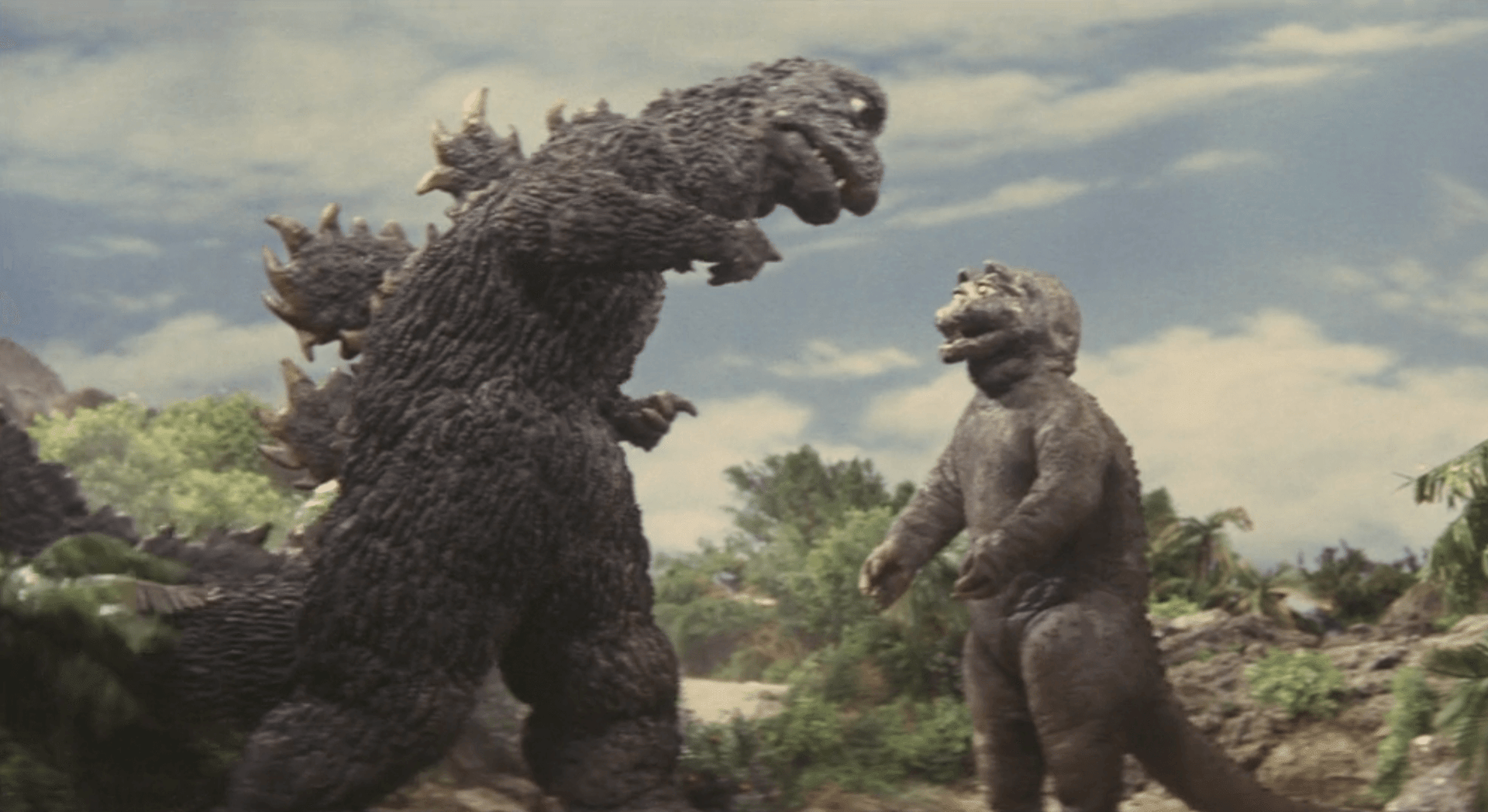
A film monster gives that habit something to work on, and Godzilla's design history shows how much the face matters. In 1954, his eyes are wide and strange, which makes his face difficult to read. As the Showa era turned him into a hero, his eyes grew larger at several points, and by Son of Godzilla (1967) he was designed to look fatherly. When the series wanted a threat again in 1984, IGN reports, they made him look and act menacing and evil. The silhouette never changed while the message did, and viewers register that shift before they can articulate it.
What Does Semiotics Say About a Monster's Body?
The study of how images carry meaning is called semiotics, and its most useful idea here is the distinction between shape and body. (We will not need the field's formal vocabulary.) The silhouette works like a logo: the bipedal stance, the tail, and the dorsal plates identify the character regardless of who made the film. The meaning resides in the body, in its mass, skin, posture, and expression.
Two ideas explain why bodies can be read this way. Literary critics call the first "reader response theory": a work's meaning is completed in the reader, so what a viewer sees depends partly on who is looking. The media theorist Stuart Hall supplied a vocabulary for film and television. Filmmakers place meaning in a design, which is encoding. Viewers draw meaning back out of it, which is decoding, and the two do not always match. One 1999 fan essay argues that early Godzilla represents the United States itself, nearly the reverse of the usual reading of the monster as a victim of nuclear weapons. Both readers were looking at the same creature.
What Five Questions Decode Any Godzilla?
We at The Lorehounds are partial to a good framework, and this one is modest: a working toolkit for the semiotics of Godzilla, not an established theory. The five questions below seem to track features that design histories of Godzilla return to again and again when they explain why one version differs from another, and each can be judged at a glance without specialist knowledge. Taken together, they ask what role a design is built to play, whether catastrophe, victim, hero, or enforcer.
How heavy is he? Mass signals inevitability, and a leaner frame signals speed and fighting ability.
What does his skin look like? Rough, scarred, or glowing skin suggests damage, and in Godzilla's case usually damage from a nuclear process. Smooth or armored skin suggests resilience.
Can you read his face? A legible face draws the viewer toward him, and an opaque one holds the viewer at a distance.
How does he stand and move? A slow, dragging gait suggests a disaster arriving, whereas a purposeful, poised stance suggests a combatant with agency.
How large is he relative to the world around him? Scale indicates how much of that world he commands.
Which Changes Come From Design and Which From Circumstance?
Not every change in his body is a statement about values, and sorting the causes helps. The Shippey Test, which we use for adaptations, separates changes required by the medium, changes driven by commercial pressure, and changes made as creative decisions, and a similar sorting applies here. Suits constrained what a performer could do, which is why the 1984 design is stiff and slow while the 1955 version was slimmed down for fighting. As the series turned toward younger audiences in the 1960s, commercial pressure softened the face. Nate describes the result in the history episode, with the face and body becoming rounder and more cartoon-like, and puts the logic plainly: "You can't sell toys if it's super, super scary." CGI removed many of the physical constraints, so the choices in a modern body are harder to attribute to anything but design, and the creative decisions are the part these questions are built to read.
How Do the 1954, Shin, and Legendary Godzilla Designs Compare?
I have applied the five questions to three bodies: the 1954 original, the 2016 Shin Godzilla, and Legendary's 2014 version. This is a small matrix and not a full survey, since the Showa and Heisei bodies sit outside it, and the cells record only what is visible on screen or in stills, plus reported heights, with interpretation reserved for the section that follows.
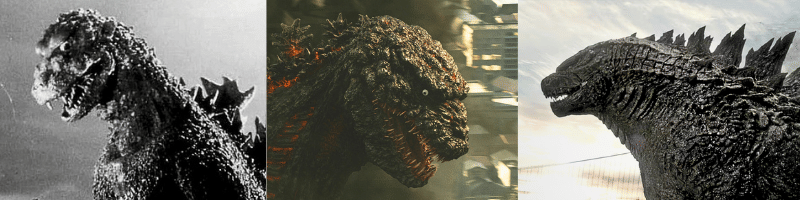
Left to right: Gojira (1954), Shin Godzilla (2016), and Legendary’s Godzilla
Question | Gojira (1954) | Shin Godzilla (2016) | Legendary MonsterVerse (2014) |
|---|---|---|---|
1. How heavy is he? | Bulky, with a heavy lower body and short arms | Heavy lower body tapering to a narrow upper body, with tiny arms | Thick and heavily muscled, with a heavy torso and thick limbs |
2. What does his skin look like? | Rough, deeply textured, dark hide | Dark, ridged hide cracked with glowing red seams | Rugged, scaled, armored-looking hide |
3. Can you read his face? | Large round head, wide eyes with tiny pupils, visible ears and fangs, hard to read | Small head on a long neck, small round eyes, irregular exposed teeth | Streamlined, elongated head that is small relative to the body, no visible ears |
4. How does he stand and move? | Upright, slow, and heavy | Upright and vertical, with a long neck and a tail held high (movement not assessed from stills) | Bipedal with a forward curve through the back and neck, deliberate in movement, frequently shown fighting other creatures |
5. How large is he relative to the world around him? | Stands above the low buildings of postwar Tokyo (about 50 m) | Dwarfs the buildings around it in the stills (118.5 m) | Stands among modern high-rises (about 108 m) |
What Do the Sources Add on 1954 and Scale?
The 1954 design drew on three dinosaurs, and the film followed the Castle Bravo hydrogen bomb test, which irradiated a Japanese fishing boat, the Lucky Dragon No. 5. The roughness of the hide is often read as nuclear injury, though the sources I have found treat that as an interpretation and do not claim it was the designers' stated intent.
According to Wikipedia, Godzilla was set at 50 meters in 1954 so that he could just peer over the largest buildings in Tokyo, and Toho later enlarged him to about 100 meters so that newer, taller buildings would not dwarf him. It lists the Legendary version at 108.2 meters and Shin Godzilla at 118.5 meters, though figures vary by film and source. The pattern is a body sized to the skyline of its time.
What Do We Know About the Shin and Legendary Designs?
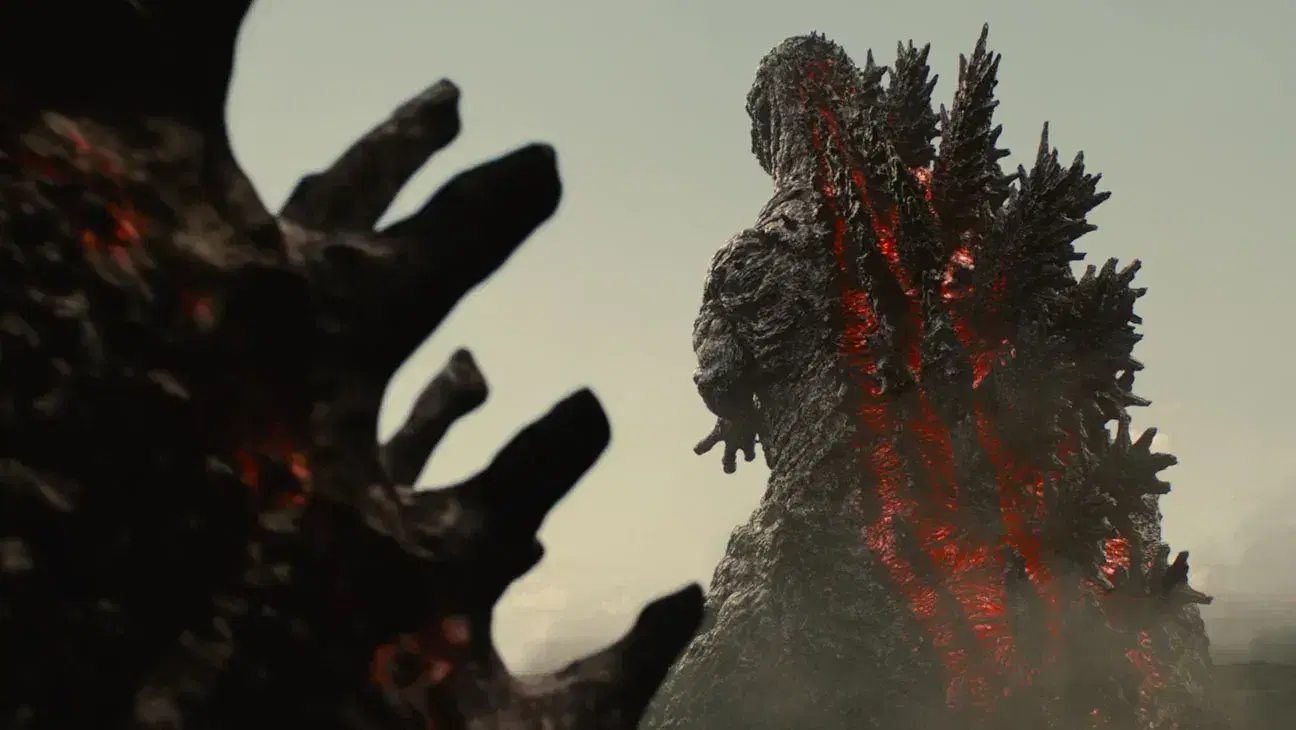
The Shin Godzilla cells come from stills and published descriptions. IGN describes tiny arms, almost like a T. rex's, with disconcertingly human-like hands, and a red stain meant to evoke radioactive origins. According to Wikipedia, co-director Shinji Higuchi aimed to make Godzilla as terrifying as Japanese effects work could manage, and critics read the film as a response to the 2011 Fukushima disaster. The film also shows Godzilla in several forms, from a creature struggling on land to the upright body shown in the table.
For Legendary, a Warner Bros. featurette on the film's making supplies the filmmakers' own account. They describe a skin texture modeled on lava, a design question of what nature would actually produce, and a creature indifferent to people. They also rotated the digital model so it would look good from every angle, since the creature would often appear in silhouette, and they say keeping the silhouette strong took a long time. Director Gareth Edwards said it was important to him that the film felt like a Toho Godzilla, a nod to the studio that created the character, and Wikipedia's account adds that he worried an early version looked cutesy and had the face and body sharpened.
What Do I See When I Look at Him?
What follows is my own reading of Legendary's body, offered as a demonstration of the method.
What Does Legendary's Body Say to Me?
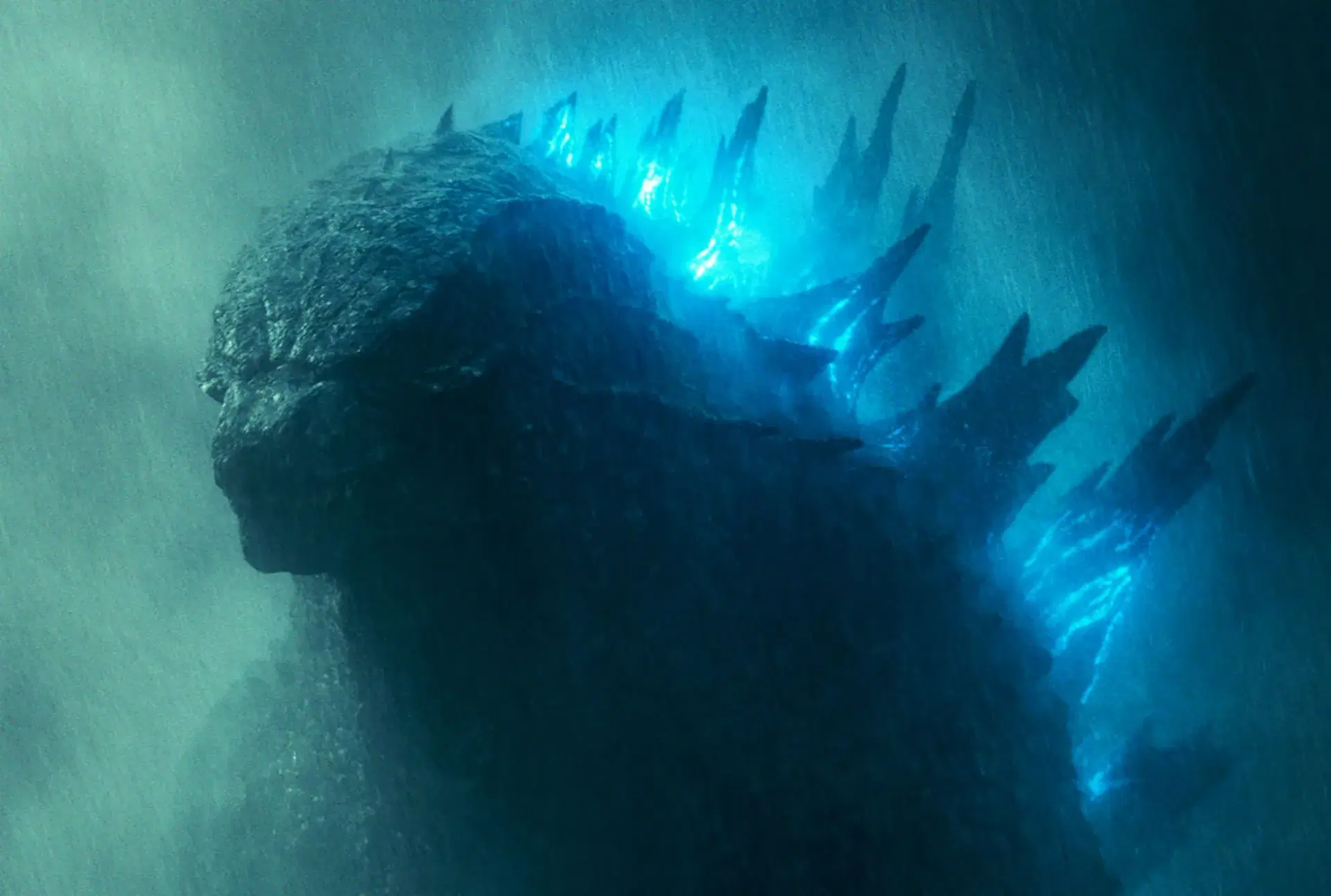
The bodybuilder I thought of in 2014 starts with the first question: the neck runs into the shoulders the way a lifter's does, and a body like this suggests strength that has been built up and carried with confidence. The 1954 face was hard to read and so asked something of the viewer. This one is easy to read, but what it announces is a hunter, and to my eye it sits closer to the dinosaurs of the Jurassic films than to the round head and wide eyes of 1954. The 1954 hide reads to me as damage and this one as armor, closer to rock than to a wound. His posture carries a forward curve, short of a wrestler's crouch but ready to lunge at any moment, and he spends much of the film fighting other creatures, which makes him a combatant with agency in terms of the fourth question.
Taken together, the cues describe a figure whose authority resides in his body: large, muscular, armored, and composed, arriving to settle a conflict that people cannot. I recognize in that a particular idea of male strength common in American action cinema, in which the body that wins is also the body that is admired. In the 1954 design, power arrives as damage, whereas in this one it arrives as an attribute.
What Is the Case Against This Reading?
The main objection comes from the filmmakers themselves, as described above. On their account, the muscle is anatomy, and the bipedal stance is simply Godzilla, the result of asking what nature would produce and of a creature indifferent to people. The film's own scientist makes a version of the argument that nature restores its balance and people should stand aside. I find the objection about intent persuasive. It does not settle the decoding, because nature offers many bodies, and the one chosen here is heavily muscled, armored, and fronted by a predator's face. Encoding and decoding need not agree, and an apex predator at the top of a natural order is one more place where that mythology can live.
What About Shin Godzilla and Godzilla Minus One?
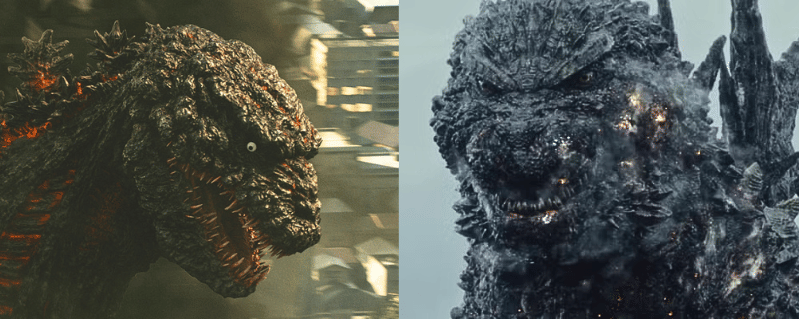
Shin Godzilla (left) and Godzilla Minus One (right)
I have not seen Shin Godzilla, so this is a reaction to stills and nothing more. In them, the body reads to me as horror before it reads as kaiju, less like an animal in armor than like something wrong with its own flesh, closer to a creature from a horror film than to a monster built to fight other monsters.
Godzilla Minus One complicates the picture. The head recalls 1954, and the hide is scarred and rugged, and in motion, he moves mechanically, almost like a performer in a rubber suit, which feels like a return to the original film. To my eye, he is more a force than a character, and the film pairs the body with horror and guilt, something the Legendary body never asks of me. When he rears his head skyward to roar, it recalls how the T. rex behaves in the Jurassic films, which is my own association and nothing more. How he relates to the two earlier bodies is a question for the 1954 and Minus One episode.
What Will Godzilla Minus Zero's Body Say?
The silhouette tells you which monster is on screen, and the body tells you what that production wants you to feel about him. The five questions are a way to begin reading it, and they will not settle what any one design means.
When Godzilla Minus Zero opens in November, I expect to ask its body the same five questions, and NateL and I will review the film in the third episode of the series. The first two cover Godzilla's history and Gojira against Godzilla Minus One. If you see something I missed, or grew up with a different Godzilla and read the same body differently, please tell us.
Further Reading
A Visual History of Godzilla Movies at IGN, a clear survey of how the design changed from film to film.
The evolution of Godzilla's design at Creative Bloq, which looks at the character from a designer's point of view.
Godzilla Through the Ages at Toho Kingdom, useful for the Showa-era changes to the face.
Godzilla Evolution at Ranker and The Evolution of Godzilla at History Vortex, for side-by-side pictures of the bodies discussed here.
Struggling With Godzilla, the 1999 fan essay on History Vortex that reads early Godzilla as the United States.
Godzilla: Rebirth of an Icon, the Warner Bros. featurette on the making of the 2014 film.
Author's Note on AI Assistance
This article was developed in partnership with Claude AI and Perplexity as research and writing tools. Perplexity compiled the initial research report, and Claude helped gather and verify further sources, organize my notes into an outline, and turn them into draft prose that I revised at each stage. The thesis, the opening observation, and the reading of Legendary's design are my own interpretation, and claims that could not be traced to a source were left out. I believe AI can be a valuable tool for writers when it is used transparently, and I review every draft to make sure it reflects my thinking and my voice.
Sources
Face and threat perception: neuroimaging in people and amygdala recordings in monkeys.
1954 design and context: Creative Bloq and The National WWII Museum.
Design history: IGN and Toho Kingdom.
Legendary design and Gareth Edwards' comments: Wikipedia, Godzilla (MonsterVerse) and the Warner Bros. featurette.
Semiotics: Wikipedia, Semiotics.
Shin Godzilla forms: FandomWire.
Fan reading of Godzilla as the United States: Struggling With Godzilla, Kaiju-Fan #10 (1999).