
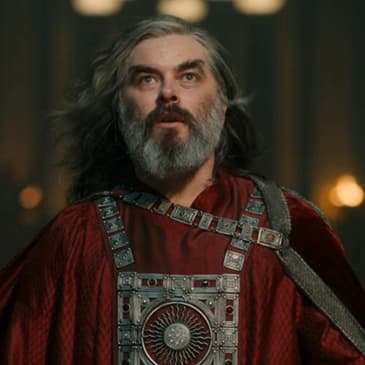
In this episode, colors take on political significance, Númenoreans and Pelargir folk show grief in various ways, Annatar finds that some dwarves are harder to deceive in others, and Berek finds Isildur, who in turn finds Estrid. We also learned that even the best – planned coronations may have unexpected interruptions, and enjoy some in-depth feedback about the symbolic and functional meanings of being branded.
Join the Conversation on the Lorehounds Community Discord:
https://discord.gg/thelorehounds
Contact Us:
Questions or comments? Send emails to: ringsandrituals@thelorehounds.com
You can also leave us a voicemail through our website, or record a voice note on your smartphone and send it to the email address above:
http://thelorehounds.com/contact
Rings & Rituals is part of the Lorehounds Network
Find us, our community Discord, and all our affiliates at:
https://linktr.ee/thelorehounds
Any opinions stated are ours personally and do not reflect the opinion of or belong to any employers or other entities.
[00:00:12] Hello and welcome back to Rings and Rituals Season 2 for Episode 3 of Season 2 of the Patrick McKay series Rings of Power, The Eagle and the Sceptre in preparation for the introduction of Season 3 in November. I'm Sara, Shieldmaiden of Rohan. Sara Brown And I'm Marilyn, the Librarian of Rivendell. And whether you listen to all of our episodes from Season 1 or this is the first time you've ever heard of us, we're delighted you're here. Our approach is to review what we mean by ritual and then apply those concepts to the different examples of ritual that we find in the next episode.
[00:00:42] From this, we'll discuss how Pana McKay depicted the cultures that they were adapting to their series. Do get in touch with us! We had our first piece of feedback already and we had some great feedback last year and we'd definitely love to see even more this year. You can email us at ringsandrituals at thelorehounds.com or you can join our Rings and Rituals channel on the Lorehounds Discord. We'll include all that information in the show notes under the link tree.
[00:01:12] And we want to say that we are a proud affiliate of the Lorehounds Barovian Broadcasting Network, where you'll find all sorts of interesting podcasts on TV, films, books, video games and other stories. Today we'll be following our usual process, identifying any rituals that we see in the episode and discussing them from the perspective of the intention, the outcome, the musical background and what the ritual tells us about the culture it is depicting.
[00:01:41] But before that, we'll have a quick break. And when we come back, we'll bring you the meat or the tofu for our vegan or vegetarian listeners without the quail sauce. Welcome back! Once again, we will offer a synopsis in chunks, followed by our analysis of any rituals we see.
[00:02:08] Please note, as always, there will be spoilers from both seasons one and two, so consider this to be your official warning. Beric departs the Numenorean camp in search of Isildur. He evades the orcs and survives the Black Forest, entering a spider's lair to find and rescue Isildur from yet another orc and several spiders.
[00:02:32] In Numenor, Elendil places a seashell on Tar-Palantir's tomb and has an unsettling conversation with his daughter, Eärian. Muriel enters and receives political intelligence from Elendil, who is watching the crowd. She also comforts a grieving mother over the death of her son in the battles on Middle-earth, even though the woman has just slapped her in the face.
[00:02:58] Okay, so I think there's something to be said here about this public viewing of an honoured monarch and the way in which they set this scene, Marilyn, don't you think? Oh yes, I was delighted that we had a ritual practically bang off the mark after, you know, going through Baby Shelob's lair and all the other stuff. So the hall is, to my eyes, the hall is dark but candlelit.
[00:03:24] There's a beautiful stained glass window at the opposite end from the entrance and a large statue of Nienna watching over all. And of course, that immediately won my heart over. Of course it did. I confirmed, actually by conversation with the design team, and then they published the conversation online, that yes, this is Nienna. It made my heart say it. Absolutely.
[00:03:52] Most of the people are dressed in black, although Eärian is wearing dark blue with colourful jewellery. Maybe a sign of her kind of kicking against some of the conventions? Yeah, you do wonder, because this comes up later on. Muriel, of course, is in deep mourning as befits the daughter of a loved father. She's got black clothing and a black veil and even black jewellery, which I found an interesting touch.
[00:04:21] And it makes me think ahead to when we know that the banner for Gondor is a black field with silver, with a tree and the crowns and so forth. And this became, spoilers, the banner for Elendil. Yeah. The black clothing, of course, is incredibly reminiscent of a lot of Western cultures here in the primary world.
[00:04:49] Not all cultures, of course, use black as mourning, do they? No, no, that's quite right. And choosing colours is important for a ritual, which we get in the next scene. But let me also just mention the lovely touch for an island kingdom. They have baskets of seashells available for people to come and pick one up and then place it upon the tomb of the dead monarch. Mark, I just, that really touched my heart.
[00:05:19] And here's where the colour thing comes in again. Farazone is also in dark blue. I sense some colour coding here, perhaps? Well, nothing is going to be accidental, is it? So, yes, I'm sure that that's true. I'm just thinking back to the seashells, the placing of the seashell upon the tomb. Correct me if I'm wrong, but it's really reminiscent of Jewish tradition, isn't it? Where they place stones upon a gravestone or a tomb.
[00:05:49] Exactly. Yes, exactly that. And I think also in some Celtic traditions, they will place stones on gravesites. But, of course, also they will build cairns as markers on the landscape for a variety of different reasons. So, this seems to be a strong human urge to, in some way, say, I was here. I saw this.
[00:06:16] I want to mark my presence and I want to mark my respect, my grief. You know, a whole variety of different possibilities there. But, you know, in the face of death, feeling as though there is something you can do, I think is very important. And so, having this shared ritual gesture, it's a task that I can perform. It shows my grieving about this.
[00:06:46] And it also helps to bind the community together to say, I am part of this group because we have this shared ritual. So, I was all over this one. I'm sure you were. And, of course, it brings great comfort, doesn't it, to have something positive, a positive action to do in the midst of grief. And being in community with that action has got to bring lots of comfort to people who are grieving.
[00:07:15] I think so. I think so. And I'll also mention, of course, there was a very soft vocal music. And I think this was diegetic. I think this was meant to be in that space and not just something that we as audience were hearing. Very reminiscent of gatherings in sacred spaces.
[00:07:32] And now, as I was listening to you, Sarah, I was suddenly put in a graveyard in Wolvercote Cemetery, where every year the Tolkien Society gathers and recognizes the grave. Oh, God, I'm going to break up here. And recognizes the shared grave of J.R.R. Tolkien and his wife, Edith. And every year, somebody stands up and sings Namari.
[00:08:01] And how they managed to do it, I do not know. And then the head of a Tolkien Society will read something that they've picked out. So, all of these resonances, sacred space, the remains of the dead, special music, special readings. Although we don't get readings in this one. But still, there is a lot here that is familiar, I think, to many audiences. And I'm really glad you picked up the Jewish Association, because I had completely forgotten that. So, thank you.
[00:08:31] No, that's fine. I mean, ritual around death, I think, is cross-cultural, isn't it? I mean, I can't imagine there are any cultures that don't have some form of ritual around death. Some of which might seem slightly familiar to other cultures, and others would be completely different. Because every culture throughout time has decided how they're going to mark death. And you're talking about the Tolkien Society event, the Enyalie at the end of Oxenmut.
[00:09:00] And it is a beautiful ritual, actually. It's a real coming together of community. And although there's always going to be a slight tinge of sadness when you stand next to somebody's grave, as we stand around Tolkien's grave, Tolkien and Edith's grave, of course, there's also a sense of celebration of somebody's life, because of what that person has brought to that community that is standing around that grave together.
[00:09:28] You know, listening to a piece read out for us, listening to the song being sung for us, and just being all together. It's a wonderful ritual that I look forward to every Oxenmut. I do too, whenever I can manage to be there in person. And you used a phrase of bringing the community together. I'm going to invite listeners to put a pin in that. As we look at questions of community and its unity or otherwise.
[00:09:58] Would you like to carry us on into the next synopsis? I shall, because here Farazon enters Miriel's private chambers, wanting her to select the colours for her coronation, and being inappropriately close to and touching her while doing so. He wants red for the future. She wants white, because that was what her father wore at his ascension to the scepter. And it is humble. And she mentions the eagle that came as well.
[00:10:25] Albert Farazon says that eagles attending coronations are very rare. So clearly we have some association here of colour choice being important and significant within a particular ritual. Yes, not just death and burial, but here again. Of course, we thought of weddings because of the association of white with purity. And now we hear that Miriel associates it with humility.
[00:10:54] Not humiliation, but humility. I always think it's important to emphasise that because for a lot of people, humility just gets slid right into humiliation. And there are two different things. They are. It's important to remember that. And again, we see a slight variation in colour in this ritual. The Aryan and Farazon are in deep blue. And Miriel and Elendil are in black. Right.
[00:11:22] I mean, we've talked about how the meaning of colours can vary in many cultures. We mentioned this last episode. We've mentioned it during this episode. I think you said last episode that in Japan, white is the colour of morning. But in Western nations, white has a very different association. It is the colour of purity. Therefore, that's why it is often chosen by brides at their weddings, which, by the way, is a very, very modern custom. It began with Queen Victoria.
[00:11:52] Yeah. So it's actually it doesn't go as far back as you might think. But still, it is now very much associated with weddings. And red might be what Farazon thinks is looking to the future. But actually, there are some very different associations with the colour red, Marilyn, right? Oh, yes. I think to others it can appear to represent blood, cruelty and even domination.
[00:12:19] So perhaps this is what Farazon is looking for in the future? Hmm. I wonder. I wonder. And so then we talk about omens in a ritual. Oftentimes, people perform rituals in order to receive some communication from the land, from their deities, from whatever sacred being they are approaching.
[00:12:45] And we hear about the unexpected visitation from the symbol of the deity in this case, Manue, who I would call a demiurge rather than a full-blown deity. That's Euru, right? Right. So Manue's eagle represents good. It represents Manue himself.
[00:13:06] And so an eagle appearing at this solemn moment for a nation, you know, the coronation of a new monarch, is a good thing. I also couldn't help but think about the Roman eagle. Oh, yes. Which became a rather dreaded symbol of domination in much of northwestern Europe at the height of Roman colonizing power. Hmm. So perhaps Farazon would view that eagle very differently.
[00:13:36] Miriel might view that eagle as being almost like a benediction, that there is approval here of her taking the scepter. Whereas Farazon might think of an eagle as being that symbol of power and domination that we think of with the Romans. Yeah. Interesting. And I really wonder how Tolkien, obviously Tolkien saw the eagle as being a good symbol, because it sure crops up a lot throughout his legendarium.
[00:14:04] But I also love to think of the play and then later the film 1776, where Benjamin Franklin berates the eagle for being a nasty bird, you know, a dominating and, you know, symbol of European tyranny, etc., etc. And so they asked him, well, what would you like instead? And he says, the turkey.
[00:14:32] So symbols have associations, folks. I've got to say that the turkey is a strange symbol to choose, because I have seen wild turkeys in the U.S., and those things look prehistoric and vicious. Yes. Well, he says the turkey is a truly noble bird, source of sustenance for early settlers. It would gladly fight off a whole regiment of redcoats because of its bravery and courage. So maybe that's what you were picking up on. Could be. Don't mess with us.
[00:15:02] Well, I wouldn't mess with one of those things. I mean, they're huge and strong and, like I said, kind of prehistoric looking. So I'm happy. As a vegetarian, I'm very happy to leave them very alone. Yes. I always love seeing them both in the fall and in the spring. One spring, in a very foggy morning as I was driving to meeting, across the road, suddenly I saw an eagle on the left side of the road standing there. No, excuse me. Turkey. Wild. Wow.
[00:15:31] Wild turkey on the left side. Well, we see eagles too, but anyway. Left side of the road, wild turkey. It slowly starts to walk out, and there's this long line of one, two, three, four, five, six, seven turkey chicks. It was beautiful. Absolutely. A very touching moment. And I'm glad that they chose a Sunday morning to walk across that road, because I hate to think what might have happened on, you know, Saturday night on that road. Oh, goodness. Yes.
[00:16:01] Yes, indeed. Anyway, let's move along here. Indeed. Next synopsis. Over drinks, Barazon, Belzegard, Kemen, and Earian doubt the queen's fitness to rule. Earian suggests she might be able to bring more people to that point of view. Valendil, overhearing the conversation, comes to talk about upper and lower classes, and Kemen takes offense.
[00:16:30] After a scuffle, Valendil warns him not to speak ill of the queen, who Valendil watched walking into a burning building to save others, including Earian's brother Isildur. When Valendil leaves, Earian tells the group about seeing the palantir at the urging of the dying king, whom she had been sketching. We see Muriel going to find it now, only to discover that the palantir has been taken away.
[00:16:59] Okay. Okay. So this is almost like a ritual of conspiracy, isn't it? I think so. Yeah. This idea of sitting in back rooms over drinks and whispering to each other over your plots and plans. I mean, we could call it a ritual in a way because it is something that has become like a trope. Exactly. We see it in films, TV shows. We can see it in books.
[00:17:29] It's this idea of a group getting together to discuss something potentially nefarious. Yes. If you want to share a secret, you can stand out in the middle of a field so you can see if anybody's coming, or you can lose the two of you in a very busy crowd where nobody's paying attention to anybody and you're just two more walkers. But you see a group of people huddled around drinks in the back corner of a tavern, lights start flashing, don't they? Yeah.
[00:17:59] They're being very careful, though, aren't they? They're using, even amongst each other, they're using allusions rather than straight out talk. Exactly. Exactly. Which we know what they're talking about because we're privy to a lot more information. But yeah, it all, as you say, is quite tropey and lets us know what's going on here. And then we have a nice little ritual between two bantam types of settling a fight of honor outside the building.
[00:18:28] Yeah, you can't see this, but my eyes are rolling. Maybe they can hear your eyes rolling. I don't know. If they roll hard enough, maybe. Well, don't roll them that hard. I think it might do damage, please. Yes, you're right. Two bantams, indeed, going at it like, yes. Why is it always young men? But yeah. I think societal gendering has a lot to do with that. I think you're probably right there.
[00:18:56] But the idea of somebody dishonoring somebody else and then another person challenging that dishonor, I mean, it is almost ritualistic. I think so. The whole, are you calling me a fill-in-the-blank? Your father is a blueberry and your mother smelled of elderberries or something that I've completely misquoted. Your father was a hamster and your mother smelled of elderberry.
[00:19:26] That's it. Or it might have been the father elderberry and the mother hamster. I don't know. I can't remember either. But it is a great scene. You silly English kniggets. I'm glad that you got the illusion there. Oh, Monty Python. Isn't Monty Python a universal symbol by now? I would hope. At least, at least the Holy Grail. Monty Python and the Holy Grail should be on everybody's watch list.
[00:19:53] If you haven't ever seen it before, dear listener, do yourself a favor. Go find it. I'm sure it's streaming somewhere. Sarah, would you like to take us forward? Okay. Now, we move scenes because Daddy Orc Gloog, what would that be? Papa Orc? I don't know. Whichever one you choose. Tries to convince Adar that there is no longer need to go to war.
[00:20:18] But Adar tells him that you can never be completely safe until you are certain that Sauron has been killed. Damrod the troll enters the camp, having most assuredly killed the messenger, and is greeted by Adar in the black speech with many epithets of praise. But Damrod only wants to know where Sauron is. Yes. Cut the fluff and get to the meat of the matter, if you will.
[00:20:45] And I found it very pointed the way they focused on that one orc head, or Ulruk head, that was hanging from Damrod's belt. It looked a bit fresher than all the other heads that were hanging from this. It did, didn't it? Like, this is just one I popped on as I walked through the gate? Or this was the one that brought me the message in the first place, and I was feeling cranky because he interrupted me in my whatever nap.
[00:21:12] But Adar seeks to placate Glug by saying that there are some dangers it is a father's task to know, and a son's task to trust the father's wisdom. And then we see that Glug himself is a father now, thinking about his own child. I mean, I have been fascinated with the way in which Payne and McKay depicted the orcs. It's so very different to the Jackson depiction.
[00:21:37] It definitely is, and that feedback that we had today is about this very topic. So stay tuned. Indeed. Indeed. It's also, again, following a ritual pattern. Adar greets Damrod with flowery, praise-filled epithets, a ritual of welcoming of an outsider of great importance, or at least of great power, into a different community. So you don't just open the door and say, Hey, yeah, come on in. Welcome.
[00:22:07] And come sit down and let's talk about it. You have to establish that this is a big being. And in this case, literal, but, you know. Literal, yes. There is a formality to what happens here, isn't there? I think so. And even the music, it sounded to me, this, again, our music we're listening to, not music that's happening in the Uruk camp. I don't think they have many musical instruments there.
[00:22:33] So this music sounded very much like a walk-on theme from baseball or wrestling or something like that. I mean, Damrod the wrestler, absolutely. I ain't betting against him ever. So, changing scenes again. In Eregion, Anatar and Celebrimbor tell Disa and Doran of the new rings of power they intend to make for dwarves,
[00:23:01] saying that such rings have already healed the great elven tree, and so the dwarf rings could help to heal the mountain. Doran recognizes that they will be expected to provide supplies of mithril in exchange. Disa asks why not offer this proposal to the king, and Anatar says that the king is known to be conservative when new ideas are brought up. Doran explains that he and his father are not on speaking terms, so he would be of little help.
[00:23:32] Anatar says that they summoned the dwarves to help them, but Doran wants to know, who is this person, Anatar? And why is Elrond not present? Anatar describes Elrond's thoughts about Doran that are really highly suspicious and in no way ring true to the prince. Disa manufactures a courteous retreat. Isn't that always what the women do? Sorry.
[00:24:02] You notice that. See our previous conversation about young men in taverns. But Doran is highly suspicious of the whole affair. While Disa agrees that it is unusual, but that it is up to the king to decide, if there is even the slightest chance of these rings helping to save the kingdom. Anatar uses lies and half-truths to stir Calabrimbor out of a willingness to wait on the dwarves warming to the idea,
[00:24:31] into an indignant insistence that the high king know nothing about what they are doing, and sends a letter full of lies in order to protect what he now considers to be my moment, the pinnacle of his career as a crafter. Hmm. So it's not really a ritual per se that's going on here, but there is definitely this dance of deception and false suggestion
[00:24:58] so that the dwarves can be persuaded and even inflamed. We have a lot of temptations being laid upon certain people in this scene, the temptations of the crafter and the double-edged chisel of creativity. So, yeah, not ritualistic, but definitely there is something that has been thoroughly plotted and planned by Anatar,
[00:25:26] and he knows how to manipulate. Oh, doesn't he just... And it takes me right back to the first time that Halbrand and Calabrimbor exchanged words when Halbrand was waiting to be received into Euregion, and that was what persuaded Calabrimbor to at least let him come in out of the rain. The thing about, isn't that always the way for us creators?
[00:25:56] Notice the word us. You know, the high ones take what we do, and they ignore us after that and our bleeding knuckles and all the rest of it. So it's part of a pattern which he started very early on. Indeed. But I think we could spot some rituals in here, couldn't we? Yeah, I think rituals of trade, perhaps. You know, there's an established dance when you're making a trade.
[00:26:26] You have deals of exchange. You go through the person who's most likely to be persuaded to your point of view. Everybody is talking at a higher level when the real stuff is going on at a lower level, and you use elusive language so that you don't necessarily say exactly what you mean. Mm-hmm. There's not a lot of bluntness going on here. It's all very subtle and suggestive. Yep.
[00:26:52] But these rituals of trade, usually both sides understand what is going on here and that there is almost a ceremonial dance to this. But here there is the added layer, of course, of Anatar's deception and manipulation so that Durin and Disa do not 100% know what is happening. Durin thinks he does. He thinks he understands that I will give you this, and in exchange you will give me that.
[00:27:22] But there's so much more going on here. Yes, and I think that Durin really does pick up on that. I don't think he trusts us with two barge poles. Oh, no, that is true. He still doesn't understand quite why. He does know that he doesn't like Anatar and that something rings wrong for him. I see what you did there. If you'll pardon the pun.
[00:27:48] But yes, there is definitely a sense that he gets that something's wrong, he just doesn't quite know what. Yeah, yeah. And I think it was Anatar's mistake of trying to put words into Elrond's mouth. Because that was what really caught Durin's attention. And afterwards, Usain Disa, there's no way that Elrond would have ever said that kind of stuff about me. So this is sus. This is definitely sus.
[00:28:16] Yes, because no matter their past bickering, Elrond and Durin actually do know each other pretty well. Oh, yeah. Yeah. So that was a bad move. I think so. You want to take us back to another landscape? Yes, let's go to Khazad-dûm, one of my favorite spaces, actually, in Rings of Power. The dwarves of Khazad-dûm appear to have only three months' food supply remaining.
[00:28:44] Prince Durin apologizes to his father for the conflict between them, and he tells the king of the offer of rings from a region, but it's clear that he does not trust it. He's listened to Disa because Disa says, this is the king's decision. It's not your decision. Yes. Thank you, Disa. Yeah, thank you, Disa, indeed, because she's right. But you can see that Prince Durin does not want his father to go ahead and accept these rings.
[00:29:12] Then we move to another landscape, one reminiscent of the Dead Marshes, where Isildur sees bodies of dead men in a shallow pool, from which he takes weapons and armor, and then he moves on. Eventually, he leaves the forests that were decimated by the earthquake, and he finds in a healthier forest an encampment which appears to have been raided by orcs. Now, from her tent shelter, we come across Estrid, and she surprises Isildur with a stab to the thigh,
[00:29:42] but manages to bind the wound to stop the bleeding. She calls him one of the sea folk, and tells him that their encampment has already departed. She'd found a map there with indications that the army moved on to Pelagia. Now, the two are ambushed on the way there by wild men, one of whom escapes on an unwilling Berek's back, but they are saved by Arondir's fighting skills. He was foraging for firewood, which he then takes back into Pelagia.
[00:30:10] Yes, and I neglected to mention there that he also takes the two of them back with him. Yes. Because Arondir is quite distracted at this point, because when he comes back, we see that Bronwyn, Arondir's beloved, had been a healer of the Pelagia folk, but she has died from the poison of the orc arrow that hit her in season one.
[00:30:37] Arondir has prepared her body and her funeral pyre, but her son Theo shows up only to light the fire and then disappear again. The rest of Pelagia's residents gather to watch the burning of their healer. Arondir seeks out Theo and tries to comfort him with a hand on the shoulder, but Theo shrugs it off. Once again, we have very clear funeral ritual, right? Mm-hmm, mm-hmm.
[00:31:05] And in this instance, the community is assembled, but I so loved the touch that it was a single woman's voice singing Bronwyn's melody. Yes, that was beautiful. It really was. And I could almost imagine them having some woman singing something. I mean, you know, how would it be? Anyway, I don't want to get too this world, that world about it all, but the effect was marvelous, and I really, really loved it.
[00:31:32] Very different, a very, very different funeral type to the one that we saw on Numenor. Absolutely. Absolutely. Absolutely. It's lovely to start having these, the same ritual to compare amongst different cultures. We already saw one in the first season with the Harfoots, a Samhain ritual of remembering their beloved dead. So now we've seen Par Palantir, and now we're seeing this community that has formed itself in Pelagir.
[00:32:02] And I wanted to point out that funeral pyres are actually quite common, and not a dishonor as was implied in The Lord of the Rings at one point, you know, with Denethor claiming he's going to burn like the heathen kings of old or whatever, and it kind of had a bad sound to it. But it's the safest way to deal with bodies in a place that doesn't have a burial ground. Indeed. Yeah. And doesn't have, you know, good equipment for digging it straight down.
[00:32:30] Maybe they're not certain about where their water resources are coming from. And I think it's also, I think it's a very beautiful way to recognize and honor your dead, particularly if they were close to nature, as Bronwyn was as a herbalist and a healer. They've wrapped her body in an off-white shroud, and the touch that still makes me feel deeply.
[00:32:57] They have a bouquet of healing herbs placed upon her, and these are the tools of her trade. And it reminds me of a scene in a fictional book about Neanderthal peoples in which their healer had been buried with red ochre and so forth, and the adopted daughter of this person was really furious and said, those aren't the tools of her trade.
[00:33:24] And she goes out and brings in a huge bunch of flowers and piles them on top of the body and said, these were the tools of her trade. And I believe, listeners, please write in if I'm not remembering this correctly, but I believe that at some point archaeologists did find a Neanderthal burial with flowers on top of the body. So if I am remembering correctly, this is a really potent human instinct.
[00:33:54] Right. And there's a simplicity to this funeral in contrast to the one that we saw in Numenor, where it's very much more ceremonial. This one is far more simple, and yet there's a beauty to both of them. It's not that one is better than the other or lesser than the other. There's a beauty to both, but the contrast, of course, is deliberate. And I think it shows the differences between what's going on with those two communities.
[00:34:23] We've already talked about the subtle hints of possible dissension in Numenor, and here I just sense a single unity of, admittedly, a much smaller community, but I don't sense any dissension or whispering or fractions between them. The only mode of dissension, of course... Is her own son. Exactly.
[00:34:51] Her only known relative, and it's appropriate for him to apply the torch. And Evrandir was all set to do that, because it really wasn't clear that Theo was even going to show up until that very last minute, which, again, I think points to the extent and the depth of Theo's grief. But also, I suspect, his guilt. Yes. Yeah. I mean, he is very young.
[00:35:20] Let's not forget that. He's actually still very young, and he's seen a lot. He's been through a lot. And witnessing his mother die has got to be incredibly traumatic. But you're right. There is guilt there, because he does feel like he is partly to blame for what has happened. To what extent you would agree with that or not is a totally different thing. But it's natural, I think,
[00:35:48] because he felt he should have been able to protect her, and he couldn't. Yes. And even more, as her understudy, if you will, I think he felt that he should have been able to heal her, because he is taking on that knowledge and those roles of healing and so on. And so I think this is something that any medical person has to struggle with.
[00:36:16] If you've had someone's life in your hands and suddenly it's not there anymore, society tells you you should have. You were supposed to. And it's so hard not to take that on. And unfortunately, I think that Theo is taking that on. And even more unfortunately, I'm afraid that he's turning that guilt into intense anger. Yes. With Errandir. Yeah. And Errandir says no word this entire time.
[00:36:46] He's kneeling before her pyre, and he bows his head almost to touch the body of his beloved, but not quite. And for some reason, I found that even more poignant, that he didn't just lay his head there. And all kinds of thoughts of here is an elf who presumably has seen mortals die before, but suddenly it's his beloved.
[00:37:12] And he always knew because of the differing lifespans that he would have to face this moment at some point. But I don't think anybody was expecting, including the audience, was expecting it to happen so soon. Right. Yeah. Yeah. I mean, there's a behind the scenes reason, of course, for why it happened. But in universe, it would be sudden and shocking. And even though she's mortal, and she would die within a very tiny,
[00:37:42] tiny blink of time for an elf, it still should have been much, much longer. Yes. The actor, whose name I did not put into our notes here, unfortunately, decided that they needed to leave the show because they felt called to support their nation that was under great difficulties at the moment, and particularly the women of their nation. So, yeah. And this was the story,
[00:38:11] this was the story that came out of that choice. Right. Yeah. Yeah. Yeah. So, shall I carry on to the next bit? Please do. Okay. So, Isildur and Estrid arrive at Pelagia. Theo treats Isildur's thigh wound, while Arondir explains why Bronwyn has died, and expresses his pleasure that Isildur survived the fire. Arondir wishes that he could tell Isildur's father of his survival, being convinced that Elendil will return.
[00:38:41] As they collect water, Arondir tells Theo that the village is lucky to have him, as a healer. Theo says the village healer died on a pyre, and he makes it clear then that he feels no need to speak to Arondir ever again. Okay. Well, it does seem like you're right, that he's turning all of that grief, sorrow, and guilt, and guilt into just pure anger.
[00:39:10] And in doing so is pushing away one of the few people who really would have his back. Yeah. And have some sense of his feelings, of course. Although, I think Theo would have rejected that notion, because we do, when people want to comfort us, what often first rises is, you can't possibly know how I feel. Which is human. It is. It is.
[00:39:38] And Theo's responses here are, they are human. They're not helpful, and they're not healthy, but they are very human. Particularly for a young man of his age. Exactly. Who's just lost his mother. So yes, I understand it. Isildur finds Theo fetching more water at what he thinks is a fountain, but it turns out to be one of the aqueducts of old Numenor that would bring water directly into houses.
[00:40:06] Theo asks if he wants his horse back, and tells him to meet him there at Moonrise. Returning later, he overhears Isildur telling Estrid how his mother died trying to save him from drowning, and was caught in a riptide. But no one knows that it was his fault. And since then, he has been driven to excel in order to earn what his mother did for him. Estrid said such a sacrifice is nothing you can earn, it's simply a gift. And after the two young men leave, Estrid does her best to burn off a brand
[00:40:36] that was put on the nape of her neck when she was forced to serve Adar. The guys sneak up on the encampment where Berak has been taken, as Theo's attempt to distract the wild men fails, a sudden attack by an entirely unexpected folk disrupts everybody's plans. Okay, then. Yes. So, this scene was not, strictly speaking, a ritual,
[00:41:02] but it does involve feelings around death, and what you do with those feelings, and what you turn them into in your life. And it centers around this question, what do we owe the people who have saved our lives? Whether or not they themselves survive. And does it matter if they are strangers, loved ones, or simply neighbors who know you? Yeah. And those are difficult questions, actually.
[00:41:31] And everybody's going to have to find their own answers for themselves, I realize, but I felt uncomfortable with Isildur saying that he somehow had to earn this thing, and Estrid being right on the mark when she said, you can't earn that. You really cannot earn that. And perhaps, again, it's a way to cope with this shattering grief. Yeah. And I don't know that we know exactly how old he was,
[00:42:00] but I think we're meant to understand that he was a child when this happened. Yeah. And so, all the more reason to say, you know, it wasn't your fault, and yet, this is what we do. How do we unburden ourselves from this kind of, these feelings of guilt and responsibility that are entirely misplaced? I mean, unless you, of course, stab the person yourself,
[00:42:27] but obviously that's not the case in this particular instance. And again, I think rituals of death, of mourning, and so forth, are intended, or they're not they succeed, to help us focus on those feelings in a different way, and maybe makes a better sense of them. Right. Yes. I mean, we live now in, I think, in this Western culture where we don't talk about death,
[00:42:57] where we avoid mentions of death. We don't have an open kind of heart to it, as other cultures do, and as older cultures would have done. We just don't. And I think because of that, it makes the ritual around funeral rites particularly important, because it's all we've got, because we don't really engage with the idea of death,
[00:43:25] whether it's because of fear, or simply feeling that it's just not something that we do. We don't talk about that, but it means that all we have left really, to enable us to deal with it, is what we do at funerals. And of course, there are increasingly different kinds of funerals now, but we always have to remember, that the funeral is not really for the dead,
[00:43:54] it's for the living people who are left behind. Absolutely. I have always felt that very strongly. And I think there, we draw comfort from saying, oh, mother would have liked this. Right. Because, again, it's something you perceive you are doing for the lost one who you loved, and the comfort comes in your thinking, I am doing what mother would have liked. Yes.
[00:44:23] And there's nothing wrong with that. No, not at all. Not at all. There are lies we tell ourselves to comfort ourselves, and it's not, you know, a horrible black lie or anything. It's just a tiny little bit of a dusting of self-deception, and it's harmless, because it helps us feel better in the moment. It's perfectly fine. Now, she's never going to listen to this, so I can tell you that my mother has already told me that she does not want a funeral. And this is unusual.
[00:44:53] She's 83, right? It's extremely unusual for an 83-year-old to say, absolutely, no, there must be no funeral. And I've tried to explain to her that the funeral won't be for her. She won't be there. Yeah. Yeah. And she says she understands that, but she's always loathed funerals. She says she finds them maudlin. And I mean, everybody has different responses to these rituals, right? Sure.
[00:45:20] And that she knows what she wants done with her ashes, and we can have our own little ritual around that, but no funeral, and she will not be dissuaded. So, yeah, it's definitely an unusual desire in somebody of her age and generation. Yeah, I can't speak to that, because, of course, there is that generational difference.
[00:45:49] But I had a friend who was not a member of the church when she died. She was practicing Wiccan, and her children knew full well she did not want a church memorial. But I don't know who it was who said, yeah, we got to do this. And so they did. They honored me by asking me if I would scatter her out, or I would conduct a ritual for them to scatter her ashes.
[00:46:17] And I know they derived more comfort from that. And then we could all go back and have a party. So maybe that's what you could do for your ritual. Oh, yeah, yeah. We will find our way around whatever is going to be best in the moment. Although I've told her, I haven't got time for it now. Could you please just put it off for at least another 10 years? I really don't have the spoons to deal with it at the moment. There you go. Yeah, exactly. Yeah. Yes.
[00:46:45] It takes a lot of spoons to deal with funerals, doesn't it? Whoever they're for. It really does, actually. Yes. More than you think. I mean, I've obviously, I've been to a few funerals. But when you're the one who has to organize it, because it is a very, very close member of your family, it takes absolutely everything out of you. It does. And she did give you a lovely gift in being very precise about what she wants to have happen. And the piece about what she doesn't want to have happen. Well, you know, sorry, mom,
[00:47:15] you won't be here. We will. And I think we're probably going to put our own needs first in that instance. So apologies. My last act of rebellion against you, perhaps. I don't know. I think she'd just roll her eyes from wherever our spirits go to and say, yeah, yeah, she's done it again. Yeah. There you go. There you go. And maybe perhaps that is a comforting thought. Yes, perhaps.
[00:47:43] But let us move from funeral to coronation. Yes, that should really improve things, right? It should lift the spirits anyway. Yeah. Let's see what happens. Numenorians gather for the coronation of their new queen. As Muriel stretches her hand to take the scepter, a male voice shouts, Queen of lies! The celebrant is outraged. But Muriel says that the grief of Numenor is sacred to her,
[00:48:12] and their pain is a prayer within the walls of the sacred hall. She assures her people that they will find their course together, and invites anyone who wishes to speak further, provided they first ponder for whom they are crying out, the buried, the kingdom, or themselves. Okay. So, I think we're back to looking at colors again, Marilyn. What do you think? Oh, yes. Oh, yes.
[00:48:42] We see Muriel dressed in shining white and silver. She still has black jewels, which I thought, again, back to the Victorians, so many of our funeral rituals come from the Victorians. They, they, I think that was the earliest example of people who would have memorial pins made with the hair of their beloved, which is an interesting practice. But jet jewelry was considered de rigueur for someone who was dressed in mourning,
[00:49:12] and even after you were allowed to go out of black for deep mourning and into purple, you know, there still had to be these, these outward signs. So, I actually like the touch. I mean, aside from the whole black and white being the colors for Numenor banners and, and, and, and sigils and so forth, I like that touch that says, yes, I am taking this role on. Yes, I am going to govern you as, you know, are my people. And yeah, I'm still mourning the loss of my dad.
[00:49:42] Right. I mean, that makes, I'm quite comfortable with that. But significantly, she's gone with her choice of white and not Farazon's choice of red. Color me, not surprised. And, yeah, Muriel has, Muriel has a strong backbone. She really, when she knows what she wants, that's what she sticks with.
[00:50:08] And she can turn it aside very gently and, you know, give her explanations and kind of avoid any kind of controversial arguing or whatever, because that's not her thing. But she's going to do what she's going to do. Everybody else, of course, is dressed in their finest. Yep. As you'd expect. Multiple, multiple colors. Absolutely. I mean, this is a celebration.
[00:50:35] And it even has a celebrant who leads her to the altar and directs her hand. Because, because remember, folks, a mural can't see anymore. So she, he directs her hand to the scepter, not handing it to her, but waiting for her to take it up. That's an important distinction, isn't it? I think so. I really think so. Because this is, I think,
[00:51:01] possibly a vestige of the very earliest Numenorean approach to things like ritual and religion. And there's no, very little sense of religiousness in this ceremony for the secular ruler monarch. Although for Numenor, I think they would kind of be puzzled that we made the distinction.
[00:51:30] Because they were established, you know, by the demiurges, by the Valar. So yeah, it's a part of the whole thing here. But that has kind of shifted away in the however many hundreds of years since Tar Elros. So the shout from the crowd is breaking a familiar to me rule. That no voice but that of the king or queen is permitted to disrupt the ceremony.
[00:52:00] Right. The first thing I think is hallowed moments are often silent moments. Including the prayers that are done on the Menel Tarma. Exactly. So perhaps this is the last vestige of their original ceremony, which focuses a lot more on, we don't want to be worshipped. It's nice that you acknowledge us.
[00:52:29] It's good to have practices of reminder and remembrance. And it's also a good way to demonstrate the sacral nature of the monarch. There is this connection. Because the monarch is the one who's allowed to speak in certain sacred moments. Anybody can go up to the top of the Menel Tarma anytime they want. But they can't speak there. They go up, they wait in silence, and then as they're descending the mountain, they can speak again.
[00:53:00] Speaking of sacred moments, Miriel claims that Numenorean grief is sacred to her, and their pain is also a prayer. Particularly at this occasion. And again, I'm reminded of the sacred duties of sovereigns. And she's stating this in a very solemn ritual moment, and I think this literally makes it so. Right. I agree. I am telling you, as your new monarch,
[00:53:29] that in my reign, I will take your pain as sacred. And take on the tasks involved with grieving, with you, because we're all grieving, and there's no point in denying it. But that becomes part of my rule, if you will, it seems. Yeah. I mean, this is how it works when you're having one monarch handing off to another monarch, is that usually, historically,
[00:53:59] the way of things is, the king is dead, long live the queen, or vice versa, or whichever, right? Yes. And so, in the midst of coronation, you've also had death. And if you are a dutiful son or daughter, and you happen to love your parent, who has died, and that is why you're now being crowned, or handed a scepter, or whichever it is, it's always going to be tied up, isn't it? There will always be death
[00:54:29] in the midst of this crowning. There has to be. Yes. And I think that must create a really challenging emotional situation between the parent monarch and the child monarch-to-be, that I'm only coming into my full flower, if you will, and power, or whatever, after you die. Right. I don't want you to die, but I want to, you know, I mean, it's a really kind of weird headspace to have to live in
[00:54:57] for however many years it might be. It is. But of course, this was not the case in the early years of Numenor. No. The child, the son, because it was almost always the son, didn't have to wait for daddy to die, because daddy had the great good sense to hand on the scepter before becoming too old to be a proper energetic ruler. Yes. Yes. And I can't remember exactly when that shifted in that history,
[00:55:26] but clearly by this time, it has shifted. Yes. Oh, yes. It shifted long before this. Yes. Yes. And I don't know that I think it's a shift towards the better. No. I think it's also important at this point that Miriel affirms the right of anyone to speak to their sovereign, even in this sacred moment. You know, she's not saying, you know, shut up and listen to me. I'm your ruler.
[00:55:55] She's saying, yes, I need to hear from you. And I want you to think about your motives for what you say before you say them. You know, be reflective with your speech. Let's, let's take it to a level of being able to have conversation and to uncover things, to explore and understand things as much as having to settle policy or, you know,
[00:56:24] saying I've had this problem and I need you to fix it for me. So. And then something happens that really puts the cat among the pigeons. Oh, doesn't it just. Earyen enters from a side direction saying that she cries out for Isildur and tells the people how she discovered the Palantir. Elendil tries to silence his daughter who throws the ball down into the middle of the court, which, side note, is very reminiscent of a Greek myth
[00:56:54] of Eris, the goddess of discord, casting an apple in the midst of a godly feast and says that it will go to the fairest in the room. Now, you got goddesses present and you make that challenge of, you know, who's the prettiest. It's no surprise that eventually this starts the Trojan War. So, I wonder if, I have to think they were trying to mirror that particular myth in this moment, whether or not
[00:57:23] people were aware of it in the first place. It does feel like that, yes. I think so. Farazan claims that Earyen lies and orders the orb to be taken away and destroyed. But Miriel says no and claims the Palantir as her own saying that they need it. Elendil then goes to pick it up and is blasted back. A riot ensues but it is broken by the shriek of an eagle of Manoe arriving to bless
[00:57:53] Miriel's coronation. All are amazed but Farazan dressed in red and gold walks to face the eagle. Belzagar starts to chant Farazan's name claiming the eagle favors Farazan maybe because it just didn't eat him out, right? I don't know. To take the scepter. The crowd takes up the call and the eagle shrieks and departs. Yeah, it's always interesting how people
[00:58:23] will be led to interpret something in such a way that favors somebody because there are multiple ways of reading what's going on between Farazan and that eagle. Oh, there certainly are and this is why societies often had people whose job it was to read the omens. Now, whether or not they did it well, who knows, but at least it's an indication that you've got to be careful how you're interpreting your facts here,
[00:58:53] folks. Maybe sit down and consult together and check a few other sources. Sorry, the librarian in me is pushing forward. All right, all right. Calm down, Marilyn. But I find it suspicious that Fatozon and Belzagar are able to encourage others to raise a ruckus so easily. You know, possibly some seeding of the crowd going on here? Yes, I think so, but also maybe too much distance from
[00:59:23] the rituals, too much time, too much mental distance from them. Yeah, it's been a long time since probably the majority of the Numenorians have felt any particular awe in the presence of eagles. I mean, a great big honking, sorry, crying eagle, shrieking eagle landing on your doorstep, I mean, that's got to raise something besides deception and lies.
[00:59:53] I mean, holy cow. Right. We know it hadn't happened for a very long time. We know it happened for her father, so there should have been some memory going on here, even if they all have been living for 200, 300 years since then. I don't know how long it was. Right, yeah, and the manipulation of the crowd, of course, it's utterly egregious because the eagle of Manwe is there to support the choice of Miriel, who is the correct person
[01:00:22] to take the scepter. Not only that, but she and her father are trying to bring the people closer to the Valar again. And so this is going to be, the eagle of Manwe is there to go, yep, you're the one, great choice, and all that. And then Farazon goes strutting over there like some peacock dressed up in those colors that he said he wanted to wear because future. Oh, yes. Right? Oh, yes. And then because the
[01:00:52] eagle doesn't, as you say, instantly swallow him, I mean, maybe the eagle wasn't hungry or maybe the eagle doesn't eat people. Um, but just because that doesn't happen, it seems to be taken deliberately so as a sign that, oh, well, this means the eagle's actually here for Farazon. Really? I mean, the eagle just takes one disgusted huff at it all and decides it's going home. Yeah, I have to think that eating Farazon would have at the very least given the
[01:01:22] eagle indigestion. Oh, my lanta. Yes, seriously. I also see this as demonstrating that the people as a whole are less respectful of the valor and the sacred. Very much so. And even, you know, sacred ritual has been replaced by political maneuvering. And now I'm wondering that earlier ritual we talked about was not held in this celebratory
[01:01:52] hall. It was held in a smaller hall with a large statue of Nienna. And I'm beginning to think that that ritual was for the faithful. It feels like it, doesn't it, with Nienna looking over. Yes, and this ritual is for everybody because, of course, she is the queen of all of the people, the ones who agree with her and the ones who disagree with her. Right.
[01:02:22] But it just doesn't work that way, does it? No. No, it does not. Do you want to finish up this episode, Marilyn? Yes, indeed. At Celebrimbor's Forge, Sauron watches as molten metal is poured into the mold that will produce the dwarf rings. Celebrimbor takes the chunk of mithril from the box King Doran holds open and goes to put it into the molten metal, but Anlatar interrupts him,
[01:02:52] reaches for it, then palms it, and instead drops something else in a very formalized ritual manner into the liquid gold. He turns and smiles at Celebrimbor, who nods. Sneaky Sauron. I have to think Anlatar is smiling and Celebrimbor is simply nodding. I kind of think that Celebrimbor felt like Anlatar stole his creator's thunder at that point.
[01:03:22] Well, he does a little bit because it should have been Celebrimbor who puts the Mithril in, but it can't be because Sauron doesn't want Mithril going in there. He wants whatever stuff. Exactly. Yes. This might be the first little chink in that armor. Yeah. Of this creator romance that has been operating for however long it's been. Creator romance. I love that. Creator romance. Thank you.
[01:03:53] And of course, Anatar is being very hieratic in his gestures and maybe this is to keep up the Maya image. Even as this gesture is the real beginning of his deception and his corruption of this whole project. I thought it was also kind of fun to note that he palms the Mithril, keeps it for himself because we do know that it is canon that he desired Mithril. Yes,
[01:04:23] he covets it and wants it. So that's very much that chunk of Mithril, that's mine that is. Mm-hmm. Mm-hmm. Yes, I went over myself to talk to the doors to get it and it you know didn't work. Oh, sorry. Future episode. Never mind. Spoilers. We did say spoilers though. We did say spoilers. You have been warned. You can at me but you can at me for that. Anything else about this episode before we move to our feedback? I think
[01:04:53] we're pretty much done Marilyn. Okay. Well, it's very exciting to get feedback this early in the process and it's even more exciting. It came from David Lorhound who is one of the three founders of the Lorhounds and which is our umbrella organization that allows us to do all this podcasting. So thank you David. I did get his permission to somewhat collapse this down because he goes into a very detailed thought process about it all. So I'll
[01:05:23] start and then I'll skip a little and continue on. So he opened by saying, when you were talking about the branding of humans and wondering why the orcs weren't being branded, I had a thought about that. It gets into biological essentialism and the question of whether a quote race close quote can be inherently evil. Tolkien struggled with this in his later years and real world ideas about race call for nuance and care. So please forgive me if I'm not as eloquent in writing as I'd like to be. And I
[01:05:53] think he was perfectly finely eloquent, but in the interest of time I'm just going to pick out a few of the more salient bits here. So he writes, humans can present themselves in all kinds of guises and even lie about their allegiances. A physical brand is a way of marking an individual definitively, which from a human point of view isn't needed for any given orc. And then skipping a little bit, he says, that difference in scale seems
[01:06:22] to be the heart of it. A banner or a badge answers the question of which unit you belong to and is meant to be seen from a distance. It can be worn, swapped, or captured, and no one is really fooled by it, because all it tells you is who is standing with whom on the field. For orcs, that is usually all anyone needs to know. Their loyalty to a master is not really in question, so the practical problem is just keeping the units straight. A brand solves a different problem. It says something about one person and it is meant to
[01:06:52] hold even when that person would rather it didn't. Humans can defect, be turned, lie, switch sides, or play both sides. So a mark that can't be taken off gives whoever applied it a kind of certainty about that individual that the badge never could. In that sense, the brand is less about identification and more about ownership, a way of securing one's person's allegiance. I think we talked about that a little bit. Yeah, yeah. That you brand things that you own.
[01:07:22] And then David continues, which brings me back to where I started. I don't think the difference in how orcs and humans get marked is really about orcs at all. I think it reflects our bias for telling human-centered stories. Even when we read or watch elves and dwarves, they are mostly proxies for different kinds of humans. We know no real elves, so we have no way of knowing what an elf mind is actually like, and anything we write or put on screen is a projection of ourselves. The same goes for the orcs, except that they seem to hold the
[01:07:52] worst imaginable parts of ourselves, boxed up and given a race of their own. Once that's done, the story treats their slaughter as entirely justifiable, right down to killing individuals on site. That may be part of why the question of a brand never comes up for them. Humans are individuals whose loyalties we have to work out, while orcs are treated as a category, and a category doesn't need to be identified one member at a time. I hope that makes sense. I know I'm
[01:08:21] dancing around a number of topics about race and cultural assumptions, but I wanted to offer a rationale for the question you raised on the pod about why a human might get a brand while an orc would not. I think that's a really good explanation of that, and it makes good sense to me. Yes, yeah, I do think it's really good. I think we talked about this a little bit, that we're pretty clear that all of the uruk were already committed to following Adar, which means father
[01:08:51] quite literally, at that point in time. Yes. At the same time, you know, we saw Glug asking father, dad, do you really think this is a good idea? Can't we just stay here and raise our kids and be happy? So the early cracks may be beginning to show here. And because the humans were the southerns who had fought against Adar and the Uruk, they need something special, some symbol
[01:09:20] to show others who are, you know, looking behind them and remind themselves that they are now obeying Adar. I mean, it's a good thing that they didn't expect them to do what Walberg had to do, kill someone who he knew, Adar's order. So what do you think? Yeah, it's so reminiscent of the branding of slaves, of course. Exactly. Yep. Yep. And it
[01:09:50] signifies ownership as well. It's an identifying mark. So yes, it reminds the bearer of who they are and to whom they belong, but it also notifies anybody else who sees them who they are and to whom they belong. Particularly if that person has escaped from somewhere. Indeed. And is trying to hide that connection, not only from the Uruk's and Adar's
[01:10:20] minions, if you will, but also from the communities they're trying to escape into. Because I'm reminded of an earlier version of Legendarium in which Tolkien writes that one of the saddest things about Morgoth's domination was that after some of the elves who had been held as thralls in Thangorodrim had escaped, the other elves would not take them in. They viewed them with distrust. Because they feared that they had
[01:10:50] been quote unquote turned, as David was alluding to earlier on. And therefore, you know, sorry, we just don't know who you are now and we can't trust that this will be safe for us. Yep. Yeah, makes sense. I think that it was a really detailed and excellently written understanding of what was going on there. I agree. That's our David. When he dies into something, he dies in deeply and it enriches all of our
[01:11:19] understanding. So thanks again, David. Okay, so that's it for this episode. Write in and let us know what you think, any suggestions you might have for rituals to look at and anything else you'd like to share with us. We welcome your feedback at rings and rituals at the lorehounds.com or on the Lorehounds Discord server where we have a special channel set up just for rings and rituals. On the Lorehounds website, there is also a contact form and a voicemail feature.
[01:11:49] Look for the contact us link in the link tree at the bottom of the episode notes. We're aiming to publish weekly episodes, but just follow any of the Lorehounds podcasts and they should be able to tell you if there are going to be any changes happening. Now also be sure to check out the other podcasts supported by the Barovian Broadcasting Network, including John, David and Alicia on the main Lorehounds podcasts. Links for all of these are also in the show notes. Our thanks to our recording
[01:12:19] engineer and editor, Bob, to David and John, our producers, and again, David, thanks for that question, and to John for arranging our theme music, as well as all those who support us along the way. Now if you would like to support us and the podcast, find us on Patreon at patreon.com forward slash the Lorehounds. subscribers will get access to ad-free versions, as well as many other benefits. Until next time then, remember, anger against oneself is a thirst that can never be slaked,
[01:12:49] and in the end, it will drink you dry. Halvar, farewell for now. Nakameen, until we meet again.