
by Bryan C (Lorebrary Editor)
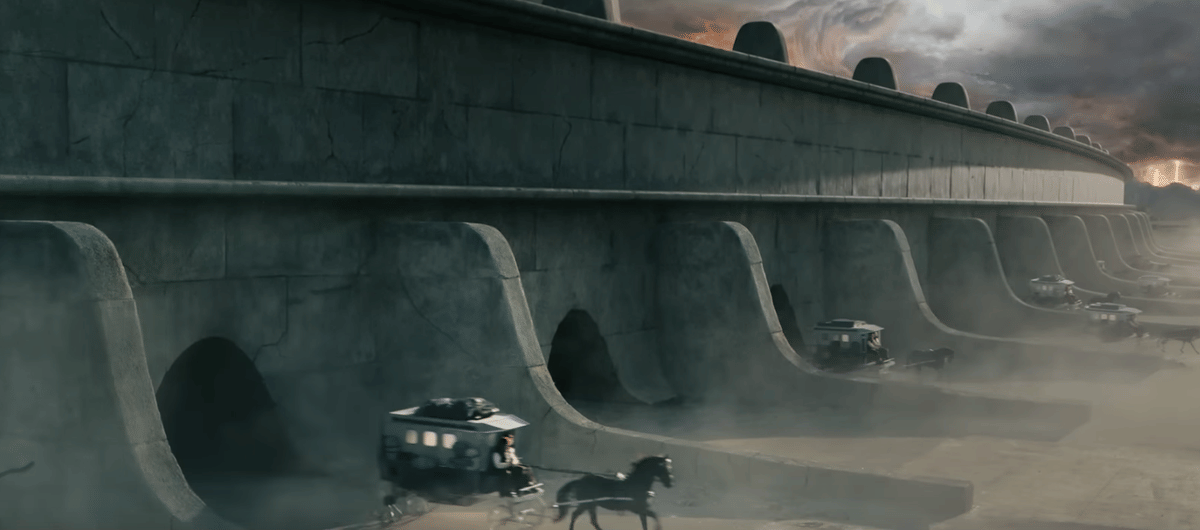
A striking scene from Wheel of Time episode 4 is when Rand’s ancestor in the Age of Legends meets Latra Sedai, and he is given a sacred mission. They take the Sakarnen and thousands of cuttings from Chora trees and put each into a single wagon in the hopes of preserving them. Throughout Rand’s visions, the Chora sapling is at the heart of the breaking of the Aiel.
Throughout history, civilizations have risen and fallen, often due to war, natural disasters, or disease. Yet, humanity has always understood the need to safeguard knowledge, resources, and genetic diversity for the future. The fear of cataclysmic events—whether from asteroids, climate change, or human conflict—has led us to create lifeboats of preservation. These vaults, archives, and hidden repositories serve as our collective insurance policies, ensuring that, should disaster strike, civilization can be rebuilt. From ancient libraries to modern seed banks, our species has repeatedly demonstrated an innate drive to protect what is most essential.
Many are familiar with the Biblical story of the Ark, found in Genesis 6–9. It tells of Noah, a righteous man chosen by God to build a massive ark to save his family and pairs of every animal species from a great flood. As humanity had become corrupt, God decided to cleanse the Earth. After 40 days of rain, the floodwaters receded, and the ark rested on Mount Ararat.
Ancient Libraries and Repositories of Knowledge
One of the earliest examples of humanity’s foresight in preserving knowledge is the Library of Ashurbanipal, constructed in the 7th century BCE in Nineveh, the capital of the Assyrian Empire. This vast collection of clay tablets contained knowledge of medicine, astronomy, mathematics, and mythology. While the library was eventually destroyed, many of its tablets survived, offering invaluable insight into Mesopotamian civilization. The desire to safeguard knowledge persisted throughout history, with the famed Library of Alexandria in Egypt being one of the most ambitious efforts. Though it was ultimately lost to time, its mission—to gather and protect the sum of human knowledge—remains a guiding principle.
Modern equivalents, such as the Internet Archive and the Google Books project, serve similar purposes on a global scale, digitizing books, documents, and multimedia to prevent the loss of knowledge due to disaster, censorship, or decay. Efforts such as these ensure that even in the face of a cataclysm, humanity’s intellectual achievements will endure.
The Doomsday Vaults: Preserving Genetic Diversity
Perhaps the most tangible effort to protect the essentials of human survival is the Svalbard Global Seed Vault, often called the “Doomsday Vault.” Located deep within a mountain on the Norwegian island of Spitsbergen, this facility safeguards more than a million seed samples from nearly every country on Earth. The goal is to ensure agricultural biodiversity, allowing crops to be replanted should natural or human-made disasters devastate food supplies.
Beyond seeds, genetic repositories also exist for animal and human DNA. The Frozen Ark Project, for example, is an initiative to preserve the genetic material of endangered species, ensuring that biodiversity can be restored in the future. Similarly, various biobanks store human DNA for medical research, potentially aiding recovery from future pandemics or mass casualties.
Space: The Ultimate Backup Plan
Recognizing that Earth may not always be a haven, humanity has begun looking to the stars for long-term preservation efforts. The Lunar Library, a project by the Arch Mission Foundation, aims to store human knowledge on the Moon using nano-etched disks capable of surviving for billions of years. Projects like the Mars Seed Vault concept also propose storing genetic material on Mars as a failsafe against an Earth-wide disaster.
The Voyager Golden Record launched aboard the Voyager 1 and 2 spacecraft in 1977, carries sounds, images, and messages intended to communicate the essence of humanity to any potential extraterrestrial civilizations. While not intended as a backup for human society, it is a testament to our awareness that existence is fragile.
A Testament to Human Resilience
Although most Chora cuttings did not survive, one did in Rhuidean. We also see Moiraine holding the Sakarnen. Our efforts to safeguard knowledge, food, biodiversity, and culture demonstrate a deep-seated resilience that Robert Jordan appreciated.