
by Doove 71 [Loremaster Subscriber]
When Andor season 2 arrived on Disney+, I knew I was in for a cracking thriller set in that familiar galaxy far, far away. What I didn't expect was to be plunged back into memories of my service with the British Army during the late 1980s and early 1990s. The series' creator, Tony Gilroy, makes no secret of drawing on real-world examples of authoritarianism and resistance. What struck me, though, was how often the camera lingers on the ordinary Imperial infantry soldier: tired, rain-soaked, running on orders and adrenaline, not necessarily menace and malice.
Those brief shots triggered a cascade of personal recollections from my time serving during one of the tensest periods of the Cold War's final act, when young soldiers like me found ourselves caught between larger political forces we barely understood. I remember the peculiar vulnerability of being 16 years old in uniform, the way a blast could shake not just the walls of your barracks but your entire understanding of where safety ended and danger began.
I hold both a UK and an Irish passport and have family rooted on either side of the Irish Sea. My aim here isn't to relitigate complex historical politics, still less to recast Andor as a direct allegory. Instead, I want to explore a haunting question that both the show and a famous Mitchell & Webb sketch raised for me: "Are we the baddies?" What happens when you discover that the uniform you wear, or the cause you follow, looks decidedly sinister in someone else's story?
My first real brush with that question came early in my career. Watching Star Wars with two passports in my pocket gives me a particular perspective on uniformed service. I was stationed near Dover when an attack on a nearby military facility killed eleven young musicians and injured twenty-one more. We used those barracks frequently, and the attack landed with the sickening intimacy of a near-miss. I can still recall the strange mixture of anger and bewilderment: how could anyone target people whose primary job was to play music?
Throughout Andor, especially in S2, we see Imperial soldiers who are, by turns, bored, green, scared, hyped up, and under-briefed, no more eager to die than the civilians they're sent to control. When a rock jarringly hits a shield in their faces on Ghorman, we flinch, not because the Empire deserves sympathy, but because we can imagine that moment: smoke, shouting, confusion, aggression, fear.
That attack near Dover made me feel, for the first time, the vulnerability of the uniformed body. The same uniform that granted me authority during exercises and operations also painted a target on my back when I was off duty. I began to understand that in conflicts driven by ideology, the individual becomes a symbol that transcends their personal beliefs or intentions.
Fast-forward a year to my deployment in Germany. The Cold War was thawing, but tensions remained high across Europe. I'll never forget the night a device detonated against a nearby accommodation block, timed for the small hours when off-duty soldiers would be asleep. The predictability of military life was shattered by the realization that enemies don't always announce themselves or follow conventional rules of engagement. My youthful certainty that conflicts had clear boundaries dissolved in an instant.
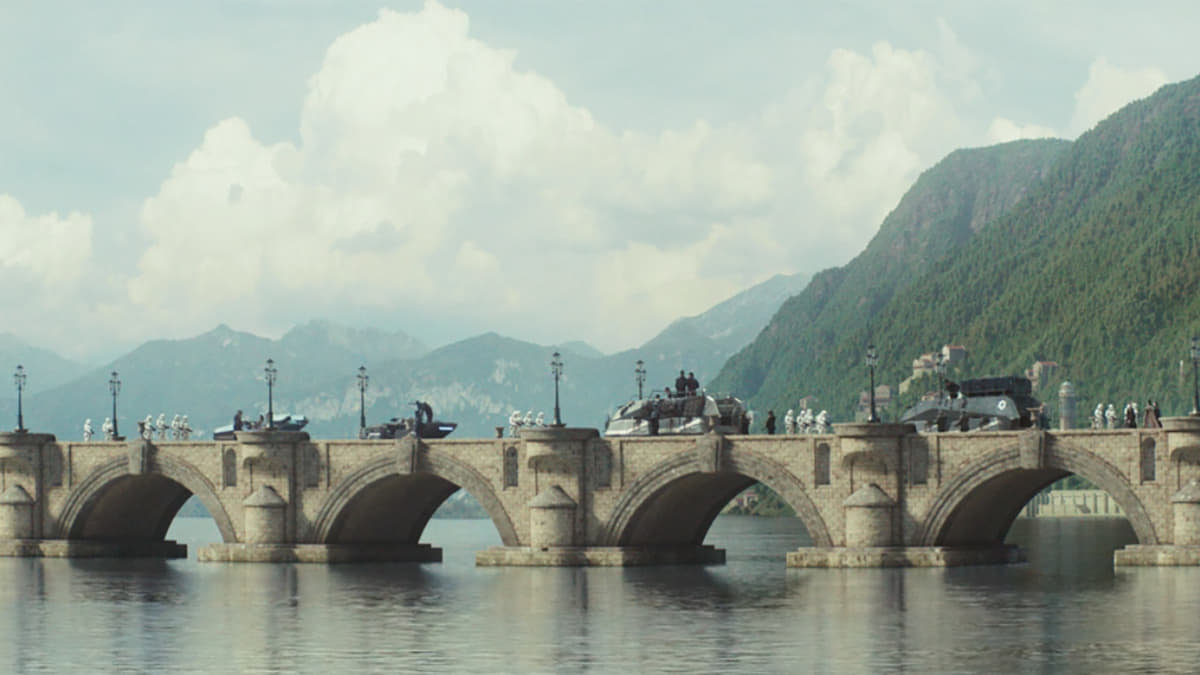
Rewatch the Naboo bridge scene in Season 2 of Andor. Luthen sabotages an Imperial supply convoy while teaching Kleya. The explosion represents victory from the Rebellion's perspective, another dent in Palpatine's war machine. For the everyday Imperial squaddie caught in it, though, it's precisely what that night in Germany was for me: bewildering vulnerability delivered without warning or quarter.
Running to establish a cordon, adrenaline flooding my system, I faced a hard truth that the show captures perfectly, to whoever planted that device, we weren't individual young men far from home. We were symbols of policies they despised, regardless of our personal feelings about those politics. That's when I first understood how perspective strips paint from moral certainties.
Years after leaving the Army, I learned that the conflicts of my service years could still reach forward through time. In 2009, two young sappers, 23 and 21, younger than some of the rebels in Andor, were killed in an attack during what was supposed to be peacetime. Hearing that news, a decade removed from uniform, felt like a breach in time itself.
I was forcibly reminded that negotiated peace is a fragile artifact, always carried at arm's length over the debris of unresolved grievances. In Andor, Cassian hopes to run from the rebellion, only to discover that the rebellion runs with him. Likewise, 2009 proved that conflicts can outlive their supposed endings, resurfacing to claim those who thought they had stepped clear.
What shook me most wasn't simply that military personnel were targeted, but the realization that for some, there was no contradiction between the language of peace and the tools of war. That cognitive dissonance is everywhere in Andor: Imperial Officers who believe order equals morality; rebels who justify violence against conscripts barely old enough to shave.
The comedy sketch that launched a thousand memes captures this perfectly. It shows two Wehrmacht officers gradually realizing that the skulls on their caps might indicate they are, in fact, the bad guys. It's funny because it punctures the macho certainty that uniforms often confer. It's sobering because history tells us real soldiers sometimes reach that epiphany too late, if at all.
During basic training, we were taught actions on finding an explosive device: establish a cordon, call in specialists, and preserve life. We weren't encouraged to dwell on who set the device or why. That was someone else's department, politicians perhaps, or historians. Andor flips that discipline on its head. It zooms out from each explosion to show bruised civilians, grieving families, and shell-shocked imperial troops. It asks us to hold all those truths together, without the anesthetic of a scrolling text that labels one side "Rebel Scum" and the other "Evil Empire."
In quieter moments, I wonder how many Imperial privates in Andor lie awake after lights out, replaying moments they witnessed but did not author. I also wonder how many people on all sides of historical conflicts have sat somewhere quiet, nursing unanswerable questions about actions taken in the name of their cause. Self-interrogation is a painful, necessary rite for anyone who has worn a uniform in contested spaces. It doesn't always yield absolution; sometimes it merely sharpens the outline of what cannot be excused, but it keeps a conscience supple instead of hardened and brittle.
Some will say it's frivolous to process real trauma through a space opera. I disagree. Fiction, particularly Science Fiction, serves as a mirror precisely because it offers protective distance: enough to lower our guard, but not so much that the reflection blurs beyond recognition. Andor let me revisit events I hadn't reflected on for decades, precisely because the uniforms were Imperial rather than British Army, the planets fictional rather than German garrison towns. In that stylized mirror, I could finally see both the 19-year-old sapper, tired, scared, running on adrenaline, and the nameless rebel planting explosives on Scarif and understand that both were, in essence, frightened young people trying to survive within systems that dwarfed them.
Storytelling, when it resists the urge to moralize too neatly, becomes a rehearsal for empathy. It invites us to ask not only "Are we the baddies?" but also "Could we have been the baddies and not known?" That question is radioactive; handled carelessly, it burns. Handled honestly, it illuminates the shared human terrain beneath all banners and anthems.
I finish thinking about carrying echoes forward, about vulnerability, perspective, and the difficulty of forgiveness. Andor reminded me that empathy doesn't excuse violence, but it can explain it, and explanations, however incomplete, are the footholds from which reconciliation eventually climbs.
The tensions of my early service years are, mercifully, no longer my daily reality. Yet their echo persists in the news and now, unexpectedly, in a galaxy far, far away. If Andor contributes anything lasting to the Star Wars mythos, I hope it's this: the insistence that every uniform contains a fallible human being, and that the question "Are we the baddies?" is one worth asking long before history delivers its verdict.
Thanks for reading. I offer these personal reflections not as a verdict, but as an invitation to watch, to listen, and to remember that even in conflicts portrayed as black and white, most of us live our lives in the grey.