

by David Lorehound
Content Warning: This article contains spoilers for Pluribus Episodes 1-2.
After our Discord community finished Episode 2 of Pluribus, the conversation splintered into distinctly different readings of identical scenes. Members were watching the same show but reacting in very different ways; almost as if they were watching different shows.
This isn't failure or a problem—it's evidence that Vince Gilligan's series functions as what scholars call an "open text," inviting multiple valid interpretations the way a Rorschach inkblot reveals the observer. The spectrum of responses suggests Pluribus has genuine vitality as art.
The Airplane Seat
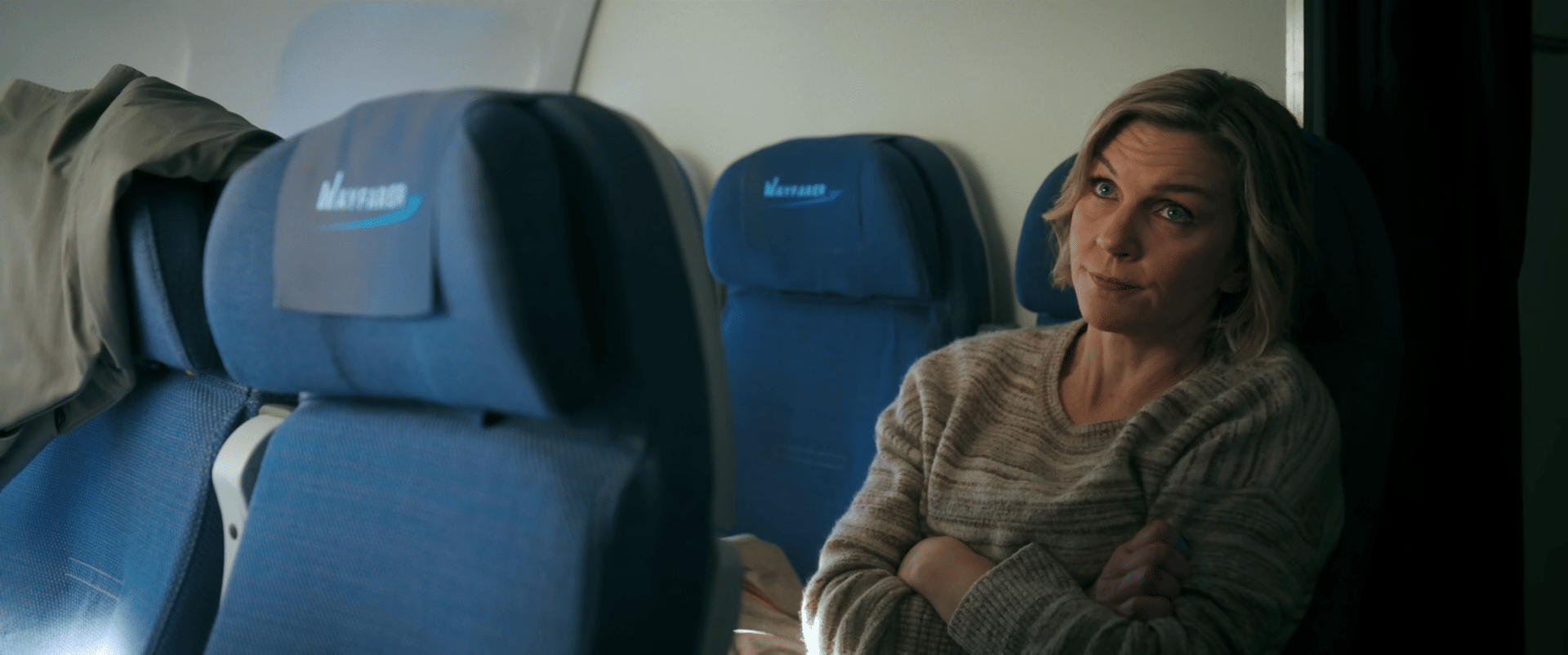
Here's a concrete example: Carol Sturka (Rhea Seehorn) is shown sitting on an otherwise empty plane heading to meet other immune individuals. The camera reveals she's chosen a seat against a bulkhead—a seat in coach that doesn't recline.
I read this as self-denial. Carol is refusing herself comfort or pleasure. I would never choose a non-reclining seat, even on an empty plane where I could sit literally anywhere. That level of physical discomfort is not preferable to me regardless of circumstances. I personally don't view the joined as a physical threat, so the "back to the wall" defensive positioning doesn't read as necessary. To my eye, Carol is punishing herself.
But I can see the alternative: strategic self-protection. Carol wants her back secured, maximum alertness, no comfort that might lower her guard. In a world where everyone else shares a collective consciousness and she's utterly alone, maybe choosing discomfort over vulnerability makes perfect tactical sense? The discomfort is the price of survival.
These opposite readings both have textual support. Same scene, same character choice, completely different psychological attribution. The difference lies in which framework we apply to organize the evidence—and that framework reveals as much about the viewer as it does about Carol.
What Is Pluribus?
Pluribus is Vince Gilligan's science fiction series about an alien RNA code that links human consciousness into a collective hive mind, creating universal happiness—except for 13 immune individuals, including Carol Sturka (Rhea Seehorn), who remains isolated while observing humanity's transformation.
The central ambiguity: Is forced universal happiness dystopian nightmare or humanity's first shot at peace? The show presents world peace achieved through erasure of the self, and refuses to say whether that's evolution or extinction.
Gilligan wanted to write an interesting show for Rhea Seehorn. Whether intentionally or not, he created something that generates interpretive complexity—precisely the kind of ambiguity that functions like a psychological test.
The Rorschach Test Framework

Hermann Rorschach's inkblots work because they have no "correct" interpretation. Ambiguous stimuli invite projection of the observer's internal frameworks. What you see reveals something about you, not something inherent in the blot.
Pluribus functions similarly. Television studies distinguishes "closed texts" that guide viewers toward singular interpretation from "open texts" that construct ambiguity permitting multiple valid readings. While most texts fall somewhere on a spectrum between these poles, Pluribus leans decidedly open.
The show leaves fundamental questions unresolved: Is Carol protecting herself or punishing herself? Is the hive mind horror or hope? These ambiguities aren't flaws—they're features. When the show refuses to answer "Is forced happiness good?", it creates interpretive space that different viewers fill differently.
Encoding, Decoding, and Why We Disagree
Stuart Hall's encoding/decoding model explains this. Creators encode messages with intended meanings. Audiences decode through personal frameworks. These processes don't necessarily align.
Hall identified three reading positions: dominant (align with preferred meaning), negotiated (accept some elements, resist others), and oppositional (decode against the grain).
The airplane seat demonstrates this. Both interpretations have textual support. The choice between them reflects the viewer's framework, not better observation.
Disagreement persists because we're applying different but coherent frameworks to genuinely ambiguous material. Consider the hive mind: the show presents evidence for both dystopian (loss of consciousness, elimination of consent) and utopian (universal peace, end of suffering) readings. Pluribus doesn't resolve this tension—it asks the question and lets viewers answer based on what they value about being human.
What This Means
The spectrum of responses our community is experiencing signals the show has vitality as art. When everyone sees exactly the same thing, the text is closed, the meaning prescribed. Divergent responses from thoughtful viewers indicate something that rewards active interpretation.
Our Discord discussions aren't resolving toward consensus, and that's appropriate. We're encountering genuine ambiguity that permits multiple valid readings. Complex television invites us to examine not just what's on screen but what frameworks we use to organize what we see.
I still read Carol's airplane seat choice as self-denial, based on my assumption the joined don't represent a physical threat. But someone who reads them as dangerous arrives at an equally valid reading of strategic self-protection. Pluribus succeeds by refusing to resolve its central ambiguities. The Rorschach test works because there's no correct answer. Pluribus works for the same reason.
We're exploring these interpretive questions in depth on our Pluribus Episodes 1-2 coverage, including how the show's visual construction supports multiple readings.
Author's Note on AI Assistance
This article was developed in partnership with Claude AI as a writing and research tool, with Perplexity AI used for source gathering and fact-checking. Claude helped compile information about reader response theory and encoding/decoding models, organized observations into a coherent framework, and assisted in transforming ideas into polished prose. Perplexity was used to gather authoritative sources, verify theoretical accuracy, and cross-check claims about the Rorschach test, Stuart Hall's encoding/decoding model, and television studies concepts. The core insights, personal interpretation of the airplane seat scene, and observations about community responses are my own. Both AI tools served as research assistants and editorial partners, enhancing rather than replacing human analysis.