
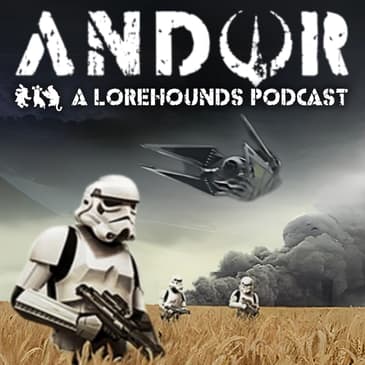
David sits down with film and television producer Tansy Gardam, host of the acclaimed Going Rogue podcast, for a deep dive into Andor's place in the Star Wars universe. They explore how Tony Gilroy's irreverence toward franchise expectations allowed him to craft something truly unique, examining the show's mature storytelling approach that trusts audiences to piece together complex narratives without exposition dumps. The conversation covers everything from the "curse" that has plagued Star Wars productions since the Holiday Special to why Andor represents a creative black swan event unlikely to be repeated. They also discuss the complex character arcs of Bix and Cinta, the politics embedded in Star Wars storytelling, and how Gilroy's background writing morally complex protagonists shaped Cassian's journey from "roach to butterfly."
Get the Season Pass for $10
Check out Tansy's podcast:
Going Rogue: A podcast about the film industry
Contact Us
Questions or comments? Send emails to: starwars@thelorehounds.com
Links to Patreon, Supercast, Discord, and Network Affiliates
https://linktr.ee/thelorehounds
Any opinions stated are ours personally and do not reflect the opinion of or belong to any employers or other entities.
Advertising Inquiries: https://redcircle.com/brands
Privacy & Opt-Out: https://redcircle.com/privacy
[00:00:01] Hey everybody, David here. And obviously we have wrapped up our full coverage of all of the Andor season 2 episodes, but we still have a few projects in the pipeline. This is one of them. And this is a two part conversation with Tansy Gardam, who is the creator and host of the Going Rogue podcast.
[00:00:46] If you have not checked out that podcast, I highly recommend that you do. Tansy is a film critic and was in TV production and has done an incredible job at researching the behind the scenes picture of what happened with the development of Rogue One and also done a whole podcast on Solo and a bunch of other podcasts.
[00:01:15] And a bunch of other movies and shows as well. She has a great insight into the world of script writing and production. And it was a real great pleasure to have a conversation with her.
[00:01:28] This conversation that you're going to listen to just now is her and I's sort of overall view of Andor and the franchise. And then we have a subscriber exclusive podcast where she and I get real nerdy about production details. I actually call it Going Nerd in honor of her podcast.
[00:01:48] But we talk about script writing. We talk about TV versus film production. We talk about costumes. We get into shot compositions and scene transitions, voiceover, a whole bunch of really fun stuff. So if you're a season pass holder, you will already have access to that. That's already out on your feeds right now. If you're interested in being a subscriber or a Supercast season pass holder, check.
[00:02:20] If you're interested in being a regular subscriber or purchasing our season pass. There are links in the show notes. The season pass is a one-time purchase. You will have that feed forever. It has all of our Andor coverage in there ad free.
[00:02:38] And for regular subscribers, monthly or annual subscriptions on Patreon or Supercast. Those are also available in that you get all of our bonus content. The 11z's movie club, our second breakfast and a whole bunch of other stuff. All of that ad free as well. Ad dollars are fickle and sometimes they're pretty good. Sometimes they're not great. And having a subscriber base really makes it possible for us to do all the work that we do.
[00:03:06] A couple of things I want to shout out before we get into the conversation. We just wrapped up our coverage of The Last of Us. Murderbot and Doctor Who are continuing. And we have a very busy summer schedule coming up. So stay tuned. We've got a whole bunch of movies and other shows that we're excited about covering.
[00:03:29] So again, thank you to everyone who listened over the course of the season. It was a really successful season. We had a lot of fun covering it. We're sad that it's over, but we're also not sad because it was a lot of work to do three episodes a week for four weeks.
[00:03:46] But we had a great community response. We have great co-hosts as well. It was so fun to talk to so many different people in our community. Speaking of our co-hosts, I'm going to be arranging for a conversation to be able to talk to all of them. At some point, I've got to get the mechanics going for that because we span like seven different time zones or something. So it's not always easy getting everybody to the same spot at the same time.
[00:04:10] Also, John, Alicia, and I still have to do our indoor season two wrap up. And again, that's a scheduling thing. We're just trying to all find appropriate time to be able to have the time because we don't want to squeeze in a short conversation. We want to have the time to actually have a deeper conversation.
[00:04:27] So thank you again to our subscribers. Thank you to everyone who listens. Go check out Tansy's podcast. There'll be a link in the show notes. It's awesome. And we look forward to talking to her again in the future. All right. Here is that conversation.
[00:04:49] So, Tansy, when I was listening to your podcast, the Going Rogue episode, it was one of the early ones. It was episode one or episode two. I never expected to hear the words bogan and force used in the same sentence.
[00:05:06] I never expected to read them. The amount of hooten and hollering I did when I learned that. Just it's supreme. So for anyone who doesn't know the original name for the dark side of the force that George Lucas was trying out, he was going to have the light side was known as Ashla and the dark side was going to be called the bogan, which for any non-Australians is kind of our equivalent of redneck, except it's far broader.
[00:05:34] It applies basically anyone Australian can be described as a bogan. Like there's no category across society that can't be derisively turned into bogan. So to hear that as like, particularly in the early drafts of the script, there's one line where Han is feeling pretty down in the trash compactor and Luke is like, no, don't let the bogan get to you. It's the bogan taking over your mind.
[00:05:56] And I don't know if non-Australians get the visceral nature of the word bogan. It is a down to your heels of your bones kind of word. Yeah. Australians really don't like anyone feeling good, but bogan in particular will be weaponized. If you feel good about anything you're doing, then to have it written off as bogan is just brutal.
[00:06:17] Yeah. Yeah. So that, that, that kind of shocked me. The other thing that I, I, I did feel a kind of affinity, you know, outside of all the nerdy stuff about shot compositions and lenses and that kind of stuff was the fact that Rome, HBO's Rome was a, a seminal show for you. And it also hit me in the early days. Rome was like, I was like, Oh my God, TV can be like this.
[00:06:39] I just did a rewatch. It's still so good. I, yeah, I was sick the other week and I binged the whole first season in about a day and a half and it's still phenomenal. Still holds up worth a rewatch. Titus Pillow. Yes. Yes. And there were some careers made from that. Absolutely. And like, I feel like there were also some people from that later jumped onto Game of Thrones, but I remember reading, I think it was James Purefoy who played Mark Antony in Rome, basically saying, no, I'd never do Game of Thrones.
[00:07:09] They stole our show. Like if we were, if we were still on, we'd be up to our eighth season. We would be Game of Thrones. So if anyone like really hated the end of Game of Thrones and needs, but wants to go back to the first seasons, high recommend for Rome. Very much so. So this is spoiler warning for all Star Wars. Yep. Everything. Anything and everything is on, on the, on the table. I have not read books. I have not read comics. I've only seen really the on screen things. I'm a child 77.
[00:07:39] And you though, seem to have done a lot of your homework because you know about Clone Wars and Rebels and a lot of other stuff too. Yes. Although I drew the line at Bad Batch. I tried. I really did try. Really? That's the one I like. Maybe I should give it another shot, but yeah, I got about two and a half episodes in and I was like, I think, I think I've seen enough here. The, the later episodes get really, really good. And this is a weird little, a weird little quirk that I discovered. I actually switched to the Japanese dub. Interesting.
[00:08:08] And somehow it elevated it for me in a different way because of the, the kind of melodrama that the characters are acting in. Does it become a bit seven samurai? It does. And the gravity of the words and the, the emotional impact and the delivery just takes on this whole new dimension that I really, it engaged me in a, in a, in a way I didn't expect. And I think it was just, I don't know why I did it. I don't know if it was, it was one of the happy accident kind of things. And I was, it changed the show.
[00:08:37] Do they still have the same voice actor voicing all the clones in the Japanese dub? I don't remember. I'd have to. Cause I think one of the things that does great me with that is that D Bradley Baker can't quite do a Kiwi accent and he's trying very hard to get it right. But Tamura Morrison, very particular Kiwi accent too, to try and capture. And it's just that little bit wrong every now and then.
[00:08:59] Right. A little bit off. So we've come together today to express our extreme, what would you call it? Yeah, we're here not to mourn Andor, but to praise him. Yes. And to swim around in it and to roll around in it a little bit. But before, and again, this is going to be a severed podcast. I'll have said all this in the intro.
[00:09:28] So, so I have, we have to start though. Like what's your assessment? Not only of season two, but of, of season one. And I would even say just throw in rogue one for the heck of it. Cause it's all part of the same franchise, right? It is, but throwing in rogue one is really throwing a curve ball into the mix. I am definitely a bigger fan of the first season of Andor than the second.
[00:09:48] And I, I wonder a little bit if that is just solely down to the release schedule or down to the fact that I had relatively low expectations for the first season. And so anyone unfortunate enough to know me would know that while the first season was airing, I was catching up with mates on a Wednesday night and I'd normally have already watched the episode and I'd be furious. I'd be so mad about how good it was and how like how Star Wars was back.
[00:10:14] And that just infuriated me, especially because I'd come in with this quite not, not aggressively down, but we'd had a preview of one, but it was a cut together of a couple of different scenes from season one. It was very poorly cut together. And in particular, it was a preview in IMAX.
[00:10:33] And while, while Andor does look fantastic, I watch it up on a projector cause I'm lucky enough to have one, but it did not scale well to IMAX and the CG in that scene did not look good when they showed us the preview. So I was going in with sort of like, okay, well, all right, let's do this, I guess. And coming out being like, maybe I should change my name to Cassia. I think I could pull that off.
[00:10:59] So I'm not far off from you in this question of like season one versus season two, but I'm curious to know your thoughts a little bit more about season two as a whole as well. And again, we're going to get into it in a minute with some character stuff and some production stuff. But yeah, like give me some more of your hot takes overall thoughts on season two.
[00:11:22] My main thing was just that it did feel at times like it was four seasons of a show that had been crushed down into one, which is an issue as well with HBO's Rome in that they were told sort of halfway through season two that they were only going to get season two. So they had to wrap up a huge amount of history that they were going to cover in more depth. And there's some really funny like chronological issues with that. I think someone's pregnant for about five years historically.
[00:11:48] But I do feel like, especially because that first season is so beautifully in depth and so incremental in Cassian's journey, that to be jumping year to year, you do lose something. And particularly, you know, you do get the characters and the actors are so fantastic that you get a sense of what has changed. You get a really strong sense, particularly with Cyril and Deirdre, but you don't get to spend that time with them.
[00:12:16] And I think it is a downfall of current television in general that you don't get to spend as much time with characters. And one of the things that's really refreshing about Andor and season one in particular is that you spend that time with them. You get to know them and you really don't get that with a lot of shorter run seasons. You've got eight episodes. You don't get to know a full cast. Whereas you think about those comfort watches. If you're rewatching Brooklyn Nine-Nine, you can get one, two lines from Hitchcock and Scully in an episode, but you know those guys so well that they will land.
[00:12:47] Whereas something like this, where you're skipping ahead, it's not like we could get one, two lines from Enza in an episode and really know where she was coming from all the time. Although it's kind of the best example of that, but to be the best example still isn't to have those four separate seasons. Right, right. Do you feel satisfied at the end of season two? I do. Like everyone, it's very funny to then be like, well, it goes into Rogue One and there's a whole other person there.
[00:13:15] Like Rogue One is not the Cassian Andor movie. And I know a lot of people have gone back and been quite disappointed by that, to be honest. On our Discord, a lot of people, when it ended, you could see the threads running and it was like, yeah, it's going straight into Rogue One or going to watch the first 30 minutes or whatever. And the general consensus was that Rogue One hits a lot harder now that you have Cassian's full story.
[00:13:41] And even though it does transition over a little bit more to Jyn, that it still punches when, you know, the punches land really hard. But it almost feels to me, and this might just be the current reference point that I'm really sticking on, it feels a bit like John Wick being in Ballerina. Because we've seen the trailers, John Wick's in Ballerina. I don't think there's much more of John Wick in Ballerina than what we've seen in the trailers. But it's definitely being sold as like, John Wick, he's back.
[00:14:07] And watching Rogue One after Andor feels a bit like going to Ballerina and be like, I can't wait for this new John Wick movie. I can't wait for the Cassian Andor's Rogue One. Yeah, I get that. I can totally get that. Ballerina, what, comes out in a month or two? It's not long. A couple of weeks only, actually. A couple of weeks. It's early June. And yeah, I remember reading some of the pre-press about it last year, and it was just like, oh, it's a John Wick story. It's like a Star Wars story. From the world of John Wick, Ballerina is the legal title.
[00:14:38] Which they changed, I think. They studio Meshuggana, right? They're messing around with, oh, we've got to capitalize on the franchise. We've got to make sure people understand what this part, it's part of this world, which is kind of sometimes annoying. Yeah, and it is interesting coming at that from sort of, obviously, I've hyper fixated on Rogue One and I know too much about it. But that branding of a Star Wars story was really heavily trialed with Rogue One and Solo.
[00:15:03] And then it doesn't appear to be on Mandalorian and Grogu, which is their first standalone movie since Solo. But it was on the second season of Andor. It wasn't on the first, but it did reappear for the second. And it's all, you know, it's marketing. It's not necessarily the creative decision. But it does inform how people watch it. Interesting. Yeah, I really, for me, I feel a little bit like Plutti trying to refine Rhino, like I tried to learning the machine.
[00:15:33] It's just all kind of too big to fit in my head. And I've been spot rewatching season two, and I'm not sure where I feel. I feel satisfied. I'm glad that they ended it the way that they wanted to end it. We have both John and Alicia, my two other hosts for the Lorehounds, are both big Wheel of Time fans. And we did pretty extensive coverage over this year and that we just got... That's being ended, yeah.
[00:16:03] Yeah. And it's a real gut punch to people. Acolytes was also a gut punch to a lot of folks in our community. And it gets into that thing of streamers as tech companies versus entertainment companies. And we have to have studios. We have to have all of the attendant things. But it's a real drag when you see the seams of the business and the gears of business rather than the,
[00:16:31] Hey, this is a television show or movie or whatever the property is that lands and moves us and entertains us. And that's where I'm getting into this thing is like, is and or art? Does it elevate? Because it's a multifaceted jewel. And the more that I'm examining season two, there's so much more going on underneath the layers. And we have this compression and the negative space of it all and everything.
[00:17:01] But it's... And I fired off a blog post today about some stuff that we'll talk about later with the NEMIC voiceover. And I know that it's hitting on those levels because we're producing extra podcasts. I am writing blog posts. We're doing video breakdown. We're doing all this stuff. Our community is talking. We have 12 subchannels for each episode of the season. They're constantly getting new comments every day.
[00:17:30] People are constantly still talking about it and still picking up on new things. And so, even though, yeah, I don't know how to take in... I don't know how to take it all in yet. Yeah. But I do think I'm not necessarily disagreeing with you. But Andor is like incredibly fortunate in that they sort of got everything they wanted in terms of budget, in terms of scale. The first season of Andor absolutely did have compromises, particularly around COVID.
[00:17:59] They wanted to have kind of a big crowd at the Eye of Aldani. That had to be seriously like wound down. That then became a narrative point, the idea that it used to be this massive celebration, but it's been really cut down by imperial lead. But I think, honestly, if you were to ask any creator, particularly on a large-scale TV show like this, to go into the sort of depth that a lot of people have done on Andor, they could do it.
[00:18:26] Like the amount of time and prep that is thought into almost any creative property. It's not necessarily equal, and the skill of execution isn't always equal, but the depth and attention is often there. Right. And so, like, I know we're going to talk a bit later about costumes because that's something that I'm super interested in.
[00:18:47] But something like Succession, I would argue, has costumes as good as Andor in terms of actually executing character through the way that people are dressed. Right. But because Succession is – I don't think they entirely used off-the-rack clothes, but it was clothing that we recognize as clothing. It's the sort of stuff that we do see in everyday life. So, it doesn't catch our eyes as much, and we don't necessarily process as much how much that costume is affecting our read on the character, but it's still there.
[00:19:16] And so, I do think that, like, Andor is very good. It's a very high level of execution. But if you got almost any TV creator and said, hey, tell me absolutely everything about absolutely everything you did, they could talk for about 10 minutes about the lamp in the back of a scene. Right. Right. But then, I would say – I would argue back slightly with Succession.
[00:19:39] Succession has spawned a whole – genre is not the right word – a whole stylistic sensibility in the market now and that whole no-label, toned-down thing. Quiet luxury. That might have existed already. What's that? Quiet luxury. Quiet luxury, yeah. Yeah, that existed, but now everybody is mimicking that and that is, you know, when you get sort of bombarded – Yeah, it's monsters dressing like they're from The Godfather.
[00:20:06] It is that cause and effect of pop culture representation. But yeah, that's more a point about the way that, like, the level of craft, particularly on these very high budget, high attention shows, is often similar. And and or is something where that level of craft is being rewarded with a level of attention. Mm-hmm. Yeah. Right.
[00:20:29] Well, it still sort of falls into this Venn diagram of a perfect show for me, though, in as much as it's spy, it's action, it's sci-fi, it's current and relevant, even though it doesn't intend to be current or relevant, right? It's just there. So, for me, there's so many Venn diagram, you know, circle overlaps that I can't not but be drawn to it.
[00:20:57] I feel a little bit like Gollum with my precious here. Like, it enchants me. It holds me. It won't let me go. Oh, yeah. Like, that does make it sound like I'm a bit down on Andor. I'm not at all. I do really enjoy it and I think it has earned the level of attention that it gets. Yeah. Well, you're here talking about it. Yeah, yeah. Evidence. And you have a six-part, you know, podcast about Rogue One, so.
[00:21:26] Yes, but that's, if anything, evidence of lack of quality or a confusion of quality, I think is a better way to describe Rogue One. It has been interesting. I've had friends watch Rogue One for the first time after watching Andor and getting their reactions. They are really uncharitable towards it. Or at least my mates have been, yeah, I just had a friend just be like, it's a bad movie. Like, I don't get why you're fascinated by this. It's a bad movie.
[00:21:54] And I, but it's, it's bad. It's an interesting failure for me. Like, it's fascinating. But it holds so much fascination and it is one of the movies that actually gets into the territory that we, a lot of people want Star Wars to get into the territory of. Hmm. The adultness of it, right?
[00:22:19] The fact that people die, that it's not, you know, it's not a, I often, I'm not alone in this, but I often describe A New Hope as a fairy tale, right? It's a rescue the princess from the dragon and they all live happily ever after. And that's one of the reasons why maybe Empire, you know, still is such a, regardless of the pedigree of Empire, the writers and the directing of it and all that stuff is because we wake up the next morning and yeah, there's still a life to be led.
[00:22:48] And so, Andor doesn't, it has us remember that life is complex and messy, even though as a structure of a plot, three acts, whatever, da, da, da. Yeah, it is unbalanced. It's an unbalanced movie.
[00:23:04] Yeah, I really do think that part of the uncharitability of people towards Rogue One now is a little bit because Andor achieves almost everything that Rogue One wanted to in terms of showing that messier, darker side of the rebellion, showing the moral complexity and grayness that is needed to set up a world where Luke Skywalker can have his fairy tale. We'll be right back after this quick break.
[00:23:49] And we're back. Well, and I think that's an interesting segue. I want to sort of square some circle elements here. And I'm curious as to, I'm sure you've picked up on the news about the cut episode or the cut scene, the part that was about Perrin, where Mon Mothma went to go see Perrin and say like, hey, you're going to have to take care of the kids because I'm off to Yavin 4 now. And he was like, you could have trusted me all along.
[00:24:16] And I'm sure you're going to have to take care of the kids.
[00:24:46] And I've heard, I think one of the bigger complaints or people feeling like they missed out on something was the K2SO of it all. But then when the Perrin stuff came up, people were just like, oh my God, like what would have that meant for us for the story? Yeah. And I think that's an interesting, you know, the Going Rogue podcast is such an eye opener to how that movie got made. Even at all that it got made is phenomenal.
[00:25:16] Yeah. And I think, you know, it's a common refrain that any film that gets made is kind of a miracle because all of the compromises and machinery to actually get something on screen. And I do kind of come from the place of no one sets out to make a bad movie. A bad movie is often a result of its process. And even there, you know, sometimes it does come down to the juice just not being there in the execution. But it does just as often come down to budgets got slashed.
[00:25:45] The marketing was bad. A release schedule just didn't suit the film. Which, yeah, like it's interesting as well, the kind of reappraisal of films. I have done like films as they come out, but I've also done one. So kind of getting to 10 years, even 15 years old now. And the way that they've been reappraised and sort of things that we looked at at the time as being too dark or too dull have kind of been reclaimed as like really interesting adult dramas.
[00:26:12] And yeah, like to be honest, Tony Gilroy's first film, Michael Clayton, it's phenomenal. It's so good. It was released around the writer's strike in 2007, 2008. And it's kind of been forgotten because it didn't have a really strong like marketing and press campaign around it. But it's Clooney, it's Gilroy. They're firing on all cylinders.
[00:26:34] Tom Wilkinson as a man losing his mind over like the ethical and moral responsibilities of what you choose to defend versus how it provides for your livelihood. Like it's a fantastic film and it's forgotten for a huge number of people. And that's my first call actually is don't watch Rogue One after watching Endor. Watch Michael Clayton because you're going to have a much better time with it. It's going to fulfill all of the things that you really want.
[00:27:00] And sort of in my notes, and I guess we could use the outline here as just a place now to jump off and sort of swim around. Yeah. But is this the most Gilroy that Gilroy has ever Gilroy'd? Because when you do go back and you watch Michael Clayton, I think it does provide a very interesting look, counter narrative, not counter narrative, but contrast to Cassian and Endor. Yeah. Same kinds of themes that we're seeing here of a sort of a man in the system stuff. Yeah. And so I was very lucky.
[00:27:30] I actually got a chance to interview Tony Gilroy for a piece for The Big Issue about Endor Season 2. And The Big Issue is a magazine. Australian magazine. Yeah. It supports people experiencing homelessness. Buy a copy if you can. It's also in the UK, although I don't write for the UK version. Right. But I put it to him, that idea of Cassian is kind of like a lot of his protagonists in that he is a man struggling against a benign system.
[00:27:57] He has to put his own comfort and his own life on hold in order to do essentially what's right. And I think something that's missing from a lot of discussion of Gilroy's work is that he does have a real sense of right and wrong. He has a really strong idea of the necessity of doing the right thing, regardless of the personal cost. And so when we talk about Endor, it's like, oh, it's really dark and gritty.
[00:28:21] There is an enormous seed of hope at the heart of all of it, which is that when push comes to shove, people will do the right thing. And Clayton really gets into that as well. But I put it to him that sort of Cassian is in line with most of his male protagonists. You know, you get people like Jason Bourne as well. And he kind of argued back that Cassian goes on a bigger journey than Clayton, that Clayton only has to get into the back of a cab at the end of that film. He has his journey and it's done.
[00:28:52] Whereas with Andor, he had to take Cassian from being that roach in the first episode and turn him into a butterfly was the way he put it and get him to where he is in Rogue One, which is kind of like, to use some fandom terminology, it's Gary Stu. He can sort of do everything required in Rogue One. He's, you know, he's a spy. He's a weapons expert. He can get, you know, in and out of places. He's sort of overpowered.
[00:29:18] And so getting him to the point where narratively it makes sense that he does have that skill set going from guy who's shooting cops in a back alley to the hero of the rebellion. Whereas Clayton is going from guy who's defending Monsanto to guy who has exposed Monsanto. Right.
[00:29:37] And I think that's the thing with, I could see Gilroy arguing back a little bit, but we on the outside are like, no, you have a type. Oh, absolutely. And this is something that I argued in the first season of Going Rogue is that kind of to the detriment of Rogue One, Gilroy does have a type and it's Cassian. And he was given what he's recently described as a corpse on a table of a movie.
[00:30:07] And Cassian was not the protagonist of that movie. Cassian is the character he's interested in. And as a result, you end up with a film that has quite a weak, passive protagonist. Right. And I think when listening to your podcast, you even talked about how Cassian originally was a double agent for the Empire. Yeah. So even in early drafts of the scripts, there is no hint of this guy who is, you know, moth to butterfly kind of thing. Oh, absolutely. Yeah.
[00:30:37] The backstory for Cassian, there was some backstory established across various kind of novels and expanded universe and comic that has been effectively wiped clean by Andor. Right. And I feel like some people got quite attached to that and sort of have riled against Andor for that. It is really interesting. I'm on like kind of different fandom spaces. Right. And the reaction to Andor on Reddit versus Tumblr, I find fascinating.
[00:31:04] That's a whole other discussion of the way that people read into shows and attach themselves to it. I would describe it as Tumblr is mad that Jin isn't in the show and no one on Reddit has ever watched TV before. To just like really broaden it out that it feels like a lot of people bringing their own baggage in rather than actually watching the show.
[00:31:28] And it's interesting too that again, but this is where I'm going to keep advancing my argument about that the show is art because people are reacting in so many different ways, be it positive or negative. We don't complain about things that we don't care about. And one of the conversation topics that we've had in our community is where's Leia? She should have been in the Senate. You know, why didn't Bail Organa mention her name? I picked it up. I picked up the Jin thing from your podcasts as well.
[00:31:56] I'm like, oh my God, like what's the time span here between Cassian coming back from rescuing Clea to the time that he leaves to go to the Ring of Kafrine to meet Tivik? And then Melshi's team going to pick up a Jin on Wobani. Like guys, like could you not even just say, oh, Galen Ursho, we have some intel on him.
[00:32:23] And I, we think his daughter is, you know, a prisoner on this planet or something. Like just something because they work. So you constantly heard Gilroy talking about in the media, we were laying track to connect Rogue One. But he was laying track to connect Andor to Rogue One, not necessarily to connect everything to Rogue One. And yeah, I do feel like Jin's absence from Andor is a misstep.
[00:32:48] Not in the sense that I wanted like, you know, Cassian and Jin going on adventures or a completely like subplot cutting to Jin doing whatever she did to end up in prison. But there is this strange thing where Jin is around almost all of Andor because she was prior to a couple of years prior to the action of Andor. She was living with Saw. She was part of his group up until the age of 16, I think they say. Right, right.
[00:33:18] So there is this strange thing where it's like, anyway, we've got to check in on Saw. Do not ask about his adopted daughter. She will come up later, but don't ask about her now. And within Rogue One, it's blink and you'll miss it. But she's in prison under a false name, which is meant to be why the Empire haven't found her. But even to have just a throwaway from Draven saying, you know, we found the daughter. Like we've got some kind of connection because Jin's connection to Rogue One is tenuous already.
[00:33:46] It's that she is conveniently both the daughter that they need and Saw's former ward. She's got all of these connections that kind of line up really neatly and they just come in and get her. But to not have any mention of that does feel, I don't want to use the word erasure, but it does definitely minimize her involvement in what becomes her story. Right, right.
[00:34:08] And I think you've talked about this a bit on your podcast too, is that this is Gilroy doing what he, his version of Rogue One. Yeah, absolutely. And so he's zeroed in on a small cast of characters and he's focused on developing them.
[00:34:28] And I think this gets into this larger question of Gilroy and the Star Wars franchise overall, because he is irreverent towards the Star Wars franchise. Yeah. And there is argument to say that was a help or a hindrance. I mean, fortunately, the apparatus around him was able to layer in all of the things that felt and made it look like Star Wars.
[00:34:55] But then his character treatments, are they as good as they are because he was irreverent of Star Wars? I think there is, and this is sort of from pulling from both Rogue One and Solo as well, over reverence to the franchise is never productive. Right.
[00:35:18] In that you have something like Rogue One, which tried to kind of perfectly mix in and touch that film, but do something different. And those two goals just can't align. You can't do grown-up Star Wars and also be absolutely fundamentally reverent to Star Wars, because Star Wars is in many ways a kid's movie. And, you know, obviously we're adults now, but most people watched it as kids.
[00:35:47] So, I think the fact that Gilroy sort of famously in an interview, like in about 2018, he was like, well, I don't like Star Wars. And he kind of had Pablo Hidalgo on tap as his kind of Star Wars fact checker almost. I think he's referred to as the Star Wars lawmaster in the credits of season two. And so, you have someone like that ready to be like, okay, we're going to connect this and this and this.
[00:36:12] But you have something like Mon Mothma's speech to the Senate, which if you want to get into canon, well, they've already done that in Rebels. They watch part of the broadcast. So, the show does tie itself in knots in some way to get around that. But honestly, I don't – I feel like the canon reverence is holding Star Wars back, particularly when you're talking about shows like Rebels. Because Rebels is good for what it is. It's not a great show. And I actually – I went back to re-watch the episode with –
[00:36:41] But that and Clone Wars are both uneven. Yeah. Yeah. There's some great parts of it. There's also some less good parts. And I went back to re-watch the episode with Mon Mothma. And I was reminded in the first couple of minutes, I was like, oh, this episode doesn't have Sabine. And Sabine is my favorite character of it. And that really made me think like, I don't think I'm going to finish this one, lads. Yeah. So, to be so reverent to not even just like the kids' films of the original trilogy, but the kids' cartoons.
[00:37:10] You know, they're on Disney XD. Disney XD is for boys 7 to 10. Like, to have to tie yourself in knots. And I know Gilroy was sort of like, look, the speech in Rebels is not good. Can we rewrite it? And they had to come up with these justifications of like, oh, she did a different speech that was rebroadcast. Like, this dovetails into this particular part of Rebels.
[00:37:30] It feels unnecessary when you're dealing with a multi-hundreds-of-million-dollar show that is aimed at broadly an adult audience who, apart from freaks like me, are not going to have seen Star Wars Rebels. Freaks like me and freaks like everybody else in our community. There's lots of us out here. There are dozens of us, as they say. But that's the thing.
[00:37:55] There was a throwaway line that Draven says to Cassian, oh, we could go watch it in my office if you want. You know? Like, bro, you said you referenced the speech on the ghost. Where's Leia? Where's Jin? Like, just a throwaway line is all we needed. Yeah. I did find the theories that Cleia was Leia undercover a real case of like, buddy, what show are you watching? Okay. Now, I will out myself and I've outed myself on previous podcasts.
[00:38:25] I did fall into the Cleia is Cassian's sister trap. And because, especially that little dream sequence that, you know, when K2SO wakes him up, I'm like, oh, it's going to be. But, you know, call me human, right? I want pattern. I want connection. I want, you know, closed circle storytelling.
[00:38:46] So, and we're so trained as a television audience to look for those connections and to ship those relationships. And the end of friends, everybody is all paired up and, you know, often, you know, to the next phase of their life. So, I can't help but have had that reaction just because I'm a modern television viewer. I will confess I had the thought when Deidre was spilling her backstory.
[00:39:15] I was kind of like, no, no, Gilroy wouldn't make Deidre Cassian's sister. If nothing else, it'd be wild to be like, anyway, here's my white sister. Right. Exactly. Well, and that brings up something that's interesting. And I think you said this on one of your podcasts. Like, I will admit I kind of like dove in and consumed as much of your Star Wars content as I could prior. You will have a far more recent memory of anything I said than I will.
[00:39:44] I'm sure I do. My wife was even enjoying it. We were driving out to be at my in-laws here this weekend. And she was fascinated by your insights and everything like that. But anyway, somewhere in your podcast, you said, I believe you said, trilogy ends where franchise cannot. And this idea that Gilroy is writing this one-off that ends and then he's done. I'm out, yo. See you guys later.
[00:40:13] I've got other things I'm going to do. I'm 70 plus something. I have still things in me that I want to get out that don't involve these layers and layers and layers of lore. There's this really great episode of, I think it's Script Notes, where he's talking to Craig Mazin and he realizes, Mazin realizes about halfway through that there isn't another season of Andor. I think he'd somehow gotten in his head that there was a third season of Andor.
[00:40:40] And he realizes that Gilroy is out, that Gilroy is free after this one. And you can hear this palpable jealousy of, motherfucker, I've got two, three more seasons of this that I have to do, of this finely attentive, very combed over, deeply detailed show that is becoming an albatross around my neck. Yeah, and I think the ability to end the show is one of its strengths.
[00:41:07] The fact that you can sort of say, all right, here's where everyone is at the end. And I love that you are able to tell what has happened to Deirdre just from her costume, that you see so little of where she is. You've just got that orange shoulder and you know. Yeah. Yeah. And I did feel it's interesting. You brought up the missing K2 episode.
[00:41:28] So for anyone who doesn't know, apparently Dan Gilroy wrote an episode that introduced K2 that was almost a horror movie or Alien, where K2 was kind of running loose on a freighter that the rebels were bringing in. So that was originally penciled in as episode nine. And then episode 10 was going to be Mon Mothma's speech. And I do get the sense a little bit that episodes 10, 11 and 12 were plotted as two episodes.
[00:41:55] And there is, I wouldn't call it a victory lap, but there is quite a bit of like, well, look how far we've come in the very last episode. Mm-hmm. And, you know, you can't begrudge Gilroy for doing that considering that he did manage to stick the landing. But yeah, that ability to actually end something to not have to be like, well, Wilman's going off on a separate mission and maybe we'll catch up with him later. Like there are definitely threads left hanging, but I can't see Gilroy being the one to pick them up. Either Gilroy.
[00:42:24] I think Dan was only there because Tony was there and John was definitely only there because Dan and Tony were there. And the whole, I'm sure the fan fiction sites are being burned up by people sort of spinning these things out. Just filling in those gaps. Yeah. I wanted, I was desperate for a Melshi, Vel, Cassian, K2, you know, side quest mission. See, the one that I'd really like would be Vel and Bix having gone off on a smuggling mission.
[00:42:51] I feel like that would have been a lot of fun because I feel like Vel definitely tells them that she's smuggling weapons for the rebellion. She's smuggling spies. Like she is like Iran contouring the rebellion. Totally, totally. And then she needs a rest and so she comes back to do intake, right? Yeah. But she's been out there doing stuff. Yeah. Right. Why do they have so many people rolling in? Because she's been out there plowing the fields and sowing the seeds. Yeah. There's so much more to talk about.
[00:43:21] Can we talk about Cinta really quick? Yes, we can. Which is another one of those fan theory people or, you know, fanfic things where people are like, oh God, if we could have this or that, you know, there's a lot of Cinta. But I did want to touch on this thing because this rolls into the question of Bix as well and how these two characters were written.
[00:43:38] And we have Gilroy on a lot of interviews talking about the primary nature of, even though Cassian as the male protagonist, the story of a number of women are very important to the rebellion. I remember when Clea was slapping Cassian around saying, oh yeah, you're not quitting. You're just being whiny. I was like, oh my God, Clea is the hero of the rebellion here.
[00:44:07] It's like, she's the backbone. She's the steely backbone that's holding this whole thing up. But then we lose Cinta in episode six, I think it was. Was it six or seven? I think it's six. It's a blur now. And then I had that very quick reaction of, oh my God, bury your gays, right? Like, okay, they're going to kill a gay character because she's gay.
[00:44:32] But then we got an email from one of our listeners from Angolupin who said, but it's actually not because she wasn't the, and we're going to talk about this on our podcast when John Alicia and I finally get around to doing our wrap up and sort of have a little round table because there are a lot of comments about Cinta and Bix's arcs. And then this idea that Cinta was not killed because she was gay, but because a stupid guy brought a stupid blaster, right?
[00:45:01] You know, and, but we lose, and she's a gut punch. She's a gut punch for Vel. She's a gut punch for Cassian as well and their relationship in some ways. And I was wondering if you had what your opinions were on the Cinta storyline. I think it's very viewer dependent.
[00:45:20] I would push back on the idea that this isn't bury your gays because it was one random guy with a random gun because the most famous example and sort of the progenitor of this entire trope of the Buffy death of, I think it's Tara. This is where I have to admit I've never actually watched Buffy. But I believe that she's killed because a random guy brought a random gun and was aiming at Buffy and accidentally shot her.
[00:45:46] And it's kind of this, you know, ultimate example of the beginning of the trope. So to say that this is not part of the trope because it does exactly how the trope started. You know, I think, I think it is from the bury your gays region in France. It has the, the stamp of it was made in this region, right?
[00:46:04] This is, this does touch on something that I think is one of Gilroy's unacknowledged weaknesses as a writer, which is romantic partners in that he is able to write these really interesting, strong women across the show. But for the most part, there is a real argument that you take maybe half of those characters and write them as men and there would be essentially no change.
[00:46:32] Someone like Vel could have so easily been a male character. Someone like Claire could have been a son rather than a daughter. Mm-hmm. I think the interesting examples are Mon and Deidre where their gender does really play into their roles for Mon as a mother and for Deidre as someone who we are encouraged to empathize with because she is a woman in a toxic masculine workplace. Right. Season one, we were all like, oh my God, Deidre's a breath of fresh air.
[00:47:01] Like she's kicking ass on all her male colleagues. Yeah. And that sort of thing where we know that she is in the right and that she's being belittled by all of these assholes at work. But. Which is such a brilliant twist of the writing because now we're rooting for the ISB. Yeah. It's like, oh my God, what are you doing to us? But the flip side of that is when you have a character like Cinta or like Bix who is largely defined by her relationship in that.
[00:47:29] And I feel like it affected Cinta far more in this season than it did last season because. Foils for a different character. And last season she did have her sort of own very distinct personality that was introduced prior to the idea that she and Vel were in a relationship. And I think the first arc, the very brief use of Cinta in that I thought was phenomenal.
[00:47:51] And then to bring her back in the next arc and kind of do a lot of the hallmarks of the bury your gaze trope where it is like, oh, we finally had this reconciliation of this difficult relationship. We've got a path forward. Like, you know, maybe, maybe this is all going to work out. Oh no, she's dead. Right. Did feel more tropey and a bit more cliche than you would expect.
[00:48:12] And yeah, with Bix this season, I feel like last season there was kind of that idea that she and Cassian were a thing in the past and that it had kind of become this problem for her. That she had this really close, complicated relationship with Cassian and that was essentially what destroyed her life. But this season, it is all about that relationship for her. And we very rarely see her outside of the context of Cassian.
[00:48:37] And I think that is one of Gilroy's weaknesses as a writer in that he can write really interesting women when they've got something to do. Once they are in a relationship, they do become the girlfriend character. A foil. And with Cinta, we have the revealing of the heart. Oh, you know, I was thinking I wouldn't come on this mission without you. I said the same thing. And then later we have the conversation.
[00:49:05] There's a conversation about bringing Drina up the driver so that she and then ultimately it's Drina out of position that ultimately leads to the sequence of that leads to her death. And then we have them expressing a newfound love and rekindling their love. And then we kill her. Yes. Right. So, it's connected to the bury your gaze trope directly in that sense of here's two women kissing on screen and now we're going to kill one. Yes. Yeah.
[00:49:35] Which is very typical of the trope. We'll be right back after this quick break. And we're back. So, let's talk a little bit about Bix too.
[00:50:05] And I'm sorry I'm doing this. No. I keep throwing your words from your podcast. So, when I'm listening to your podcast, I'm like, oh my God. Hey, it makes my life easier. Thoughts have already been had. I can just be an empty vessel. Yeah. Yeah. But you were inspiring me and I would stop whatever I was doing, washing the dishes or whatever and run to my computer so I could write a note. But you had this other comment, the reason for revolution is empathy. I'm pretty sure it was you.
[00:50:33] It's in quotes in my notes. So, I don't know. Look, I don't remember saying it. I'll take credit. Sure. I'm giving you credit. So, you know, hey, what the heck. Yeah. But this question of Bix and the emotional arc that she goes on and the choice that she ultimately makes. And obviously, there is some really difficult stuff along her journey, watching Tim get killed in front of her. Tim with two Ms. Yes, Tim with two Ms.
[00:51:00] I think that makes him a clone in some deep Star Wars EU lore. Right. And obviously, being tortured and being a victim of attempted sexual assault. And then her agency and her relationship with Cassian and her position within the rebellion.
[00:51:22] And there is so much nuance in Arjuna's portrayal on screen. And there are some really, really interesting things. There's an idea that I have cooking around in my head, but I don't know how to approach it. Because the idea of jihad is, you know, political in modern political context has to do with, you know. The early 2000s. The early 2000s. Yes.
[00:51:49] But if you go to some more essential readings of the text, the greater and the lesser jihads are about defending the weak. That's a lesser jihad. And the greater jihad is the internal struggle of working through your demons, working through whatever issues you have. And I really see Bix going through this journey. And I know we have this ending, but she is dealing with a bunch of stuff.
[00:52:13] But then I'm like, ah, but like, and other people have been pointing this out quite a lot in our community discord. Is Bix only in relationship to Cassian? Or does she have her true own arc? And how do we factor and how do we process the various traumas that she has gone through? And the things done to her, right? You know, she didn't ask for that guy to show up, but, you know, on Space Iowa.
[00:52:42] But, you know, yet she's dealing with it. So, how do we frame that and how do we process it when Gilroy's room didn't have a single woman writer credited? No, no female writers. I believe Sana Wallenberg was in the room when they had their kind of brief intensive writer's room days. She's the producer of the show. Okay. But, yeah, I do feel like Bix's arc is almost entirely in relation to Cassian. Right.
[00:53:11] And the thing that strikes me is there are very simple ways to just give her a bit more life. Even her conversation with Vel in, I want to say it's episode seven or eight, the idea that that's in her house, that she's there making tea, waiting for Cassian, and Vel shows up to talk about Cassian. And if that had been in the commissary where Bix is, like, peeling potatoes, that she has this really small, like, ground-level part of the rebellion that she's doing.
[00:53:41] Or if they were on a mission. Like, there are things that Bix could be doing, and she's kind of never doing much. Right. And that makes sense for me in the Coruscant arc where she is in a real place of pain and she's also confined. She is undercover. She can't really go anywhere or relate to anyone. But once she's with the rebellion, that should be her opportunity to really break out and kind of redefine herself.
[00:54:07] And I suppose it is something where, you know, you don't want to get into the simple binary of gender of it. But were you to have a show with a female protagonist, her male partner behaving like Bix, I don't think any writer would have signed off on it. I think it would have been, no, he needs to be doing something. We need to be, you know, machine tooling something. That there is that sort of expectation of action. Yeah. That is assumed for male characters and not for female characters.
[00:54:36] And I brought this up in one of my bonus episodes. I definitely remember I brought this up because it is something that I always fall back to. But Lulu Wong's movie, The Farewell, I love partly because Awkwafina's character is never allowed to just kind of sit with an emotion. She always has to be doing something because she's on this family vacation. They're trying to not tell the grandma that she's dying. And so they've always got to be taking photos. They've got to be going and trying the cakes.
[00:55:04] They've got to be looking for a lost earring. That she's never allowed to be still. And that feels like a far more, like, nuanced depiction of the way that you actually engage with the world as a woman. That you can't ever sort of not be press ganged into helping out with something. And so to have Bix just sitting at home making tea does feel like it comes from a very male perspective of, well, where's Bix? Well, she's at home.
[00:55:28] It's like, to be honest, the distraction of just doing something, of getting out of the house feels far more in key with where Bix is emotionally in that. That you would want to be out peeling potatoes for the rebellion or shooting Nazis for the rebellion. I think that you have that really great moment of her absolutely murking Dr. Ghorst. She'd want more of that, I think. Right. Right. And they have set her character up to be competent. Yeah. She's a mechanic.
[00:55:58] I think there's something really interesting in just her being the person who has to, you know, fix a bunch of Y-wings with string and glue because they can't get the right metal parts in. That she's sent off with Vel to try and negotiate a bunch of fuel shipments. The first time we see her, she's working on removing parts from an engine. She's got a welder's mask on. She runs the shop. Tim defers to her all the time with this stuff. And she's the one who can kind of identify the valuable things to steal.
[00:56:26] That she is the more informed party between her and Cassian. Yeah, absolutely. And why Luthen sort of ostensibly comes to visit her in season two. Like, oh, I had a weapons appraisal for you. Yeah, and I do think it kind of can't go on mentioned that both Bix and Cinta are non-white women. Well, they are portrayed by non-white women. Depends how you interpret Star Wars existence of race.
[00:56:53] But the fact that they are the characters who were kind of left behind, I think, again, I do stress this a lot on my show, that the kind of bigotry by omission is still bigotry. It's very rarely intentional. So, I think a lot of, for example, male writers will not fully understand the female characters and will fall into patterns that are in line with misogynistic tropes.
[00:57:21] Not through malice, but just through ignorance, essentially. And I think ignorance is not necessarily the dirty word that we treat it as because ignorance is something that is so easy to cure. It is something that just needs the thought and the acknowledgement. But I do think that it does come through with Bix and Cinta, that the implications of those two characters being the two women of color being the ones who are dragged into these relationship-based plot lines.
[00:57:51] Right. Right. Yeah. And we talk often in our community around scripts, the scripts that men and women, and being the broadest definition here for gender norms. Like, oh, this is what guys do. This is what gals do. This is how we go forward and stuff.
[00:58:12] And sometimes you don't know that those scripts are running until you're confronted in a moment and then being able to have the grace and the space to confront that script and realize, oh, I've been running part of my life this way and I didn't really necessarily be aware of it. And I think we could see that a little bit with Bix's ending. Yeah. And I know for- I think any ending that Reddit can successfully predict, you should have to take a second stab at.
[00:58:38] But I am firmly on the side that anyone thinking that baby's Poe, you're wrong. It's clearly Rey's mum. Rey's Latina now. We've retconned all of that. Fair enough. And Gilroy was like, oh, we're trying to always do something new. We're always trying to do something new. Well, obviously the ending didn't, even though it works because it gives us a sense of hope, right? We know Cassian's going off to his doom and we need some sort of something to leaven our feelings. And I know for a lot of people, that's the way it worked.
[00:59:06] But at the same time, could you have been more tropey with Bix's character than to be safe on the farm with the child? And it does also really externalize her decision to leave. It makes that decision to leave be about how do I look after this baby, not a decision. Because presumably the way that Adriana Hona performance it definitely is that she's aware she's pregnant when she leaves. Yeah, right.
[00:59:28] So, that does make it a choice about how do I protect the family, the nuclear family, this child who will, you know, how do I put myself second yet again in this narrative while I make a self-protective choice? And again, like that is something that can absolutely work if you've established a character who does put themselves second to the degree that it becomes harmful, that it's, you know, that it is part of their character journey. Like there are absolutely ways that you can execute that.
[00:59:57] I don't think it was necessarily executed here. Right, right. And this gets into the whole Schrodinger's allegory of the politics of Star Wars. And we like to point out the fact that, you know, and I think somebody posted a picture of an original script. Maybe this was on Blue Sky. Maybe Alicia posted this on Blue Sky. Original script notes from Lucas who is saying, oh yeah, you know, the US is the empire, right? Oh, absolutely. Yeah. Yeah.
[01:00:26] And there's this beautiful data set that supposedly, I don't know, you know, it's one of those things. I've seen it on the internet. It might not be true where it was mapping the choice between playing as the empire or the alliance, the rebel alliance in some Star Wars mobile game. And it mapped the majority choice on nations and it had, you know, projected it onto a globe.
[01:00:49] And basically anywhere that had been colonized would play as the rebellion, the US, the UK, France, those kind of colonizing nations that were playing as the empire. It's there and you can't avoid it. And we, you know, we've gotten some comments and we've gotten some notes and we're like, sorry, we may not talk about a specific candidate or a specific political party, but we're not going to talk about the tenets of fascism.
[01:01:11] We're not going to talk about the fact that, you know, you have systems of control that disappear people or, you know, marginalize people or. Yeah. One of the things I find fascinating about like Star Wars and kind of media in particular, but Star Wars, like, you know, is the example is that there is such an acknowledgement that empire is bad. The empire are the bad guys. And Andor does dig into that.
[01:01:37] I think Rogue One kind of started digging the hole and Andor really, you know, hits water on it in that empire is the theft of resources. It is recasting people who are trying to protect their actual home as, you know, little spidery rats who are trying to steal and are so arrogant. And, you know, how dare they not want to share their wealth to the Commonwealth? But, yeah, it is.
[01:02:00] It's something where in fiction we can so easily acknowledge that colonialism bad, funnily enough. But at the same time, like I got an email on my podcast that was railing against the fact that I do. It's not really a land acknowledgement. It's just an always was, always will be at the end of my podcast, which is acknowledging that, you know, I do live on stolen land. I live on land that was violently stolen from the Woiwurrung and Boron, like that I live on land that is the legacy of colonialism, that I'm the legacy of colonialism.
[01:02:30] I have convict and settler ancestors. I am in no way First Nations Australian. To be able to come to a series that is about the evils of empire and then get mad when someone talking about that acknowledges that we are all the result of the evils of empire. It's, yeah, it's kind of, it is like the way that we can all acknowledge that sexism is bad when it's in media.
[01:02:54] And then when it's happening around us, we're like, oh, but, you know, there's nuance and context to that guy who just used a slur. Like, I want to change gears slightly and I want to float an idea to you, which is in this, and I picked this up in thinking about all of the solo of it, the Rogue One of it. But I think it goes back to the holiday special, the Star Wars holiday special.
[01:03:23] My beloved, like just every year, put it on, see how far you can get. Right. We covered it. John had never seen it before. And we did a joint with another pod that we're connected to called Properly Howard. And their whole shtick is he's a professor of divinities and the other guy's a standup comic, Stephen Anthony. And they look at old movies and they rate them on a Howard, what's the guy's name? What's the director? Ron Howard. Ron Howard. Ron Howard. Yeah. Ron Howard scale.
[01:03:53] Is it a plus or minus from a typical Ron Howard film? Anyway, we had a lot of fun talking with them about that. The holiday special. But I think Star Wars has been operating under a curse ever since the holiday special. That they keep falling down the same hole of cooks in the in too many cooks in the kitchen, too many expectations.
[01:04:20] We're going to just, you know, Rogue One and Solo were supposed to be cheaper and faster produce. Both of them ballooned out of control. We've had a lot of expectations for the television shows. And I was kind of theorizing, like, did Gilroy break the curse? Is he the first guy that has been able to escape the trap of all of these common problems that keep tripping up?
[01:04:50] Because, you know, there's a lot of great creative people who've been involved in a lot of great stuff. You can't take any name from any of the things that have been produced and say, oh, that person's a shit director. They're actually all great in their own rights, but they've all gotten chewed up by the machine that is Star Wars. Yeah, and definitely I would counter that I think the first season of The Mandalorian is a really great expansion of what Star Wars can be.
[01:05:18] And I feel like that partly comes because it tries to kind of lean into that Saturday morning cartoon serial. Like it was going back to the sort of things that George Lucas was looking at when he made Star Wars. And then unfortunately, it did sort of start to eat itself and become Star Wars, Star Wars. Right. But yeah, I think it is really interesting in that Star Wars itself came from so many different things.
[01:05:46] Everyone points to Hidden Fortress and Westerns and serials and kind of everything that George Lucas put in a blender and then sieved through his own very strange ideologies and thoughts. And he produced Star Wars largely because of the editors who were working on it. But they were the ones who actually sieved it. Because it was a shit show, apparently. Yeah, oh, absolutely.
[01:06:09] But also, you know, he was just sort of right place, right time in that someone like Ben Burtt, this guy who just goes around like hearing the world in a way that no one has or will ever again. And being able to weaponize that for this out of this world sci-fi film. But that, yeah, there were so many different influences and so many different talent sets. And then after that, Star Wars became its own thing.
[01:06:37] And it was the idea that you wanted to make a Star Wars movie. Well, you make a Star Wars movie, you don't make a hybrid samurai, Western, serial, weird noises, good editing. Like those elements weren't what you were trying to replicate. You were trying to replicate Star Wars. And that eventually, like an AI that is only able to train on AI-influenced information, you're going to get something that doesn't actually have any meaning.
[01:07:04] That is probabilistic and looks like something that exists. But the longer you look, the stranger it is. And I feel like you do kind of get that with The Mandalorian where they were like, all right, Star Wars, it had a Western. Let's lean into the Sergio Leone Western of its all. Let's not do like John Wayne. We're doing a weird spaghetti. Like, it can be a bit strange. And then we're going to also, following kind of that Lucas path of we're also going to throw in Wolf and Cub.
[01:07:34] We're going to throw in this. Show me the baby. Throw in this other like seminal Japanese film series. And, you know, they were sort of recreating the recipe to some degree, but they were actually going out and getting new ingredients. And I feel like Andor kind of has that again, where they were sort of like, okay, we're going to go and get the production designer from Chernobyl. We're going to get the writers from House of Cards and Nightcrawler. We're going to get these actors who have largely done theatre.
[01:08:03] We're going to pull from all of these different sources. And we're going to make something that leads into Star Wars, but doesn't necessarily spend its whole time being like, this is Star Wars. And so, I was just going to say, I don't think it's necessarily that he's the first to break that curse. But I think he has, to some degree, gone back to what made Star Wars work initially and picking all those ingredients.
[01:08:27] And yeah, you have something like the counterpoint, I suppose, is Solo, which tried to do that, which tried to be like, oh, we're going to do a Western because Star Wars is part Western. The McKebe and Mrs. Miller of it all. But I think one of the fundamental issues there is they didn't make a Western. Had they committed? Had Solo been a full-on Western? If Solo was for a few dollars more with Chewie and Han instead of Lee Van Cleef and Clint Eastwood, I would not have stopped talking about Solo since it came out.
[01:08:55] The problem is that within that, they were then like, oh, but we are making a Star Wars movie. And this is where I go back to the point, pointing back to the holiday special, that the curse that Star Wars has been suffering from is firstly evident in that production. Because it was, we've got to get Star Wars on the screen. We need to be able to sell toys. We need to remind people of all of these wonderful things. And then we have different directors. We have different writers. We're pulling in actors.
[01:09:25] And we're trying to pull all of this thing together. And it's a complete shit show. And that is the first thing that we have seen of Star Wars before Empire Strikes Back. And so, that tendency has been in the mix all along. Whereas Empire and Return of the Jedi were still Lucas himself pushing through and owning the process and making sure it got done the way he kind of wanted it to get done. Yeah.
[01:09:52] And I do think that the reaction to Phantom Menace is really interesting in how it affects Attack of the Clones and Revenge of the Sith. Because George would love to say that he made exactly the movies he wanted to make with all of the prequels. But he didn't. Like, the reaction to the Phantom Menace was so vitriolic that he did veer from his intended path. And I think it would have been fascinating to see what he would have done had he been allowed to continue.
[01:10:21] I say fascinating. I don't say good. But, yeah, there is that kind of expectation of what is and isn't Star Wars. And the reaction to Phantom Menace was this is not Star Wars. So, the attempt to course correct does sort of come through as early as that, even though it is still Lucas steering the ship.
[01:10:41] And it's interesting when we compare and contrast to the other star properties, Star Trek, where they've been able to more successfully branch the franchise out into, okay, we can do some of this and we can do some of that. We can play around with some genres. We can do some heavy impact movies and we can do some lightweight TV shows and nobody gets too freaked out. If it's bad, it's bad. People complain it's bad. But at least they're getting it.
[01:11:04] Whereas with Star Wars, there's an emotional charge around all of this stuff that anything that it just sends people wild. Yeah. And I think that Star Trek possibly has freedom because it did have a new cast early in its run relative to Star Wars. I mean, Star Wars was Han, Luke, and Leia for 20 years and that it was Luke and Leia's mom and dad for another 15.
[01:11:31] That it was sort of centered around so much the same people, you know, Obi-Wan's here. He's young and hot now, but he's still the same guy. Whereas Star Trek so early on had that concept of, look, here's a bunch of guys, a bunch of new guys. They're doing kind of the same thing, but they're different guys. And there is a willingness to accept that kind of different existence within the same universe. I mean, yeah, the thing with Star Wars is the insistence on everything ringing in tonally. I'm like, we live in the same world as like Baby Shark and Rambo.
[01:12:00] Like there is such a multitude to the human experience that to insist that Star Wars is only one thing. In a world where, you know, you've got glup shadows left, right and center, it feels so bizarre to insist that there is only one definition of Star Wars. And that's like where I come at the canon as well is that something like Andor I think absolutely is canon. Something like Rebels, I'm like, look, you could feasibly say this is the version of history that we let kids watch.
[01:12:29] Like this is how we tell it when we're like repeating the events. Derivation of it. That we've given, you know, we've put some kids in charge. We've got a different spin on the narrative. And I think that Lucasfilm would probably benefit from being able to say, look, it's all a certain point of view. Canon is not be all and end all, but they are backed into their own corner there. And it's not like Star Trek didn't have its problems getting out of some of those same traps.
[01:12:58] But however they've done it. You've got to get a guy a beard. That's the trick. Just let one man grow a beard and you're fine. I think it's stepping over the backs of the chairs to sit down in them. That's really the thing. Oh, yeah. Yeah. Like a cool English teacher. Beard stepping over the back of the chair. You're fine. Absolutely. Forget the bald guy drinking tea. No. Forget about that. We'll be right back after this quick break.
[01:13:37] And we're back. We can start to wrap it up a little bit. And I have some questions just for you about your podcast. But it's interesting. I've been really thinking about this. Is Andor a black swan? Is it a one of one? Yes. And is it? Yes. It's not happening again. No. No. Yeah. And regardless of Gilroy in the story, but just it's so many unique circumstances. COVID, the writer strike, the particular writer.
[01:14:02] I think there's a lot that is embedded in the relationship between Gilroy and Kennedy that I don't think a lot of people actually appreciate. That they are two of a kind from an era that is bygone. And that she could trust him in a way that she couldn't trust Lord and Miller or Gareth Edwards or anybody else.
[01:14:20] Well, the thing that I think a lot of people forget about Kathleen Kennedy as she's become the Baba Yaga of the Star Wars franchise online is that almost every film that these people who profess to hate her also profess to love.
[01:14:34] She had some level of involvement with that she is of an era of producer that kind of isn't allowed to exist anymore in a lot of spaces, which is someone who is a story producer who is deeply involved in the creative process. And our idea of a producer these days is the money man or at best the logistics guy. Schmoozing or getting this person and that person in the room and hammering it out till it gets worked out. Yeah.
[01:15:01] But I've been hugely lucky to work with quite a few producers who are just genuinely brilliant creatives. And it gets written out of their title because the idea is that they are the one just producing content, which is another word that I hate. But that completely erases their creative involvement with something. And the producer is often the kind of sensible head in the room. They are the person who's like, oh, well, yes, I get that you writers have fixated on this for two and a half days.
[01:15:29] However, the audience won't have like you need to remember this. You need to remember the limitations you're working within, but that they are not the enemy. And Kathleen Kennedy does come from, you know, she was Steven Spielberg's producer for most of his career. Right. Like it is a creative role. And the relationship that she has with Gilroy, I think, is affected by the fact that he's produced quite a lot as well. And they both come from a generation, a time and place together.
[01:15:58] And yeah, there was that time where you could be a writer-producer, where you could be a producer who has a hugely creative role. And that that has kind of been eliminated by almost the alienation of labor in some regards. But yeah, I think that Andor will never happen again for a number of reasons, largely because just the economics of streaming has completely changed. Yeah.
[01:16:24] The incentives and the ideas behind it obliterated. And they were obliterated before the second season. And had Andor not been as critically well-received, were it not kind of treated as, oh, shit, they made a good Star Wars, they wouldn't have been able to execute the second season on anywhere near this level. So, let's start to wrap up a little bit. I'm really curious about your professional background and how you've got into this.
[01:16:52] Because when I first, I heard a shout out on the Script Notes. I think it was the Script Notes podcast. I highly doubt it was Script Notes. Somebody said, I'm pretty sure it was. I don't think those guys shouldn't know who I am. Like there's a certain level of people who should not know that I exist. And they're in there. Now I have to go find it. Because it was one of those things, one of those questions of like, oh, what's current or what are you reading or listening to or watching that is giving you some ideas or inspiration?
[01:17:20] And I'm pretty sure one of them said that they heard your podcast. And I was like, oh, okay. And I went and checked it out. That's how I fell into all of your back catalog. But when I first started hearing you talk, I was like, oh, shot composition, lens choices, dolly moves. I was like, oh, my God. She's speaking my language. So I'm curious as to how did you fall into this and what sort of professional background? None of us make a living off of podcasting. Even though we wanted to. If only. If only.
[01:17:49] I've just got to start talking about like eating raw liver and getting jacked and just the worst medical misinformation. And I could do it. That's right. No. So my background is in production. I was a film school kid, uni. I got incredibly lucky. I got possibly the only paid internship in the television industry and just refused to leave that company for a long time. And they kind of taught me a lot of what I know.
[01:18:16] But I think the thing that really, really sticks in me is when people are confidently wrong about something. And a lot of the discussion around Rogue One was just people being so confidently wrong about the way that a production works. Right. And kind of saying, oh, well, this happened during the reshoots. And it's like, well, absolutely. That couldn't have. Like, that's not how any of this works.
[01:18:44] And one of the interesting things about Rogue One is that there are a lot of things that weren't how something works. That it did deviate a lot from the way that a production is traditionally run. But that didn't mean that it was getting to the point where I keep seeing it repeated. The idea that Tony Gilroy was the one who suggested that they should kill the entire cast at the end of Rogue One. And it's like, my brother in Christ, how do you think that that could have been the timeline?
[01:19:08] So, yeah, it sort of came from the I'm actually instinct of having a production background, reading a lot of things that were being talked about, like a lot of interviews and kind of engagement with cast and crew on Rogue One and sort of being like there is a real story here of a film that I found really confusing when I saw it in that I felt that there was a movie in there that was not the movie I was watching. There was a disturbance in the force.
[01:19:37] Yes, absolutely. And yeah, when I came out of Rogue One, I saw it with a friend and her reaction was that didn't feel like Star Wars. And that has kind of stuck with me in that idea of what we do and don't feel is Star Wars and the audience's place within the creative process because they are the ultimate arbiters of whether or not something worked. A creative can say, this was my intention. This was how I tried to execute it. This was how we tightened it up in the edit.
[01:20:03] But ultimately, if an audience doesn't get that, then they haven't really achieved what they set out to do and that kind of dissonance between intention and execution. And so, that's a really long way to say that I was a TV producer who got into podcasting. We recently covered Eraserhead for our Patreon subscriber movie exclusive. We did a little David Lynch retrospective and that's what people voted for.
[01:20:31] That's a movie that the mismatch between audience and creator is pretty wide. My favorite audience reaction to Eraserhead was that the Lucases watched it shortly after it came out and just that someone had written down that Marsha Lucas was just cackling through it, that she thought it was the best comedy she'd ever seen. She had a wonderful time watching a different movie to everyone else. That's amazing. That's awesome.
[01:20:57] So, I'm curious that your podcasts are incredibly well-researched and Going Rogue was six, Going Solo was four. What sort of a time horizon for you to do all of that primary research? And then you write these incredible scripts and I think that, like I said, my wife and I were driving out for this weekend and she was as captive and she is not at all into this stuff that I do.
[01:21:26] And she was captivated because your presentation was compelling, but you build these really well-constructed arguments and you lay the information out in a way that's entertaining and informative. So, how do you go about doing that kind of – it's mind-boggling to me. I'm just another white guy on the internet with a microphone, right? Like, do we need more of us?
[01:21:49] But you're going through and you're actually building these really intricate scripts based on a deeply researched topic. How do you do that? I think, again, it comes from sort of railing against people being confidently wrong in that I kind of have to be confident and if I'm going to do that, I have to be right.
[01:22:10] So, I do definitely possibly over-research stuff and it's been interesting sort of – I do almost always have to seriously pare back scripts in terms of like this degree of like research and detail often isn't helping the argument that I'm trying to make. It's just giving example after example after example. Are you your own editor in that process? Yes.
[01:22:34] So, I do have a couple of mates who are like sort of story editors in that they will listen to rough cuts and often give. And on that level, it is a creative advice rather than like sitting there with the timeline. Editor is such a wriggly word in sort of any entertainment media. Yeah. But yeah, like what it comes down to is I am also a writer and like I do definitely approach the podcast as if it is, you know, it's a script. It's a story.
[01:23:03] There needs to be a compelling argument. There need to be arcs. There needs to actually be something there. Like there are episodes that I've sort of abandoned early in research because ultimately the story wasn't there or it wasn't interesting. The way that you broke up both Rogue and Solo so that there's these great inflection points that you're hung and you're like, oh, I got to listen to the next episode. Thank you. You're right into it.
[01:23:29] And then just from a podcast editor to podcast editor, you know, I didn't try. I've just learned on the fly. But the way that you sequence your music, so you've got the rising music in your breaks and stuff like that. So, you know, again, just kudos for all the work you do. I've been mentioning to a lot of our community as well that your research and your insights for me have changed the way that I look at Rogue One and Solo.
[01:23:58] Where I had very, very simple opinions about, oh, it was a shit show and it was a mess and this kind of stuff. That actually, no, there's a lot more. There's a lot of creativity. There's a lot of creative people. There's a lot of well-intentioned people. But it's just a project, the worst example of project management gone to hell. Yeah. And especially Solo. It sounds like Solo is just a wild ride. And so, it's changed my whole attitude towards those movies.
[01:24:25] It's softened my opinions about what we actually have because I have an understanding that's broadened. Yeah. And I think that does come again from my theory that no one ever sets out to do a bad job. No one is sitting down being like, well, guys, we've got to make this movie and it's got to be a piece of shit. Like, Morbius, we need to do something indescribably bad here, folks. We've really got to just up the ante on how you can make a movie that doesn't exist. Like, that's never the thought process.
[01:24:55] Everyone always goes in with the best of their intentions. And I think- Yeah. Lord Miller dropped everything to go do Star Wars, right? They were doing Spider-Verse, right? Yeah. And the tension as well between what people's idea of a best intention is. But then you also have the fact that at the end of the day, the audience are the arbiter of whether or not something worked.
[01:25:15] And, like, you know, it is slightly a selfish thing in that I've worked on productions where the end product did not at all reflect the effort that had gone into it or the thought that had gone into it. And there was often an explanation for that. And I feel like anyone you approach in the creative arts, if you're like, hey, I really liked this, there is either a story behind how it almost didn't work or a story behind how the person who made it work hated it. Like, yeah. Yeah.
[01:25:42] And there is, there's a lot of art that goes into commercial popcorn movies and often gets left out of that narrative. Right. So, just wrapping up, we're going to sever the podcast here in just a second. And then you and I are going to get into some more nerdy production. I'm calling this part of our podcast Going Nerd. Good.
[01:26:06] We're going to talk about, you've got some notes on writing, costuming, and film versus TV production. I have some specific notes about some transitions and shot compositions. And then a couple of key scenes. One is the Nemeck voiceover.
[01:26:27] And then the other is Cassian at end of season one, episode three, and the visual and the sound design of the scene there. So, if you're interested in that content, join us on our respective Patreons. That's going to go out on yours as well as ours. So, they're going to be cross-posted for that.
[01:26:49] And I really like the way that you phrase it on your podcast that, you know, it's about supporting the work that we're doing. Oh, yeah. That's mostly because my bonus episodes are the ramblings of a mad woman. You're in good company. I feel right at home here. But I'm curious as to – so, people can just search for Going Rogue and that's how they're going to find you on the internet. There's a far right podcast that also has that name. And there's a pretty far left one as well.
[01:27:19] Mine's the one that looks like a film podcast. It's got a little – yeah. Yeah. I picked a sufficiently, like, common name that multiple people would go for. There's one that looks AI generated. It's not that one, I promise. Well, I'll put a link in the show notes for sure. But I'm just – what are you consuming right now for media? Are you watching or reading or listening to anything that has got you interested in the world beyond the end?
[01:27:47] I've been on a real John Wick kick. I've just finished re-watching all of them and also getting into kind of the production details behind that. And that's because I will have an episode on ballerina in a few weeks. So, that is partly work but also a lot of joy. I'm a big action movie fan. Okay. I also just – I've seen part of one of them but I probably sat down in the cinema and watched The Roundup Punishment the other day,
[01:28:14] which is a Korean action comedy cop movie that basically the main concept is what if a cop was really big and he punched real good? And it's so much fun. It's Don Lee who was also in Eternals and Train to Busan. If you've ever seen a Korean actor and be like, oof, that's a big boy, that's Don Lee. But yeah, I had a huge amount of fun with that as an action comedy. Nice.
[01:28:41] And I'm reading Cassius Sinclair's book, The Golden Thread, which is absolutely in my interest. It's about the history of fabric or rather fabric across history and how it's this thing that because for so much of history, fabric was something that biodegraded, it's largely missing from the historical record. But you think about like – Your Roman dodecahedron. Yes.
[01:29:08] But yeah, particularly like women's work across history was almost always in the production of textiles and that because swords rust at a slower rate than fabric disappears, there's this entire like, you know, millions of lives that were spent making something that we just leave out of the way we tell history. So I'm loving that. Tansy Gardam, thank you so much for joining me today. This was a lot of fun.
[01:29:35] And would love to be able to talk with you again in the future. Spaghetti Westerns, you know, are a love of mine. No, my most controversial opinion for a few dollars, better than Good, the Bad and the Ugly. I'll go to bat for it. Good, the Bad and the Ugly doesn't have a hat shooting scene. But it has an amazing graveyard scene. Oh, it does. So I have to go there. All right. Well, anyway, future topics potentially. Yes, absolutely. Thanks again for joining us. It's been a great pleasure. No, thank you for having me.
[01:30:05] The Lorehounds podcast is produced and published by the Lorehounds. You can send questions and feedback to starwarsatthelorehounds.com and get ad-free access to all Lorehounds podcasts at Patreon or Supercast. Connect with us on Blue Sky. Links for everything in the episode show notes. Any opinions stated are ours personally and do not reflect the opinion of or belong to any employers or other entities. Thanks for listening. Thanks for listening.