
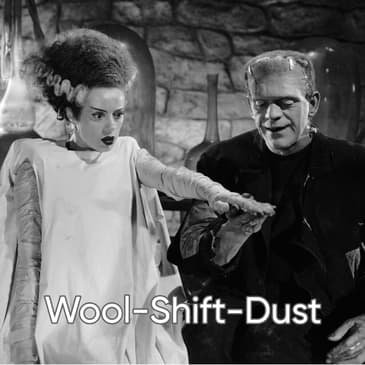
Ayesha from the Every Sci-Fi Film Ever podcast joins Elysia for a look at the classic Universal Monsters films Frankenstein (1931) and Bride of Frankenstein (1935), discussing everything from on-set drama and injuries to Hollywood's new decency codes – to, of course, how the films both do and do not adapt the book they're based on.
As they dissect the philosophy and filmmaking behind these movies, they also set the stage for that period of mad-scientist filmmaking, and give an overview of how the adaptations of this story have gone from there – up to a preview of the new Guillermo del Toro movie Frankenstein (2025) and Maggie Gyllenhaal's upcoming The Bride! (2026).
Frankenstein on Every* SciFi Film Ever:
The 1st Frankenstein film (1910, 13 min)
1931 & 1935 film short docs:
- "The Frankenstein Files: How Hollywood Made A Monster"
- "She's Alive! Creating the Bride of Frankenstein"
Frankensteins on Film (Letterboxd list)
Get in touch
Email: WoolShiftDustPodcast@gmail.com
Bluesky: Elysia
Lorehounds Discord: https://discord.gg/gM5VhTea2T
Explore the Lorehounds network for more book / film / TV / game / music podcasts
Produced by Elysia Brenner
Intro & outro music: “Castle of Dread” by Jaccob
Additional Music & SFX from Freesound.org & Ovani Sound
Advertising Inquiries: https://redcircle.com/brands
Privacy & Opt-Out: https://redcircle.com/privacy
00:00 --> 00:01 [SPEAKER_06]: how you do.
00:02 --> 00:08 [SPEAKER_06]: Mr. Carl Emily feels it would be a little unkind to present this picture without just a word of friendly warning.
00:08 --> 00:20 [SPEAKER_06]: We are about to unfold the story of Frankenstein, a man of science who sought to create a man after his own image, without reckoning upon God.
00:21 --> 00:30 [SPEAKER_06]: He is one of the
00:30 --> 00:36 [SPEAKER_06]: I think it will thrill you, it may shock you, it might even horrify you.
00:37 --> 00:53 [SPEAKER_06]: So, if any of you feel that you'd not care to subject your nerves to such a strain, now is your chance to wear it, respond to you.
01:19 --> 01:21 [SPEAKER_04]: Hello listeners Alicia here.
01:21 --> 01:28 [SPEAKER_04]: Thank you for your patience with my packed last couple of months and understanding my need to prioritize making rent money.
01:28 --> 01:36 [SPEAKER_04]: But I am delighted to be back now with the third and final part of the wool shift dust portion of the Frankenstein series.
01:36 --> 01:41 [SPEAKER_04]: If you're wondering what I mean by third part, that's because of subscribers already got two episodes.
01:42 --> 01:52 [SPEAKER_04]: The first is about the story of the creation of Frankenstein, the year of no summer and the background of the romantic slash Gothic literary movements.
01:52 --> 02:02 [SPEAKER_04]: The first episode spot lights Lord Byron and John William Poledory and an audio version of the vampire by John William Poledory.
02:02 --> 02:22 [SPEAKER_04]: And then the second episode, which somehow wound up being even chunkier, is about Mary and Percy Shelley and their family and the creation of the novel itself and also talk through Mary's other novels.
02:22 --> 02:28 [SPEAKER_04]: into the 1831 version of the novel followed by a comparison between the 1818 and 1831 version.
02:29 --> 02:34 [SPEAKER_04]: So we've got scandal, we've got literature, we've got politics, it's all in that episode.
02:35 --> 02:38 [SPEAKER_04]: But today, I am joined by a special guest.
02:38 --> 02:42 [SPEAKER_04]: I shakhan from every sci-fi film ever the podcast.
02:43 --> 02:47 [SPEAKER_04]: I know some of you are already fans of hers in the rest of you are likely soon to be.
02:48 --> 02:52 [SPEAKER_04]: Choosing out of the literally hundreds of adaptations.
02:53 --> 03:02 [SPEAKER_04]: Today, we're going to talk about the pair that defined how we think of Frankenstein and his monster arguably even more than the novel I just discussed.
03:03 --> 03:11 [SPEAKER_04]: And of course, all of this is triggered by the new Guillermo del Toro Adaptation, which you can already watch now on Netflix.
03:12 --> 03:23 [SPEAKER_04]: And you'll get a full breakdown of that movie as well in the Large Hounds feed after this one stay tuned to the end of the episode for more programming information for both this feed and the Large Hounds feed.
03:23 --> 03:32 [SPEAKER_04]: but we will briefly talk about these films at the end of this episode, this episode was recorded a while ago before I had seen the new film.
03:33 --> 03:44 [SPEAKER_04]: So, no spoilers here, and we will also preview a bit next year's new adaptation called The Bride from Maggie Gillen Hall that has been pushed to release in early 2026.
03:44 --> 03:52 [SPEAKER_04]: So here we go, let's welcome Isha and warning, spoilers for all things
03:54 --> 04:00 [SPEAKER_04]: So welcome, I should come from every sci-fi film, ever, Asterix podcast.
04:01 --> 04:02 [SPEAKER_04]: Thank you.
04:02 --> 04:03 [SPEAKER_04]: Asterix, almost.
04:04 --> 04:04 [SPEAKER_04]: Yes.
04:05 --> 04:13 [SPEAKER_04]: So can you explain for those who are unfamiliar yet the concept of your podcast, what sort of things you've covered so far?
04:13 --> 04:19 [SPEAKER_03]: Um, so I was lying in bed after a really, really, really tough week and I was like, I just, I make podcasts for living.
04:19 --> 04:24 [SPEAKER_03]: I just want to make a podcast that I just love to work on all the time, instead of all the stressful stuff, what would I want to do a podcast done?
04:24 --> 04:30 [SPEAKER_03]: And this title, every single side of I film ever came into my mind and I'm just going chronologically,
04:30 --> 04:36 [SPEAKER_03]: Astrix, almost starting in 1902, we are currently in the 1960s.
04:36 --> 04:38 [SPEAKER_03]: I usually speak to two academics.
04:39 --> 04:44 [SPEAKER_03]: So we can get into a bit more of the cultural significance as well as the content.
04:44 --> 04:52 [SPEAKER_03]: So we're talking about, oh, it's 1927 Germany and we're in between two world wars and Hitler's around, but he's not game power.
04:52 --> 05:00 [SPEAKER_03]: So putting stuff within historical context as well as dealing with the people who made the film,
05:01 --> 05:07 [SPEAKER_04]: So as we're recording now, your most recent episodes were La Chate from 1965.
05:07 --> 05:22 [SPEAKER_04]: Yes, Matt, which is about film, which is one of the only ones, I mean, I'm surprised by obviously you hit all the classics, you know, like Kong invisible man or things around this era that we're talking about now at the 30s.
05:22 --> 05:29 [SPEAKER_04]: but there's also you surprised me by introducing me to a lot of films that I didn't already know about.
05:30 --> 05:36 [SPEAKER_04]: For example, Alita, the going back to the 20s, you know, that's so weird.
05:36 --> 05:40 [SPEAKER_04]: It's a very seminal side of my film, I realize.
05:40 --> 05:45 [SPEAKER_04]: or just imagine, which seems kind of influenced by that in some way, a musical from the musical.
05:45 --> 05:48 [SPEAKER_03]: And those cool rom-com sci-fi.
05:48 --> 05:49 [SPEAKER_03]: They were like, let's just put it all together.
05:49 --> 05:53 [SPEAKER_03]: Just as the depression hit and see what happens.
05:53 --> 06:01 [SPEAKER_03]: So yeah, I myself is the reason I'm doing this, this is ideal science fiction films, but I never get enough time to watch films.
06:01 --> 06:05 [SPEAKER_03]: And so if I have a deadline of every two weeks, then I have to watch them.
06:05 --> 06:07 [SPEAKER_03]: And it's also the excuse I've got, like, family of what kids,
06:07 --> 06:10 [SPEAKER_03]: I've got a partner like hang out with, but then it's like, you know what?
06:10 --> 06:10 [SPEAKER_03]: I've got to do work.
06:11 --> 06:15 [SPEAKER_03]: And my work is watching science fiction thrice.
06:15 --> 06:17 [SPEAKER_04]: I mean, that's how you have to play it.
06:18 --> 06:19 [SPEAKER_04]: It's my evil plan.
06:21 --> 06:23 [SPEAKER_04]: Yeah.
06:23 --> 06:25 [SPEAKER_04]: So, yeah, so last few days, one of the ones I actually had seen before.
06:25 --> 06:28 [SPEAKER_04]: And your most recent episode was episode number 42.
06:29 --> 06:32 [SPEAKER_04]: So, I think you credited your partner on making this connection.
06:32 --> 06:37 [SPEAKER_04]: But of course, you dedicated that to Douglas Adams.
06:37 --> 06:41 [SPEAKER_03]: Yeah, so the answer to the life universe and everything.
06:41 --> 06:43 [SPEAKER_03]: Yeah, so I do a few details.
06:43 --> 06:54 [SPEAKER_03]: I do details all the time because if I find something interesting, I will go down that rabbit hole and then I will, I'll make an episode about it, but 42, I adore which I can sketch the galaxy.
06:54 --> 06:56 [SPEAKER_03]: I read it as a teenager and I think it's
06:56 --> 07:01 [SPEAKER_03]: one of those things that ends up being quite a shared experience between friends in life.
07:01 --> 07:06 [SPEAKER_03]: So it wasn't an academic discussion, even though we did have a bona fide academic onboard.
07:06 --> 07:15 [SPEAKER_03]: It was just like three friends having a really fun chat about the franchise and about stories and the characters.
07:15 --> 07:22 [SPEAKER_03]: So yeah, by the time this comes out, if you're saying we can have the next one's actually on Panic in the Zero, which I haven't edited yet.
07:23 --> 07:25 [SPEAKER_03]: But
07:25 --> 07:26 [SPEAKER_04]: Okay, great.
07:27 --> 07:48 [SPEAKER_04]: And I will probably refer some more to two, especially two relevant episodes to today's conversation, which is your sixth episode was titled Frankenstein Ghost Hollywood, and your 12th episode was titled Mad Scientist, Frankenstein Dr. Jekyll and Boris Karloff, and listeners will find links to those in the show notes.
07:48 --> 07:51 [SPEAKER_04]: Is there anything you want to say about those two episodes in particular up top?
07:51 --> 07:59 [SPEAKER_03]: Um, I think Frankenstein is one of the top three in terms of the podcasting apps, like in terms of how popular it is.
07:59 --> 08:00 [SPEAKER_03]: Oh, okay.
08:00 --> 08:02 [SPEAKER_03]: So, so that's quite interesting.
08:02 --> 08:16 [SPEAKER_03]: And the mad scientist one is because kind of when you get towards the Second World War era and up until the golden era of 50s, this just an absolute like this Swades and Swades of these mad scientists.
08:16 --> 08:20 [SPEAKER_03]: And you can understand why that would happen because people are kind of getting over
08:20 --> 08:27 [SPEAKER_03]: the weapons and stuff we've been used in the First World War, and then the Second World War, and it's what is the role of science in society.
08:28 --> 08:32 [SPEAKER_03]: And also it's such a fun trope like Mad scientist.
08:32 --> 08:36 [SPEAKER_03]: So I watched a ton of Mad scientists movies.
08:36 --> 08:40 [SPEAKER_03]: a lot of which feature Boris Carloth in the main role as a last time.
08:40 --> 08:41 [SPEAKER_03]: So, yeah.
08:41 --> 08:43 [SPEAKER_03]: So, I know it's really fun.
08:43 --> 08:44 [SPEAKER_03]: Yeah.
08:44 --> 08:48 [SPEAKER_03]: He had that downpuff as well as being Frankenstein.
08:48 --> 08:49 [SPEAKER_03]: Being a great side of the question.
08:50 --> 08:55 [SPEAKER_04]: For anyone who doesn't know Boris Carloth played the monster, quote unquote in these two movies.
08:56 --> 08:58 [SPEAKER_04]: But then later he was like, I'm done with the monster makeup.
08:58 --> 08:59 [SPEAKER_04]: I am the scientist.
09:00 --> 09:03 [SPEAKER_04]: Including in a later Frankenstein movie for Universal.
09:03 --> 09:04 [SPEAKER_03]: Yeah, yeah.
09:04 --> 09:06 [SPEAKER_03]: I mean, the makeup party took four hours.
09:07 --> 09:09 [SPEAKER_03]: So I can see why you started with that.
09:09 --> 09:16 [SPEAKER_04]: I mean, it's definitely, it's a lot worse for a lot of creature monsters.
09:16 --> 09:23 [SPEAKER_04]: I don't know how much, like for instance, Jacob awardees playing it in the new Gamma del Toro film.
09:23 --> 09:26 [SPEAKER_04]: And obviously, you got to do a lot to that man's face to make it not beautiful.
09:26 --> 09:28 [SPEAKER_04]: But I don't know.
09:28 --> 09:30 [SPEAKER_04]: I don't know if that's a particularly involved one.
09:30 --> 09:40 [SPEAKER_04]: But I was thinking like in the wheel of time, there was the elephant creature, which is like a fox, like humanoid creature, and that's the thing.
09:41 --> 09:46 [SPEAKER_04]: For that, we have to find someone, and this is apparently a thing.
09:46 --> 09:56 [SPEAKER_04]: You, they look for someone who not only can act, but who is experienced with being in the makeup chair, because you're going to be seven hours.
09:56 --> 10:00 [SPEAKER_03]: And being in a makeup chair for that long, I mean, I, I'm not one of those.
10:01 --> 10:05 [SPEAKER_03]: I can't stand going to sell on the only reason I go is to get my hair cut because I can't do it myself.
10:06 --> 10:11 [SPEAKER_03]: I could, I thank God, I'm not an actor.
10:11 --> 10:41 [SPEAKER_04]: Yeah, and then, you know, you have to be careful then after it's applied in the way that you eat or go to the bathroom or sit down, you know, so yeah, we'll talk a bit more about Boris Karloff's experience with that, but you said that you created this this podcast in part to give you an excuse to watch more science fiction, why why the genre science fiction would draw to that genre and and you want to shout out any favorites who had growing up or any favorite eras.
10:41 --> 11:04 [SPEAKER_03]: Oh god, like I just I don't think I knew as a child that it was science fiction that I loved and and also I don't think like I recently had to do my top 50 greatest films all the time and I think maybe one film made it, one science fiction film made it into the top ten so it's not like it's my only genre and it's not my favourite film is like science fiction but
11:04 --> 11:20 [SPEAKER_03]: It's one of those things that I think strangely I have quite a low bar for science fiction, so you can just put in a few ray guns or like, you know, like anything that involves, you know, remote people or making Android anything like that.
11:20 --> 11:25 [SPEAKER_03]: And I just, I just have always been drawn to it and space and,
11:25 --> 11:28 [SPEAKER_03]: what is it to be human and all those kind of things just really, really excite me.
11:28 --> 11:43 [SPEAKER_03]: So, it is my favorite genre and in terms of the films that made huge impression growing up, I mean loads of them, I grew up in the 80s, so we've got back to the future, probably what I should hold a bunch of films, I shouldn't have too young, including Terminator.
11:43 --> 11:51 [SPEAKER_03]: I recently began to realise that perhaps I'm one of the few, if only people who hadn't seen the promotional material for Terminator 2.
11:51 --> 11:53 [SPEAKER_03]: but had seen Terminator too young.
11:54 --> 12:06 [SPEAKER_03]: And so when I went into all that in the cinema, the effect it had on me not knowing, like the way they set it up is that Arnie comes back and then you've got the T1 and you expect the T1 to be saving John Connor.
12:08 --> 12:11 [SPEAKER_03]: But anyway, point being, it was just perfect for me, it blew my mind.
12:12 --> 12:14 [SPEAKER_03]: And yeah, I love science fiction.
12:15 --> 12:18 [SPEAKER_03]: I don't know really exactly why and work began.
12:18 --> 12:26 [SPEAKER_04]: Speaking, we were just talking about Terminator because Robert Patrick is playing a character and piecemaker.
12:26 --> 12:27 [SPEAKER_04]: Yes.
12:28 --> 12:29 [SPEAKER_04]: Yes, I've been watching that.
12:29 --> 12:29 [SPEAKER_04]: I have no idea.
12:29 --> 12:30 [SPEAKER_04]: I know I'm out today.
12:30 --> 12:30 [SPEAKER_04]: Yes.
12:31 --> 12:32 [SPEAKER_04]: Okay.
12:32 --> 12:32 [SPEAKER_04]: All right.
12:32 --> 12:32 [SPEAKER_03]: Cool.
12:32 --> 12:33 [SPEAKER_04]: Anyway, the thoughts on this.
12:33 --> 12:38 [SPEAKER_04]: I mean, so if anyone who doesn't know, we have been covering piecemaker weekly on the Laura Hound's feed.
12:38 --> 12:38 [SPEAKER_04]: Oh.
12:39 --> 12:41 [SPEAKER_04]: And any thoughts on the season so far?
12:41 --> 12:45 [SPEAKER_03]: Um, I had to actually catch up my husband and watch the first season.
12:45 --> 12:48 [SPEAKER_03]: So I had to catch up and watch the first season or just call it up now.
12:48 --> 12:51 [SPEAKER_03]: So we're ready for, I think it's a Thursday release, which will be the final.
12:52 --> 12:52 [SPEAKER_03]: Right.
12:52 --> 12:52 [SPEAKER_03]: Right.
12:52 --> 12:53 [SPEAKER_03]: Yeah.
12:53 --> 12:57 [SPEAKER_03]: So we're not only working out by the time this episode of the top, but yeah.
12:57 --> 13:01 [SPEAKER_03]: I'm really surprised at John Cena's acting skills.
13:01 --> 13:03 [SPEAKER_03]: I mean, I love the way he's able to make fun of himself.
13:04 --> 13:21 [SPEAKER_03]: I think it's got a really fun tone, but then it also deals with white supremacy and all these kind of serious and scary topics, which may or may not be quite relevant to what's going on right now.
13:22 --> 13:25 [SPEAKER_04]: And what's your background with the Frankenstein,
13:26 --> 13:31 [SPEAKER_04]: genre IP, you know, with the with with the novel films, your general feelings about it all.
13:31 --> 13:39 [SPEAKER_03]: So I was actually thinking about this and I realized I don't remember my first memory of Frankenstein because it's so ingrained in our culture.
13:39 --> 13:54 [SPEAKER_03]: It's one of the things that I realized I must have been in my pre-teen early teens when I went to watch the Robin Hood film with Kevin Costner and I'd realized I hadn't watched the Disney film and I knew the full Robin in story but I don't think I'd ever watched maybe I had, maybe I'd watched one of those really old films with them.
13:54 --> 13:56 [SPEAKER_03]: Errol Flynn or something.
13:56 --> 14:00 [SPEAKER_03]: Anyway, similar with Frank said, I don't remember a moment where I'm like, oh, this is new.
14:00 --> 14:01 [SPEAKER_03]: This is Frankenstein.
14:01 --> 14:02 [SPEAKER_03]: It's just always existed.
14:03 --> 14:09 [SPEAKER_03]: And so, would have seen the film at some point probably on BBC 2 growing up.
14:09 --> 14:10 [SPEAKER_03]: And...
14:10 --> 14:11 [SPEAKER_03]: if they'd shown.
14:11 --> 14:29 [SPEAKER_03]: As in, I've seen stuff and then it's always referred to in so many different ways and then you see new versions of it and you know cartoons and the monsters and like there's so many things that have that kind of Frankenstein character that I don't think I really acknowledged at beginning to that.
14:30 --> 14:30 [SPEAKER_03]: It's so ingrained.
14:31 --> 14:32 [SPEAKER_03]: Yeah, how about you?
14:33 --> 14:42 [SPEAKER_04]: Um, that I mean, it's a good question because it is one of those ones, indeed, as you say, it's so ingrained and, you know, I've said this about like, doing, for example, or Star Wars.
14:42 --> 14:52 [SPEAKER_04]: Um, I don't remember which version I was exposed to first probably I watched probably I was exposed to the movies we're going to be talking about today first.
14:52 --> 15:02 [SPEAKER_04]: There's a good chance it's a first thing that a kid sees.
15:02 --> 15:09 [SPEAKER_04]: I can't remember whether I picked it up myself or was given it in school equally likely to be honest.
15:11 --> 15:22 [SPEAKER_04]: And yeah, I think I just really, I'm very, I've talked about them, I'm podcasts that I am very into 19th century literature and history.
15:22 --> 15:26 [SPEAKER_04]: I just think it's a very interesting turning point.
15:26 --> 15:32 [SPEAKER_04]: in terms of culture, in terms of science, in terms of all these things that this story is responding to?
15:32 --> 15:39 [SPEAKER_03]: Yeah, I mean, if you think about 18, 18 as well, I adore, like, I adore pride and prejudice and stuff like that.
15:39 --> 15:41 [SPEAKER_03]: And so I think it's really interesting that it's that period.
15:41 --> 15:45 [SPEAKER_03]: And it has so much exciting change going on.
15:45 --> 15:51 [SPEAKER_03]: Like, the French Revolution's happened, and there's kind of, you know, England's at all,
15:51 --> 16:08 [SPEAKER_03]: like France and there's just Napoleon's around and the industrial revolution and the fact that there's so much new stuff happening and there's a real spirit of you know how a human's going to deal with this change which is I think a lot of that stuff is throughout science fiction and that's why it's so exciting.
16:08 --> 16:09 [SPEAKER_04]: Yeah.
16:09 --> 16:17 [SPEAKER_04]: Yeah, so I mentioned at the top of this episode that there are two extra episodes that came up before this for subscribers.
16:17 --> 16:23 [SPEAKER_04]: And in the first one, I do go into the background, the setting for the writing of the novel.
16:24 --> 16:36 [SPEAKER_04]: And I talked about how John William Paladori, he's another writer that was in this group retreat at the Vila Diodati, which we'll talk about with Brighton Frankenstein.
16:36 --> 16:47 [SPEAKER_04]: But he wrote a diary, as he was traveling with fire and to get to Switzerland where they all met up, traveling through Belgium.
16:47 --> 17:00 [SPEAKER_04]: And this was, I learned through this diary, or, you know, I just never thought about this context, but it was one year after the Battle of Waterloo, this was just so fresh, so fresh.
17:01 --> 17:16 [SPEAKER_04]: and just interesting to see how they sort of both idolize and criticize Napoleon at the same time and hold him up as this sort of maybe almost Dr. Frank and Stiny in figure?
17:16 --> 17:17 [SPEAKER_04]: Oh, that was something.
17:17 --> 17:17 [SPEAKER_04]: Yeah.
17:17 --> 17:21 [SPEAKER_03]: I'll look some of those that stuff up, that sounds really interesting.
17:21 --> 17:26 [SPEAKER_03]: So John Poledore, I think, was Byron's doctor, his physician.
17:26 --> 17:45 [SPEAKER_03]: Yeah, and yeah, and then he wrote the vampire, but I think that's really interesting because I can see how Napoleon would be that vague figure of kind of like freedom and everything, but then also he wanted to then become like an emperor again and that's right.
17:45 --> 17:47 [SPEAKER_03]: It would be interesting if I left thoughts on it.
17:48 --> 17:50 [SPEAKER_04]: All right.
17:50 --> 17:57 [SPEAKER_04]: Well, we are going to focus on these two universal movies, Frankenstein for 1931, Bride of Frankenstein from 1935.
17:57 --> 18:01 [SPEAKER_04]: They are sort of, I mean,
18:02 --> 18:13 [SPEAKER_04]: They are not only the most famous adaptations, they sort of shaped the way that we see this story in popular culture and the creature, especially almost more than the novel itself.
18:14 --> 18:14 [SPEAKER_03]: Yeah.
18:15 --> 18:24 [SPEAKER_03]: Yeah, I saw, because I'm doing a presentation, I saw some illustrations from 1831.
18:24 --> 18:27 [SPEAKER_03]: a Frankenstein, and he just looks like a person.
18:28 --> 18:39 [SPEAKER_03]: So it's really interesting how this version of Frankenstein is when we imagine what Frankenstein is, I've been from the vast majority of people imagine Boris Carter for this makeup.
18:39 --> 18:54 [SPEAKER_04]: Yeah, yeah, like as a kid, probably before I ever, you know, it's, you know, I said that this, these films are the first, I saw more likely I saw Frankenstein in other popular culture who were in some sort of monster alley movie or something.
18:54 --> 19:03 [SPEAKER_04]: And I remember as kids, us walking around with the arms out and all that and that's very much this movie and not the not all for this series of movies.
19:03 --> 19:04 [SPEAKER_04]: Yeah, I should say.
19:04 --> 19:18 [SPEAKER_04]: But we will shout out to the other Universal Movies and some other Frankenstein favorites at the end, but these two films are the focus because together they roughly tell the story of the book.
19:20 --> 19:25 [SPEAKER_04]: It's actually surprising to see how much of the book actually landed in Brighta Frankenstein.
19:25 --> 19:26 [SPEAKER_03]: Yeah, original.
19:26 --> 19:29 [SPEAKER_03]: Yeah, um, yeah, it is interesting.
19:29 --> 19:51 [SPEAKER_03]: I mean, I think they both do also stray very far away from the book, just because Frankenstein is such a basic character in the film, where as he learns to read in the novel, then he's kind of like, yeah, it's more of a personality than just being kind of a
19:51 --> 20:03 [SPEAKER_04]: We're going to, I'm not going to recap the book that was one of the episodes for subscribers goes into recapping the book in more detail, but we will shout out differences like that as we talk through the movies.
20:05 --> 20:09 [SPEAKER_04]: Between these two films, Frank and Stein and Brian of Frank and Stein, which do you prefer?
20:09 --> 20:12 [SPEAKER_04]: Do you have a favorite?
20:13 --> 20:21 [SPEAKER_03]: I enjoy bride more, just because I think it's so much funnier and it's kind of it's hammer, it's happier, it's more fun.
20:22 --> 20:28 [SPEAKER_03]: But I think the impact of the first film is more intense, it's a more serious film as well.
20:28 --> 20:48 [SPEAKER_03]: I mean, I've never watched a film and been scared, like I don't think because of our sensibilities of change so much over the last 90 something years that I don't think it can scare us, but I can see how that could have been very scary when you haven't been exposed to those kinds of things and that makeup would have been so different.
20:48 --> 20:54 [SPEAKER_03]: Whereas we, you know, we've got little cartoons that look like Frankenstein now, like it's it's not the same
20:55 --> 21:05 [SPEAKER_03]: like, our brains don't interpret it as what it would have been interpreted as the time, and when it was considered so gruesome and terrifying that, you know, people were writing about it, and complaining about it.
21:06 --> 21:07 [SPEAKER_03]: So it's a really tough call for me.
21:07 --> 21:16 [SPEAKER_03]: I would say Frankenstein is the better film, but if I wanted to have fun, I'd probably put on pride.
21:16 --> 21:19 [SPEAKER_04]: I see, yeah, I've always, I prefer bride.
21:20 --> 21:43 [SPEAKER_04]: I think it's just, I probably because it adapts more of the book in many ways, but I just did a rewatch of both last night in anticipation of this conversation, and I have to say that the original hit me in the emotions more than usual, and yeah, it does have those powerful scenes that we'll be talking about.
21:43 --> 21:56 [SPEAKER_04]: I think a lot of people over time have come to some collective cultural agreements that the bride is like one of or the peak universal monster movie.
21:57 --> 21:57 [SPEAKER_02]: Do you agree?
21:57 --> 22:04 [SPEAKER_02]: Oh, so let me see what I think it's thoroughly enjoyable.
22:05 --> 22:07 [SPEAKER_02]: I think I don't know.
22:09 --> 22:17 [SPEAKER_03]: It's difficult because is it the film that I'm laughing at and like throwing on for a good time or is it the film that's affecting me the most deeply?
22:18 --> 22:36 [SPEAKER_03]: Um, I think Bride is probably up there, but if it feels like almost like a comedy to me, like it's, you know, like, and that's also why it's, it's not as big as, for an emotional effect because in, in Frankenstein, you see the monster being treated so terribly.
22:36 --> 22:58 [SPEAKER_03]: you know from the get-go and yeah well he does get tortured in bread he does he does but he also makes a friend and he makes a couple of friends and he has you know he relaxes and he has a bit of a better time of it of his kind of life experience after being born
22:58 --> 23:00 [SPEAKER_03]: Yeah, I don't know.
23:00 --> 23:03 [SPEAKER_03]: I'm quite the teacher from the Black Lagoon as well, they say.
23:03 --> 23:05 [SPEAKER_04]: Yeah, yeah, no, that's fair.
23:08 --> 23:14 [SPEAKER_04]: Yeah, no, the monster gets his moment of respite in bride and probably more than he does in the book.
23:14 --> 23:15 [SPEAKER_04]: That's for sure.
23:15 --> 23:16 [SPEAKER_04]: Oh, that was nice.
23:16 --> 23:17 [SPEAKER_04]: Hownded throughout as well.
23:18 --> 23:19 [SPEAKER_04]: Okay, we'll get into it.
23:19 --> 23:24 [SPEAKER_04]: I just want to say that both movies are pretty easy to find online.
23:25 --> 23:28 [SPEAKER_04]: If you want to watch them, you can pause here and come back.
23:29 --> 23:32 [SPEAKER_04]: Is there any content warnings, you know.
23:32 --> 23:38 [SPEAKER_04]: people will have heard at the beginning of the episode, I played the intro to the 1931 film.
23:40 --> 23:47 [SPEAKER_04]: It's so charming now, especially as you say, we, yeah, I'll be saying our sensibilities have changed.
23:47 --> 23:49 [SPEAKER_04]: You know, like, nobody's getting gathered in this film.
23:49 --> 23:50 [SPEAKER_04]: Like, what?
23:50 --> 23:51 [SPEAKER_04]: What am I scared of?
23:51 --> 23:51 [SPEAKER_04]: Yeah, that's true.
23:52 --> 23:57 [SPEAKER_03]: There's no real body of what what it was going on.
23:57 --> 24:00 [SPEAKER_03]: Yeah, it's it's it's
24:00 --> 24:10 [SPEAKER_03]: I don't think it would have been charming in 1931, but it's interesting when he says, you know, we're dealing with life and death, but I think with Frankenstein, it's so fascinating to think, or what is the book about?
24:10 --> 24:17 [SPEAKER_03]: Obviously, there is this thing of, you know, there's a man who is creating other man and that is, you know, it's an abomination because it goes against the laws of God.
24:18 --> 24:29 [SPEAKER_03]: But what's always fascinated me about monsters is what they represent to us as human
24:29 --> 24:55 [SPEAKER_03]: I think that's kind of passed over quite a lot like I don't know what he is supposed to represent because when I'm watching it I'm like this is a this is a kid he's just been born into this big bulky like relatively scary body for the time um and I remember on um on my podcast and this it was rather like her she was saying that monsters tend to be boundary dwellers and I love that concept of of a monster being like what is what is the boundary that he's dwelling on?
24:56 --> 25:09 [SPEAKER_03]: but I do find it really fascinating because he's kind of like a child that is learning about life, but it's as usual, the real monsters are us because of how mistreated he is and that fritz, oh my god.
25:10 --> 25:15 [SPEAKER_03]: Yeah, we first see Fritz's base, you're like, oh, is he the monster?
25:15 --> 25:21 [SPEAKER_04]: No, he's just he's just someone who's mean and Fritz is who you're if you're waiting for us to talk about.
25:22 --> 25:26 [SPEAKER_04]: I go we will bring it up where that comes from but Fritz is I go basically.
25:27 --> 25:32 [SPEAKER_03]: Yeah, um, yeah, so that that idea of
25:32 --> 25:41 [SPEAKER_03]: you know what do you think like what do you think the main theme is of it is about people kind of transgressing on the laws of God I guess.
25:41 --> 25:58 [SPEAKER_04]: Yeah that's definitely what upset the sensors the most it sounds like and we're getting to that as well but I guess in terms of content warnings for today there is a child who is killed that is what
25:58 --> 26:01 [SPEAKER_04]: got me most emotional when I rewatch last night.
26:01 --> 26:03 [SPEAKER_04]: So I guess I would be my biggest content morning.
26:04 --> 26:05 [SPEAKER_04]: Um, you know, there's this ableism.
26:05 --> 26:07 [SPEAKER_04]: There's all that 1930s stuff.
26:07 --> 26:10 [SPEAKER_04]: It's not that bad when it comes to sexism.
26:10 --> 26:23 [SPEAKER_04]: It's just the only female character doesn't have much to do or I guess there's more female characters and bride but only one of them has much to do and she's and what she's supposed to do is make it funny.
26:23 --> 26:37 [SPEAKER_03]: Yeah, um yeah, it is it is I don't think I could take any of it seriously though, and that's that's probably my problem in watching it like I watch these films is like little Kind of currusties of the age and I can't
26:38 --> 26:50 [SPEAKER_03]: I can't get too emotional because I can't take them seriously and I think that and I think that gets worse with pride because I think James well is purposefully making it really funny.
26:50 --> 26:57 [SPEAKER_04]: Yeah, I mean, it's the horror genre is drifting toward comedy at this point, I would say.
26:57 --> 27:01 [SPEAKER_03]: Yeah, and that whole Una O'Cona character, and she's quite a few of the shows.
27:01 --> 27:02 [SPEAKER_03]: She's so out of the top.
27:02 --> 27:05 [SPEAKER_04]: Yeah, we can fight up, but she's so out of the top.
27:05 --> 27:09 [SPEAKER_04]: People complain about her in, what is it, the invisible man?
27:09 --> 27:22 [SPEAKER_04]: Yeah, but in the invisible man, it fits there because I feel like, you know, she kind of sets that comedic tone, but it's also being played up by um, what's his face, the invisible man himself, um, blanking.
27:24 --> 27:34 [SPEAKER_03]: Why am I also blanking now that you've said that because my brain was going to the police officer and now you've just Claude Reigns.
27:34 --> 27:35 [SPEAKER_03]: Claude Reigns.
27:35 --> 27:36 [SPEAKER_03]: What a voice.
27:36 --> 27:37 [SPEAKER_03]: What a band.
27:38 --> 27:39 [SPEAKER_04]: Yeah.
27:39 --> 27:42 [SPEAKER_04]: I mean, that one is more comedic in the film.
27:42 --> 27:46 [SPEAKER_04]: It feels like whereas here I'm like she's just doing way too much.
27:46 --> 27:49 [SPEAKER_04]: She's doing like take it down a notch or not.
27:49 --> 27:55 [SPEAKER_03]: Yeah, she's just like yeah, she's just she's that for she is that for comedic release.
27:55 --> 28:16 [SPEAKER_04]: There's no other reason I know yeah her character is does nothing other than convey information in a way it's meant to be comedic Yeah, and clearly James well also directed the invisible man, so he liked her Yeah, yeah, she's part of it like apparently had a bit of a gang and a bit of a crew and so she would have been one of those people
28:16 --> 28:17 [SPEAKER_04]: Yeah.
28:19 --> 28:19 [SPEAKER_04]: Yeah.
28:19 --> 28:25 [SPEAKER_04]: But if you need any more nudges to watch these two films, they are short.
28:25 --> 28:27 [SPEAKER_04]: They're both barely more than an hour.
28:27 --> 28:30 [SPEAKER_04]: They are well received.
28:30 --> 28:33 [SPEAKER_04]: The original has a 94% from critics and rotten tomatoes.
28:34 --> 28:46 [SPEAKER_04]: The bride has a 98% you'll see roughly a, you know, meta critic, 91% for the original
28:46 --> 28:52 [SPEAKER_04]: A public readings tend to be a little bit lower because people don't appreciate old films the way we do.
28:54 --> 29:09 [SPEAKER_04]: The bride was nominated for one Academy Award for Sound Recording and, yeah, that sort of, you know, horror in general gets get-a-wise that, at awards shows, except last year.
29:09 --> 29:14 [SPEAKER_04]: We had two horror nominees, and this year, sinners is likely to do well.
29:14 --> 29:20 [SPEAKER_04]: The new Frank Stonestein, which will be teasing, will certainly get at least some craft awards.
29:21 --> 29:24 [SPEAKER_04]: So horror is breaking out of the ghetto, but it didn't end then.
29:24 --> 29:31 [SPEAKER_03]: And I also think, I think it is in 1931 that the lead character in Dr. Declan Mr. Hyde, one in Oscar.
29:31 --> 29:38 [SPEAKER_03]: So I think I get the feeling like comedy and horror does get slided now, but I don't know if that was always the case.
29:39 --> 29:43 [SPEAKER_04]: It's definitely always been one of the most reliable genres at the box office.
29:43 --> 29:44 [SPEAKER_04]: Oh yeah.
29:44 --> 29:46 [SPEAKER_03]: It's saved studios more than once.
29:46 --> 29:46 [SPEAKER_04]: Yeah.
29:47 --> 29:47 [SPEAKER_04]: Yeah.
29:47 --> 29:51 [SPEAKER_04]: I mean, certainly universal, the maker of these two films we're talking about today.
29:51 --> 29:57 [SPEAKER_04]: Yeah, Dracula, which came out also in 1931, was
29:57 --> 30:00 [SPEAKER_04]: definitely save them in a make make a break moment.
30:00 --> 30:04 [SPEAKER_04]: So they're like, let's do more of those horror films, those sci-fi horrors.
30:05 --> 30:14 [SPEAKER_04]: There's a budget for these two, it was 262 reportedly for the original 397 reportedly for Bride.
30:14 --> 30:19 [SPEAKER_04]: The third one in the series was above 400, but
30:19 --> 30:31 [SPEAKER_04]: They did, you know, there's different estimations for the box office, they all range between like 2 million or 12 million for each of these films or each of these first two at least.
30:31 --> 30:34 [SPEAKER_04]: So it was doing well for them.
30:35 --> 30:36 [SPEAKER_04]: Yeah.
30:37 --> 30:47 [SPEAKER_04]: Do you have any final thoughts that you would share to anyone to, whether or not they should actually watch these films for themselves before
30:47 --> 30:49 [SPEAKER_03]: I mean, I think you should definitely go and watch them.
30:50 --> 30:51 [SPEAKER_03]: I think they're enjoyable films.
30:51 --> 30:58 [SPEAKER_03]: I think considering, you know, like people are like, oh, I don't like a lot of old films that, I mean, my kids pretty much refuse to watch black and white films.
30:58 --> 31:00 [SPEAKER_03]: So if you're one of those people, I don't even know what you're here listening to.
31:00 --> 31:04 [SPEAKER_03]: Just but like, if you're opening, open to watching black and white films.
31:04 --> 31:05 [SPEAKER_03]: Yeah, definitely.
31:05 --> 31:06 [SPEAKER_03]: I think they're worth watching.
31:06 --> 31:08 [SPEAKER_03]: I think they're interesting.
31:08 --> 31:09 [SPEAKER_03]: I think
31:09 --> 31:10 [SPEAKER_03]: I'm also engaging.
31:10 --> 31:12 [SPEAKER_03]: It's not like I would I get bored watching these films.
31:12 --> 31:17 [SPEAKER_03]: I find the really engaging and entertaining and as I said, I find the second one pretty funny.
31:19 --> 31:19 [SPEAKER_03]: So yeah, watch it.
31:20 --> 31:22 [SPEAKER_03]: It's a good evening and you can watch them back to back.
31:22 --> 31:24 [SPEAKER_03]: They all said really short.
31:25 --> 31:26 [SPEAKER_04]: Yeah, yeah, exactly.
31:26 --> 31:27 [SPEAKER_04]: It's a perfect double feature.
31:28 --> 31:30 [SPEAKER_04]: All right, on that note, we're going to take a quick break.
31:30 --> 31:33 [SPEAKER_04]: And when we get back, we're going to launch into the first film.
31:33 --> 31:34 [SPEAKER_04]: Right.
31:35 --> 31:53 [SPEAKER_04]: Okay, and we are back, we are ready to talk about a Frankenstein, the, well, as I say, the original from 1931, but actually, it's not the first film, there was the first film.
31:53 --> 31:53 [SPEAKER_04]: Yeah.
31:53 --> 31:54 [SPEAKER_04]: Yeah.
31:54 --> 32:01 [SPEAKER_04]: You can find the 1910 film online, actually, I'll link it in the show notes that's out of copyright, so it's free to share.
32:01 --> 32:03 [SPEAKER_04]: It's only 13 minutes long.
32:04 --> 32:10 [SPEAKER_04]: It's, you know, it's one of the earliest film adaptations, so the limited, like, they have to be in one room.
32:10 --> 32:13 [SPEAKER_04]: It's done by Edison Studios.
32:13 --> 32:24 [SPEAKER_04]: He didn't direct it, but I know you and I both have thoughts about Tom, it's innocent.
32:24 --> 32:26 [SPEAKER_03]: Are you going to go first just a while or should I go first?
32:26 --> 32:28 [SPEAKER_03]: No, I mean go for it, yeah.
32:28 --> 32:30 [SPEAKER_03]: So I mean, I'd heard all the stuff about, you know, how are you?
32:31 --> 32:34 [SPEAKER_03]: So you had a patents company and other people would do the work and he'd take all the credit for it.
32:34 --> 32:37 [SPEAKER_03]: And I'm not saying there wasn't valuable stuff that came from that.
32:37 --> 32:46 [SPEAKER_03]: And I think in terms of, you know, building a landscape across America and making a successful country, I'm sure he had a big part to play in that.
32:46 --> 32:53 [SPEAKER_03]: But the reason that really bound me up was when I was doing research for LaFourge,
32:53 --> 33:03 [SPEAKER_03]: I learned about the fact that he made the motion pictures patterns company, which is also known as the Edison Trust in which in the theory and the image of it.
33:03 --> 33:08 [SPEAKER_03]: It's like, oh, you know, when you want to protect the copyright of filmmakers, but in reality.
33:08 --> 33:14 [SPEAKER_03]: it was just a monopoly or a cartel in which Edison could control the whole filmmaking business.
33:15 --> 33:26 [SPEAKER_03]: And I've also read that the Edison's in New Jersey at this point in his life and I read the reason that people like Hollywood is one of the reasons that exists is that people wanted to get as far away from Edison as possible.
33:27 --> 33:30 [SPEAKER_03]: But also on top of that, there's the hypocrisy but the fact that he
33:30 --> 33:45 [SPEAKER_03]: Pirated hundreds of copies of La Voix Dance Loan, which was hugely successful, and Melia's at one point is completely broke, you know, pretty much homeless at one point, pretty much like he's really, really poor, can barely, you know, rub two coins together as they say.
33:45 --> 33:51 [SPEAKER_03]: And so Edison made a huge, and other producers in the US made a huge profits for it.
33:51 --> 33:57 [SPEAKER_03]: And then, you know, he's got the nerve to start this motion picture patents company, which is awful.
33:57 --> 34:04 [SPEAKER_03]: Yeah, and Melia has had to set, when that started happening, he had to send his brother over to the US to try and manage the idea that people are just stealing his work.
34:04 --> 34:07 [SPEAKER_03]: So, yeah, that's one of the reasons.
34:07 --> 34:31 [SPEAKER_04]: Yeah, I mean, so that's linked to the movie industry where Edison really did dominate the American sphere there in the early days, but of course, we don't have time to get into all of it now, but famously, he also treated Tesla rather badly while they were competing about electrical currents.
34:31 --> 34:32 [SPEAKER_04]: And
34:32 --> 34:43 [SPEAKER_04]: Just in general, he was the type of guy who would buy your patent to kill it and yeah, just steal whenever possible work from other people.
34:44 --> 34:46 [SPEAKER_04]: claim it as his own.
34:46 --> 34:51 [SPEAKER_03]: And I think that might be relevant because we might be talking about another mad science fiction film later in which that happens.
34:53 --> 35:00 [SPEAKER_04]: But yeah, so the 1910 film it was done by Edison Studio.
35:00 --> 35:05 [SPEAKER_04]: He did not direct it, but yeah, he had the infrastructure because again, you could only
35:05 --> 35:12 [SPEAKER_04]: had to film in one room and he even had the studio, the Black Mariah Rick turned for this sunlight and things like that.
35:12 --> 35:15 [SPEAKER_04]: So that's who did the first film.
35:15 --> 35:22 [SPEAKER_04]: There are two films from 1915 and 1921 that are now considered lost.
35:22 --> 35:28 [SPEAKER_04]: And I would say the next big one is the one we're going to be talking about today, but there are other influences along the way.
35:28 --> 35:34 [SPEAKER_04]: Like, you brought up their goal of from 1920 when we were talking privately.
35:34 --> 35:36 [SPEAKER_04]: And that is, yeah, that's one that I have watched.
35:36 --> 35:42 [SPEAKER_04]: It is, it comes from, you know, Jewish mythology, bringing a goalem to life.
35:42 --> 35:46 [SPEAKER_04]: Obviously, there's clear Frankenstein camps.
35:47 --> 35:52 [SPEAKER_04]: That's a decent, you can find it online, that's a classic silent horror film.
35:53 --> 36:01 [SPEAKER_04]: And then, of course, you've talked extensively on your podcast about, I'm going to say, Jackal and Hyde, but Gical, I guess, is the original.
36:01 --> 36:07 [SPEAKER_03]: A lot of people say Gical, so yeah, I always pronounce everything wrong, so everyone just be kind to me.
36:07 --> 36:32 [SPEAKER_04]: I mean, yeah, I mean, a jack-hole in the high, I suppose is at least the American pronunciation, but I suppose in the early days, I said, jico, no, they're more likely say jack-hole, but there's, I ended up watching the ones from 1912, 1913, 1920, the one with John Barrymore, I think that's my favorite, and then the two quote-unquote big adaptations from 1931 and 1941.
36:33 --> 36:49 [SPEAKER_04]: I do think the 19, we'll talk about the differences between Frankenstein and the book and Frankenstein in this movie, but the 1931 Dr. Jekyll to me is closer to book Dr. Frankenstein than the Dr. Frankenstein in these movies.
36:50 --> 36:51 [SPEAKER_03]: Fair, fair, absolutely.
36:51 --> 36:55 [SPEAKER_03]: Yeah, and I really enjoyed that version as well.
36:56 --> 36:59 [SPEAKER_04]: Yeah, my, I mean, it's such a, it's a good version.
36:59 --> 37:00 [SPEAKER_04]: It's such a dark version.
37:00 --> 37:07 [SPEAKER_04]: I find that Jack on Hyde stories difficult to watch because they're about like, mistreating this for a woman mostly.
37:07 --> 37:12 [SPEAKER_03]: Really, and that goes back to what these monsters are, right?
37:12 --> 37:15 [SPEAKER_03]: Like that they tend to be kind of,
37:15 --> 37:21 [SPEAKER_03]: quite often about what's kind of unrestrained like abuse violence.
37:21 --> 37:30 [SPEAKER_03]: Like a lot of these things will be kind of captured and in like a monster and that's definitely Dr. Jackal the things that a civilized man should not do is what Mr.
37:30 --> 37:31 [SPEAKER_03]: Hype does do.
37:32 --> 37:32 [SPEAKER_04]: Yeah.
37:33 --> 37:40 [SPEAKER_04]: By one thing, I think the cinematography in the 1931, Dr. Jackal and Hyde is great.
37:40 --> 37:42 [SPEAKER_04]: You can tell that they're really
37:43 --> 37:49 [SPEAKER_04]: pressing the boundaries of what was possible the time and redefining was possible the change in the mirror and stuff like that.
37:49 --> 37:50 [SPEAKER_04]: Yeah, impressive.
37:50 --> 37:52 [SPEAKER_04]: Yeah, except I hate that.
37:53 --> 38:04 [SPEAKER_04]: So the use of this vignette thing, which is for anyone who doesn't know it's just basically making a darker on the outside, but they use such an extreme version of this in this movie, it feels like I'm watching it with a flashlight.
38:04 --> 38:11 [SPEAKER_03]: I wonder if that, again, is the German expressionism kind of effect coming up?
38:11 --> 38:22 [SPEAKER_03]: Yeah, the German expressionism had such an influence globally that I think that a lot of these kind of films want to kind of evoke that as including the 1931 Frankenstein.
38:22 --> 38:38 [SPEAKER_04]: Yeah, well, I mean, but the vignette thing that was, because I do, I love German expressionism as one of my favorite genres, like my favorite silent films are foused in the cabinet of Dr. Calagari, and both relevant to this discussion.
38:38 --> 38:46 [SPEAKER_04]: Yeah, and I love Dr. Calagari, and these films today are clear.
38:46 --> 38:52 [SPEAKER_04]: The ones who were discussing now are clearly influenced by German
38:52 --> 39:00 [SPEAKER_04]: the way they do, the black and white lighting, the dramatic lighting and use of shadows and angles and the, yeah, absolutely.
39:01 --> 39:02 [SPEAKER_04]: Yeah.
39:02 --> 39:04 [SPEAKER_04]: Yeah, I ended up, um,
39:05 --> 39:16 [SPEAKER_04]: Because you did, we talked about how you have the Mad Scientist episode, and you had a list of movies that were, you were like, you can watch, she's ahead of this Mad Scientist episode.
39:16 --> 39:18 [SPEAKER_04]: So I ended up watching all of those movies for funsies.
39:19 --> 39:21 [SPEAKER_04]: And my favorite.
39:23 --> 39:26 [SPEAKER_04]: It wasn't my podcast, that was playing along really well.
39:26 --> 39:33 [SPEAKER_04]: But my favorite of the one, since you put on there, was the Man who changed his mind from 1936,
39:33 --> 39:48 [SPEAKER_04]: Dracula, Frankenstein, and others in some ways, but also surprisingly feminist for its time, and maybe with the most sympathetic, mad scientists who's played by Boris Galloff.
39:48 --> 40:05 [SPEAKER_03]: Yeah, and it's because it has a female side to stand out, which, you know, she has agency, and she doesn't want to just go off and get married to the kind of, like, the rich, medium, ogle son who was chasing, like, it's interesting to have that kind of character in, you know, in the 30.
40:05 --> 40:06 [SPEAKER_04]: Oh, my goodness.
40:06 --> 40:10 [SPEAKER_04]: And she remains intelligent and competent all the way through the end.
40:10 --> 40:10 [SPEAKER_03]: Yeah.
40:10 --> 40:11 [SPEAKER_04]: I was so afraid.
40:11 --> 40:17 [SPEAKER_04]: I was like, oh, they're setting it up so that we can learn
40:17 --> 40:21 [SPEAKER_04]: Is a scientist who does science things and spoilers?
40:21 --> 40:21 [SPEAKER_04]: And today.
40:22 --> 40:25 [SPEAKER_04]: Yeah, that's it.
40:25 --> 40:27 [SPEAKER_03]: And also it's interesting how it starts with her, as well.
40:27 --> 40:32 [SPEAKER_03]: So it's not, you know, although we can say the borrower's call of characters, the central character.
40:32 --> 40:36 [SPEAKER_03]: It starts with her heading to see him and it and she is a, like, as close to a central character as a woman could get in a mad scientist film.
40:36 --> 40:44 [SPEAKER_03]: Yeah, like, like, like, like, like, like, like, like, like, like, like, like, like, like, like, like, like, like, like, like, like, like, like, like, like, like, like, like, like, like, like, like, like, like, like, like, like, like, like, like, like, like, like, like, like, like, like, like, like, like, like, like, like, like, like, like, like, like, like
40:44 --> 40:49 [SPEAKER_04]: Yeah, I mean, I would say she's a perspective that we're following throughout, mostly.
40:50 --> 40:53 [SPEAKER_04]: And she cares about the mad scientist, that's unusual, too.
40:53 --> 40:55 [SPEAKER_04]: It's not just like, I hate you die.
40:55 --> 41:02 [SPEAKER_03]: It is a sympathetic character though, even though, I mean, the thing is they was tip over into, like, crazed, mania, murdering type stuff.
41:02 --> 41:20 [SPEAKER_03]: But again, like, that's where the Thomas Edison thinking is in, with the, the, the guy, the media mogul, um, the newspaper man who funds his research, and then he just takes it away and then, and then when Boris Carlos character is saying, no, but I will continue my research.
41:20 --> 41:22 [SPEAKER_03]: And that's what tips him over the edge.
41:23 --> 41:24 [SPEAKER_03]: Mm-hmm, fair, fair.
41:25 --> 41:26 [SPEAKER_04]: Who is the real monster?
41:29 --> 41:38 [SPEAKER_04]: So I talked in the pre-epicodes about how putting Frankenstein the novel and the context of the romantic with the capital or literary era.
41:39 --> 41:48 [SPEAKER_04]: And when I was thinking about these, these mantimes, movies are obviously coming out, let's see, a century later or so.
41:49 --> 41:56 [SPEAKER_04]: Do you think though that they are in some ways carrying on the romantic sort of anti-hero role?
41:57 --> 42:03 [SPEAKER_03]: No, I don't think they are, and if they are, it's probably just residue rather than intention necessarily.
42:03 --> 42:11 [SPEAKER_03]: I do think James World does have like some sympathy with the character any and he portrays that in the films, but
42:13 --> 42:35 [SPEAKER_03]: I think the way it's portrayed in the books is being this kind of here is a being that is outside of society and does not understand or know the rules of society and is coming to as well to the fully formed, you know, in an adult body and what that person does within our society and then it kind of examines what's wrong with our society to degree.
42:35 --> 42:40 [SPEAKER_03]: I don't think that's
42:40 --> 43:06 [SPEAKER_04]: I mean, we do get the sense, and I think this does come from James Well rather than obviously universal, doesn't care, and obviously this disappears as the universal horror series goes on without his influence, but we have that questioning of science that the Romantics put
43:07 --> 43:09 [SPEAKER_04]: is, can you go too far in science?
43:09 --> 43:12 [SPEAKER_04]: And James Will was not a religious man.
43:12 --> 43:16 [SPEAKER_04]: We talked already about how the sensors didn't.
43:17 --> 43:21 [SPEAKER_04]: We're nervous about, uh, with a, I mean, they cut out the, the famous line, right?
43:21 --> 43:26 [SPEAKER_03]: Like, um, let me just, do you gonna play that or should I find it?
43:27 --> 43:28 [SPEAKER_04]: Oh, yeah, I'll play.
43:28 --> 43:30 [SPEAKER_04]: I'll play the original version later.
43:31 --> 43:31 [SPEAKER_03]: Okay.
43:31 --> 43:37 [SPEAKER_03]: So, but, um, Henry in the name of God and then Henry says the name of God, obviously cut over this in the name of God.
43:37 --> 43:40 [SPEAKER_03]: Now I know what it feels to be God and that had to be cut out.
43:40 --> 43:42 [SPEAKER_03]: Even though this is before the Hayes Code is probably,
43:43 --> 43:53 [SPEAKER_03]: you know implemented it's there but it's everyone ignores it because you know the audience wouldn't have liked that it's a really just large parts of the country very religious and it's blasphemous.
43:53 --> 43:59 [SPEAKER_04]: Yeah, we're going to get into that a bit more but this quote from Frankenstein said to stage.
44:00 --> 44:11 [SPEAKER_06]: This creature of yours should be kept under God, not my words
44:12 --> 44:15 [SPEAKER_10]: Have you never wanted to do anything that was dangerous?
44:16 --> 44:19 [SPEAKER_10]: Where should we be if nobody tried to find out what lies beyond?
44:19 --> 44:24 [SPEAKER_10]: You never wanted to look beyond the clouds and the stars.
44:25 --> 44:30 [SPEAKER_10]: Or to know what causes the trees to bud, and what changes the darkness into light?
44:31 --> 44:35 [SPEAKER_10]: But if you talk like that, people call you crazy.
44:36 --> 44:42 [SPEAKER_10]: Well, if I could discover just one of these things,
44:43 --> 44:46 [SPEAKER_10]: I wouldn't care if they didn't think I was crazy.
44:48 --> 44:51 [SPEAKER_04]: It's this idea of just wanting people to believe you.
44:51 --> 44:53 [SPEAKER_04]: I connect so much with that.
44:53 --> 44:57 [SPEAKER_04]: And also, it's something we see reflected in this story.
44:57 --> 45:03 [SPEAKER_04]: Like, it's interesting how Frankenstein is used as a mirror of
45:03 --> 45:13 [SPEAKER_04]: current of the ideas of the creators and society because we see so many different versions of Dr. Frankenstein and the monster and how they interact.
45:13 --> 45:28 [SPEAKER_04]: For instance, in the Curse of Frankenstein, the first of the Hammerhorre series of Frankenstein's from 1957, there we get like the most evil
45:28 --> 45:56 [SPEAKER_04]: But the nightmare for him is that spoiler for this old movie is that at the end He is sent to the gallows and nobody believes him whereas kind of a bit the bitter sweet ending of the man who changed his mind movie We just talked about with Anna Lee That one in the end he says to her the Boris Carlov sign to says to her, you know at least people believe me now
45:56 --> 46:00 [SPEAKER_03]: Yes, because he gets laughed at by the whole scientific community.
46:02 --> 46:10 [SPEAKER_04]: So it's sort of, I mean, I suppose there's this, this story is always about drawing parallels between Frankenstein and his creature.
46:10 --> 46:19 [SPEAKER_04]: And there's this sort of loneliness to it, I guess, where you feel like an outsider because people don't think the way that you think.
46:19 --> 46:26 [SPEAKER_03]: Yeah, but also that, I mean, that's when we talk about what you should and do, there's always that theme in science and science fiction, right?
46:26 --> 46:32 [SPEAKER_03]: Like we probably, like the nuclear bomb was probably inevitable.
46:32 --> 46:36 [SPEAKER_03]: We definitely shouldn't have made it, but it's that thing of
46:36 --> 46:43 [SPEAKER_03]: scientific progress and where that takes us and who is it, you know, in service to and and again it goes back to Faust.
46:43 --> 46:53 [SPEAKER_03]: No, like they're kind of deal with a devil like if you give me all the knowledge, then I mean we don't live in those kind of religious societies anymore, but what are we giving up?
46:53 --> 46:55 [SPEAKER_03]: Where does our morality lie?
46:55 --> 46:57 [SPEAKER_03]: Like even nowadays with
46:57 --> 47:27 [SPEAKER_03]: various tech roads and the kind of technology they are enforcing on us against that will very often and you know what what is the end-gold what is the end-gold sorry why we why are we having all this AI that most I've never met anyone who wants who wants AI and is it what is it in the service to because it just feels like it's in the service it's not in the service to progress it feels like it's just in the service to money and yeah I guess that's how the cookie crumbles
47:27 --> 47:33 [SPEAKER_04]: Yeah, here, I guess the mad scientist genre is about rich men who are willing to spend all their money for science.
47:34 --> 47:36 [SPEAKER_04]: Yeah, no, it's almost like we have the opposite.
47:36 --> 47:38 [SPEAKER_04]: Like it must kill science, so we make money.
47:38 --> 47:39 [SPEAKER_04]: Yeah, anyway.
47:40 --> 47:52 [SPEAKER_04]: Um, so these, I have talked about in previous episodes, like the notes for our two episode on the Laura Hound's feed or our coverage of a Christmas Carol for anyone who doesn't know.
47:52 --> 48:00 [SPEAKER_04]: Luke and I, we have done extensive coverage of a Christmas Carol in this bullshit dust feed and we will continue to do that this year.
48:00 --> 48:16 [SPEAKER_04]: So there's some surprising overlaps between that and this, but one of them is that these books that came out in the 19th century, one of the ways around it's skirting copyrights is that people would do play adaptations of them.
48:16 --> 48:40 [SPEAKER_04]: and then the play adaptations of them often became more influential on the film versions than the source material themselves and that is true also of Frankenstein where the first play adaptation is presumption or the fate of Frankenstein so 1823 and that not only influenced
48:40 --> 49:08 [SPEAKER_04]: later movies like adding the this Fritz character, you know, the sidekick, but it also influenced Mary Shelley's own book because she released her first version in 1818 and she saw this play and she had had some feedback and she had lived some experiences in life
49:08 --> 49:15 [SPEAKER_04]: of her own book, and that play was, was in part influential on that.
49:15 --> 49:32 [SPEAKER_04]: But the movie that we're talking about now, it is an adaptation specifically of the stage play, Frankenstein, an adventure in the Macabre by Peggy Webbling, which was first published in 1927, and that play is hard to find.
49:32 --> 49:38 [SPEAKER_04]: I can't, I have to say I haven't read it, but we are assured that that's where there
49:38 --> 49:40 [SPEAKER_04]: might have come from there.
49:40 --> 49:49 [SPEAKER_03]: Yeah, apparently what I was reading about it was that it's where that Peggy babbling's the person who called the monster Frankenstein for the first time after his creator.
49:49 --> 49:52 [SPEAKER_03]: So apparently that confusion is her fault.
49:53 --> 49:53 [SPEAKER_01]: Peggy.
49:53 --> 49:58 [SPEAKER_03]: And I'll use Frankenstein interchangeably with the monster.
49:59 --> 50:07 [SPEAKER_03]: I'll be letting her know because again, it's it's so ingrained in society's a child when someone's as Frankenstein to you, you have no clue who Victor Frankenstein is when you're like eight.
50:08 --> 50:11 [SPEAKER_03]: Frankenstein is a green thing with bolts coming out of his head.
50:11 --> 50:16 [SPEAKER_04]: Yeah, yeah, bolts coming on his head is definitely an invention of this video.
50:16 --> 50:17 [SPEAKER_04]: Yeah.
50:17 --> 50:27 [SPEAKER_04]: So the story, this film story was by John L. Ballderson, a screenplay by Garrett Boarts and Francis Edward Farrow.
50:27 --> 50:38 [SPEAKER_04]: And it was originally going to be directed by Robert Flory, but his idea was he just had the monsters like a simple killing machine, you know, no paythos to it.
50:39 --> 50:47 [SPEAKER_04]: And Universal wanted Bella Lagosi, famous for playing Dracula, at this point, to play the monster in that version in Lagosi.
50:47 --> 50:50 [SPEAKER_04]: Apparently said no, or they said no to him or whatever.
50:50 --> 50:53 [SPEAKER_03]: Apparently you wanted to play Victor Frankenstein, right?
50:53 --> 50:57 [SPEAKER_03]: But also they filled some, they had test screenings.
50:57 --> 51:00 [SPEAKER_03]: from that, which I haven't seen, and I would love to see it, but apparently they're lost.
51:00 --> 51:06 [SPEAKER_03]: So yeah, there's a rumor that, um, head of Universal, Carl, how do you say surname?
51:07 --> 51:08 [SPEAKER_03]: Lamelli.
51:09 --> 51:09 [SPEAKER_03]: Lamelli.
51:09 --> 51:10 [SPEAKER_03]: Lamelli, yeah.
51:10 --> 51:10 [SPEAKER_03]: Lamelli?
51:10 --> 51:11 [SPEAKER_03]: I think now, maybe.
51:11 --> 51:12 [SPEAKER_03]: Yeah.
51:12 --> 51:15 [SPEAKER_03]: Just thought Lago C look quite funny as Frankenstein.
51:15 --> 51:17 [SPEAKER_03]: So that could be why, but also for me, yeah.
51:17 --> 51:21 [SPEAKER_03]: But you know, Lago C himself said that he didn't want to play it because he wanted to play it.
51:21 --> 51:27 [SPEAKER_03]: Well, he might say that anyway, because yeah, I think he had a hard time kind of establishing himself in the US.
51:27 --> 51:30 [SPEAKER_03]: And yeah, even though he's a huge star.
51:30 --> 51:39 [SPEAKER_04]: Yeah, it sounds like he comes across as a bit petty sometimes, particularly toward he was there's a sort of rivalry with Boris Carlos.
51:39 --> 51:44 [SPEAKER_03]: Yeah, but I do imagine like coming over to the US and having that kind of accent, like I can imagine.
51:44 --> 51:51 [SPEAKER_03]: Like it's tough now, having an accent in modern Western society and I imagine 1930s have been far worse.
51:52 --> 51:58 [SPEAKER_03]: So I have a lot of love for
51:58 --> 51:59 [SPEAKER_03]: mistreated.
51:59 --> 52:01 [SPEAKER_03]: I'm a little accent, quite often.
52:01 --> 52:01 [SPEAKER_04]: Yeah.
52:01 --> 52:08 [SPEAKER_04]: Well, and it was in the ghost of Frank and Stein, which is like the fourth movie in the series, he does end up playing the monster.
52:08 --> 52:11 [SPEAKER_04]: They did a lot of casting, reshuffling, says he series went on.
52:13 --> 52:17 [SPEAKER_04]: And he it may actually make sense because
52:17 --> 52:26 [SPEAKER_04]: spoiler for the end of the third movie, but he plays a character, Igor, or Igor, who's brain ends up inside the monster.
52:26 --> 52:36 [SPEAKER_04]: So it makes sense that the monster would speak with the Hungarian accent, but apparently when they showed it to the studio execs, they laughed.
52:36 --> 52:44 [SPEAKER_04]: at his accent, and so they ended up cutting that out, so the certain aspects of that movie don't make sense.
52:44 --> 52:54 [SPEAKER_04]: For example, the reason why we do the Frankenstein walk with the arms out is because he was supposed to have gone blind, but they cut all the lines explaining that, the monster went blind.
52:54 --> 53:03 [SPEAKER_04]: So we just, we do the walk and we see him shuffling around and all the films after that, but it's never explained because, yeah, they were laughing at Legosi's accent.
53:04 --> 53:05 [SPEAKER_03]: Interesting.
53:07 --> 53:25 [SPEAKER_04]: But yeah, luckily for the world, this film ended up being directed in the version we saw by James Whale, who it is relevant to, especially when we get to a bride of Frankenstein, he was an openly gay man, which obviously in 1931 isn't that common.
53:25 --> 53:30 [SPEAKER_04]: I definitely recommend the 1998 movie Academy Award nominee.
53:30 --> 53:32 [SPEAKER_04]: I think it might have been one, something anyway.
53:32 --> 53:35 [SPEAKER_04]: Uh, gods and monsters, where they're a column.
53:35 --> 53:37 [SPEAKER_03]: Yeah, you might have seen one.
53:37 --> 53:38 [SPEAKER_04]: And I really definitely want to watch it.
53:38 --> 53:43 [SPEAKER_03]: Yeah, I've been, it's been a while since I did the episode, but yeah, I really want to watch that.
53:43 --> 54:01 [SPEAKER_04]: Yeah, it's about his kind of last days looking back and filtered through the character of Brendan Fraser, a young Brendan Fraser plays a gardener who ends up being his listening piece and helping him interrogate this legacy that he's sleeping behind and after his last days.
54:02 --> 54:13 [SPEAKER_04]: Now we kind of have made some reference to this, but you want to explain to people what this
54:13 --> 54:18 [SPEAKER_03]: Okay, so this is, this is, I recently read a book, my Thomas Dorothy about pre-culture cinema.
54:18 --> 54:21 [SPEAKER_03]: It's an amazing book, I highly recommend it, but I'm fascinated by this era.
54:22 --> 54:25 [SPEAKER_03]: And so, the Depression's hit, Hollywood's going crazy.
54:25 --> 54:26 [SPEAKER_03]: They're showing all types of stuff.
54:26 --> 54:33 [SPEAKER_03]: I saw something from Tarzan in his mate, which was released in 1934 and got cut, but it's an underwater swimming scene.
54:33 --> 54:35 [SPEAKER_03]: It's called The Underwater Ballet, you can find on YouTube.
54:36 --> 54:42 [SPEAKER_03]: But it is full nudity of Jane, as she jumped into the water, Tarzan pulls her clothes off,
54:42 --> 54:43 [SPEAKER_03]: and they're just new.
54:43 --> 54:49 [SPEAKER_03]: So Hollywood, like in terms of whatever the boundaries are of what's acceptable, is going crazy at this time.
54:50 --> 54:56 [SPEAKER_03]: They put in the Hayes Code, but from 1930 to 1934, there's no way of implementing it.
54:56 --> 54:59 [SPEAKER_03]: You can kind of like wheeze all your way out of stuff.
54:59 --> 55:01 [SPEAKER_03]: You could put stuff in and go, yeah, yeah, it's going to be fine.
55:01 --> 55:03 [SPEAKER_03]: We'll change a bit or change a bit here and there.
55:03 --> 55:04 [SPEAKER_03]: But it is a very
55:04 --> 55:08 [SPEAKER_03]: back and forthing and the power still lies with Hollywood.
55:09 --> 55:13 [SPEAKER_03]: And then in 1934, they decided to implement it properly.
55:13 --> 55:26 [SPEAKER_03]: A man called Joseph Brink comes in to make sure he's going to implement stuff and he has to okay the film to the people who finance the film in New York before they get the money in everything.
55:26 --> 55:31 [SPEAKER_03]: So then it becomes that is proper Hayes Code Hollywood after that date.
55:31 --> 55:38 [SPEAKER_03]: So up until so they call it pre-code machine 1930 and 1940 because it's that weird period where there is a code but no one's really paying attention to it.
55:39 --> 55:39 [SPEAKER_04]: Yeah.
55:39 --> 55:50 [SPEAKER_04]: Yeah, but then we do have the where a lot of the first movie obviously so that's pre-code and then Bride is 1935 so that's right after the code is officially amended.
55:50 --> 56:03 [SPEAKER_04]: So the second movie Bride was more directly censored in some ways, but then the first movie was censored after the fact where different places would remove reals of film and some of them
56:03 --> 56:14 [SPEAKER_04]: In general, some of these would be lost, and the scene where Frankenstein throws a little girl in the water was lost for decades, I believe, until it was recovered in like 1990 or something.
56:14 --> 56:17 [SPEAKER_03]: Yeah, apparently it was a DVD release for the first time people saw it.
56:18 --> 56:18 [SPEAKER_03]: Wow.
56:18 --> 56:29 [SPEAKER_03]: And things like that, the reason things would have been cut back then after they had been filmed would have been either local states and cinemas cutting them out because they would find the objectionable.
56:29 --> 56:33 [SPEAKER_03]: or simply because they didn't want the hassle of films not doing well.
56:33 --> 56:39 [SPEAKER_03]: And a lot of racial reasons as well, like a film, they wouldn't test racial boundaries because those films wouldn't do well in the south.
56:39 --> 56:46 [SPEAKER_03]: So it's a kind of a self-sensorship rather than a censorship that's being applied on to the industry.
56:46 --> 56:47 [SPEAKER_04]: Right.
56:47 --> 56:59 [SPEAKER_04]: Right, like we often see where China's a big market for films and for the longest time, those criticism of particularly Disney catering to, oh, we can't say this because then they won't play it in China.
56:59 --> 57:03 [SPEAKER_04]: And yeah, yeah, it still exists.
57:03 --> 57:03 [SPEAKER_04]: Yeah.
57:03 --> 57:14 [SPEAKER_04]: Yes, we, as we mentioned, that this was one of the biggest issues was this whole idea of the fact that Frankenstein is a story about a man trying to play God.
57:14 --> 57:21 [SPEAKER_04]: That's the point of the story and the point is that he fails, but just to drill that home, here's a quote from the first movie.
57:21 --> 57:33 [SPEAKER_10]: I'm going to turn that ray on that body and in doubt with life, and you really believe that
57:34 --> 57:35 [SPEAKER_10]: It has never lived.
57:37 --> 57:38 [SPEAKER_09]: I created it.
57:39 --> 57:41 [SPEAKER_09]: I made it with my own hands from the bodies.
57:41 --> 57:44 [SPEAKER_09]: I took from graves from the gallows anywhere.
57:46 --> 57:47 [SPEAKER_10]: Go and see for yourself.
57:48 --> 57:55 [SPEAKER_04]: So he's sort of, he's Frankenstein takes a lot of pride throughout the film in laying God.
57:56 --> 58:00 [SPEAKER_04]: But they, as you said, they had to cut some e-lines for that.
58:00 --> 58:01 [SPEAKER_04]: Yeah.
58:01 --> 58:06 [SPEAKER_04]: Yeah, including potentially the best, best seen in the film, but we'll get to that later.
58:08 --> 58:09 [SPEAKER_04]: All right.
58:11 --> 58:15 [SPEAKER_04]: Well, so the film over all
58:16 --> 58:36 [SPEAKER_04]: where you know with the the cradle of the writing of the story came from and where the book itself is set and just to recap the plot very briefly with the help of his hunchback to lab assistant Fritz Dr Frankenstein steals body parts from the graveyard and university science department to piece them together into a new being
58:36 --> 58:49 [SPEAKER_04]: which he imbues with life, unable to control the creature, Frankenstein and his fellow scientist, Dr. Waldman, played by Edward Banslone, abuse it, leading to its killing Dr. Sloan and escaping.
58:49 --> 59:04 [SPEAKER_04]: Out in the world, the creature brings destruction, both accidental and intentional, killing a little girl and attacking Dr. Frankenstein's bride Elizabeth, leading the villagers to storm and burn down a windmill with the creature inside.
59:05 --> 59:07 [SPEAKER_03]: Yeah, that that those like I love the mob.
59:08 --> 59:09 [SPEAKER_03]: I love the mob with torches.
59:09 --> 59:10 [SPEAKER_03]: It's so much fun.
59:11 --> 59:15 [SPEAKER_04]: I mean, that's that chat at the very end of the movie of the Whimmel burning on the hill.
59:16 --> 59:17 [SPEAKER_04]: Not at all from the book.
59:17 --> 59:18 [SPEAKER_04]: Completely iconic.
59:18 --> 59:19 [SPEAKER_04]: Oh, yeah.
59:19 --> 59:20 [SPEAKER_04]: Absolutely.
59:20 --> 59:24 [SPEAKER_03]: I think I think Fritz is such a great character as well.
59:24 --> 59:26 [SPEAKER_03]: I'm glad they added that.
59:26 --> 59:32 [SPEAKER_03]: And the part I absolutely love is kind of, you know, the check-off's gun, but it's check-off's abnormal brain.
59:32 --> 59:37 [SPEAKER_03]: Like, I have this interesting lecture, and they're like, this is a normal, healthy brain.
59:37 --> 59:38 [SPEAKER_01]: You know, it's a good one, this brain.
59:39 --> 59:50 [SPEAKER_03]: You want this abnormal criminal brain, and so when Fritz takes the, as soon as he takes the normal brain, you're like, oh, no, that's something I'm going to happen and he drops it.
59:50 --> 59:53 [SPEAKER_04]: Yeah, yeah, I mean, the whole normal abnormal brain.
59:53 --> 01:00:00 [SPEAKER_04]: Again, not for the book, but that is definitely, you know, where we're talking in peak era of for knowledge and stuff.
01:00:00 --> 01:00:03 [SPEAKER_04]: Yeah, you Jennings, yeah, things like that.
01:00:03 --> 01:00:07 [SPEAKER_04]: So not proper science, but yeah, that definitely plays a role here.
01:00:07 --> 01:00:18 [SPEAKER_04]: And in Fritz is played by Dwight Fry, who I particularly love my favorite role of his is as Renfield in the 1931 Dracula movie.
01:00:19 --> 01:00:21 [SPEAKER_04]: I just in general, Dracula.
01:00:21 --> 01:00:27 [SPEAKER_04]: Renfield is one of my favorite Dracula characters or maybe my favorite Dracula character overall.
01:00:27 --> 01:00:42 [SPEAKER_04]: He's just so unhinged and Dwight Frey gives such a good such a good performance is that he does come back and he is in both of these films because his character dies in the first film But he comes back as Carl in the film.
01:00:42 --> 01:00:43 [SPEAKER_03]: I was like, Carl looks just like Fritz.
01:00:43 --> 01:00:45 [SPEAKER_03]: I didn't realize it was the same actor.
01:00:46 --> 01:00:47 [SPEAKER_03]: That's how it was like Carl.
01:00:47 --> 01:00:49 [SPEAKER_03]: I'm like, oh, it's someone else.
01:00:50 --> 01:00:51 [SPEAKER_04]: Yeah, exactly.
01:00:51 --> 01:00:59 [SPEAKER_04]: Yeah, he's he's Dr. Pretoria says deranged henchmen in the Brad Frankenstein, but potato for Tato.
01:00:59 --> 01:01:01 [SPEAKER_04]: He plays pretty much exactly the same.
01:01:01 --> 01:01:03 [SPEAKER_04]: They just changed his name.
01:01:04 --> 01:01:05 [SPEAKER_04]: Yeah.
01:01:05 --> 01:01:09 [SPEAKER_04]: I know this this was we've talked about Boris Carl off, but this was his big break.
01:01:09 --> 01:01:10 [SPEAKER_03]: Yeah.
01:01:11 --> 01:01:15 [SPEAKER_04]: He'd he'd a part of it and like dozens and dozens of films and yeah, this was it.
01:01:16 --> 01:01:23 [SPEAKER_04]: This was the one the made and famous and I think this is why he was more willing to deal with the makeup and all that.
01:01:24 --> 01:01:25 [SPEAKER_04]: Jack Pierce was the makeup artist.
01:01:25 --> 01:01:26 [SPEAKER_04]: He's
01:01:26 --> 01:01:27 [SPEAKER_04]: become really famous for it.
01:01:27 --> 01:01:42 [SPEAKER_04]: I do recommend you can find on YouTube documentaries from the 1999 special edition DVD release, including the Frankenstein files, how Hollywood made a monster, and that goes deep into the makeup and production design.
01:01:43 --> 01:01:55 [SPEAKER_04]: I'll link that in the show notes, but basically the flat head, the bolts, the heavy boots, which were apparently
01:01:55 --> 01:02:00 [SPEAKER_04]: Jack Pierce slash James Wells invention for this movie.
01:02:00 --> 01:02:02 [SPEAKER_04]: And this is what we think of the monster now today.
01:02:03 --> 01:02:10 [SPEAKER_03]: Absolutely, it's phenomenal because as I said, I think it's an engraving from 1931, looks nothing like what we think of Frankenstein.
01:02:11 --> 01:02:17 [SPEAKER_03]: And I get the feeling the new films won't well, the new Guillermo del Toro film won't go in that direction, but yeah.
01:02:17 --> 01:02:33 [SPEAKER_04]: No, yeah, it's more, well, I think the new Guillermo de Torofilm is mixing book with, it seems like he's, like, Guillermo de Toro is a Frankenstein super fan, so I think he's mixing a lot of influences together for his, but especially the book.
01:02:33 --> 01:02:40 [SPEAKER_03]: Yeah, I'm actually very excited about the film, but that is because I've now gone and watched the the trailer.
01:02:40 --> 01:02:41 [SPEAKER_03]: Yeah, so I tried to avoid it.
01:02:41 --> 01:02:41 [SPEAKER_03]: Yeah.
01:02:42 --> 01:02:44 [SPEAKER_03]: I'm not, my expectations are just through the roof.
01:02:45 --> 01:02:46 [SPEAKER_03]: It's all because of you.
01:02:46 --> 01:02:47 [SPEAKER_04]: That's it.
01:02:47 --> 01:02:53 [SPEAKER_04]: It's so far, it's been doing the festival rounds and it's been pretty warmly received so far.
01:02:53 --> 01:02:57 [SPEAKER_04]: And like, for example, the,
01:02:56 --> 01:03:15 [SPEAKER_04]: only quote unquote negative reviews I've seen around it personally are one person called a bombastic I'm like well I hope so and another person in this part this journalist has been excoriated online so I don't remember the name I won't call it out but they said that
01:03:15 --> 01:03:24 [SPEAKER_04]: basically, they were complaining that, oh, well, the monster is actually the more sympathetic one, which leaves the scientists away.
01:03:25 --> 01:03:32 [SPEAKER_04]: Like, it sounds like everything I'm hearing for you guys is that he understands the source material, which obviously does.
01:03:32 --> 01:03:32 [SPEAKER_03]: Yeah.
01:03:33 --> 01:03:34 [SPEAKER_03]: Yeah.
01:03:34 --> 01:03:35 [SPEAKER_03]: I think it's going to be amazing.
01:03:36 --> 01:03:36 [SPEAKER_04]: Yeah.
01:03:36 --> 01:03:36 [SPEAKER_04]: Yeah.
01:03:37 --> 01:03:37 [SPEAKER_04]: Yeah.
01:03:37 --> 01:04:00 [SPEAKER_04]: Anyway, 1931, we, you know, talks about Boris Carlov stopped playing the monster at some point and another people like Legosi stepped into play, but then Boris Carlov does come back much later in the series and House of Frankenstein in place, not a Frankenstein, but a different mad scientist because unbelievably, House of Frankenstein does not feature a single character named Frankenstein.
01:04:02 --> 01:04:05 [SPEAKER_04]: it's just six in the series for nineteen forty four.
01:04:05 --> 01:04:07 [SPEAKER_03]: Yeah, it's the house, the spirit.
01:04:10 --> 01:04:13 [SPEAKER_04]: Exactly, like you just call him Frankenstein.
01:04:13 --> 01:04:16 [SPEAKER_04]: You just keep making up new Frankenstein's it's fine, do it again.
01:04:16 --> 01:04:18 [SPEAKER_04]: Yeah.
01:04:18 --> 01:04:23 [SPEAKER_03]: It's like in the second film where like, um, well, sorry, Henry, because they changed the name, don't they?
01:04:23 --> 01:04:32 [SPEAKER_03]: Henry Frankenstein's father just suddenly dies, and they don't really explain it because at the end of the first film he's very much alive.
01:04:32 --> 01:04:39 [SPEAKER_04]: Yeah, um, we saw the Frankenstein in these two films the doctor is played by calling live.
01:04:39 --> 01:05:00 [SPEAKER_04]: We'll talk a bit more about his tragedy in the second film and that becomes more, he's a tragic figure behind the scenes and I think James will, he refused to recast him for the second film, even though he had gotten quite far in alcoholism by that point because he was like, you know, this sort of unhingedness actually serves the character well.
01:05:00 --> 01:05:07 [SPEAKER_04]: Okay, Elizabeth, the love interest in the first film is play by May Park.
01:05:07 --> 01:05:11 [SPEAKER_04]: I mean, I actually, I like her better in the first film in the second film.
01:05:11 --> 01:05:15 [SPEAKER_04]: They do recast right on, I don't think it's the actresses fault in the second film.
01:05:15 --> 01:05:16 [SPEAKER_04]: Oh, no, it's never.
01:05:16 --> 01:05:17 [SPEAKER_04]: Yeah, but they just, yeah.
01:05:18 --> 01:05:33 [SPEAKER_04]: women do they need to have a personality tell me no no only there to caution you to be more moral that's it that's the role is of plays in the second film here it's like tell me about your work tell me about your work anyway yeah she's not given much to do but she's there
01:05:33 --> 01:05:48 [SPEAKER_04]: The more interesting female character from the first film is a little girl Maria who is killed who is played by Marilyn Harris and apparently she loved like as a child, she loved the monster in costume.
01:05:49 --> 01:05:54 [SPEAKER_03]: Yeah, there is something about Frankenstein, that Frankenstein, but I think appeals to children, I don't know why.
01:05:54 --> 01:05:55 [SPEAKER_04]: Yeah.
01:05:55 --> 01:05:59 [SPEAKER_04]: Did you ever watch the secret, the spirit of the B-high?
01:05:59 --> 01:06:02 [SPEAKER_04]: No, and I have had it recommended multiple times.
01:06:02 --> 01:06:07 [SPEAKER_03]: Including, I think, on my podcast, but I never managed to catch up with my recommendations.
01:06:07 --> 01:06:09 [SPEAKER_04]: No, it's the list is always too long.
01:06:09 --> 01:06:12 [SPEAKER_03]: Yeah, it's supposed to be beautiful because that I think is about a child, right?
01:06:12 --> 01:06:13 [SPEAKER_03]: Right.
01:06:13 --> 01:06:13 [SPEAKER_03]: Yeah.
01:06:13 --> 01:06:30 [SPEAKER_04]: Yeah, so it's a Spanish film from 1973 and apparently, and you can see it watching it, it was one of Guillermo de Toro's primary inspirations for Pan's Labyrinth, because it is about, it is specifically, it's about a child in, in
01:06:30 --> 01:06:32 [SPEAKER_04]: Is it in Mexico?
01:06:32 --> 01:06:33 [SPEAKER_04]: Is it anyway?
01:06:33 --> 01:06:34 [SPEAKER_04]: It doesn't matter in a small town somewhere.
01:06:34 --> 01:06:45 [SPEAKER_04]: They are showing the 1931 Frankenstein movie, you know, like someone's brought in the prints and they've set up a screen in the square and the whole town is watching this film.
01:06:46 --> 01:06:55 [SPEAKER_04]: And it makes an impression on this young child who then after that discovered, oh yeah, it's definitely France.
01:06:56 --> 01:06:59 [SPEAKER_04]: I'm sorry when we're saying it's
01:06:59 --> 01:07:11 [SPEAKER_04]: because she discovers a man hiding out in the barn and she kind of tries to help him because to her, she's thinking of this is like this Frankenstein character and then she feels so peaceful.
01:07:11 --> 01:07:12 [SPEAKER_04]: Yeah.
01:07:12 --> 01:07:15 [SPEAKER_04]: And then Yami, no spoilers, but her innocence is shattered.
01:07:16 --> 01:07:28 [SPEAKER_04]: But it's interesting that this is obviously a film that deeply influenced Guillermo d'Artoro in general because it's a clear inspiration for Penn's Library in which takes this conceit of the child imagination.
01:07:28 --> 01:07:34 [SPEAKER_04]: It turns it up to 11, but it's also, it is literally about Frankenstein.
01:07:36 --> 01:07:37 [SPEAKER_04]: Absolutely.
01:07:38 --> 01:07:42 [SPEAKER_04]: Um, yeah, we've even shouting out some of the differences with the book.
01:07:42 --> 01:07:44 [SPEAKER_04]: No, obviously I'm not going to summarize a whole book here.
01:07:44 --> 01:07:48 [SPEAKER_04]: We already did that episode, uh, but just talking about some more key differences.
01:07:49 --> 01:08:07 [SPEAKER_04]: Uh, one important thing missing that is we can see has been reintroduced for the Guillermo del Toro film is the Arctic framing story, which is where the book starts and ends
01:08:08 --> 01:08:22 [SPEAKER_04]: Third character who is leading an expedition there and encounters Dr. Frankenstein pursuing his monster and they both end up telling him their story and that's how we get the book.
01:08:23 --> 01:08:26 [SPEAKER_04]: So it's interesting that it's being brought back.
01:08:27 --> 01:08:35 [SPEAKER_04]: Also, where did you think about the fact that this film opens with Dr. Frankenstein himself, Robin Grace?
01:08:37 --> 01:08:38 [SPEAKER_03]: I absolutely love that.
01:08:38 --> 01:08:42 [SPEAKER_03]: It's just, and it's so, like, they're just waiting for that group to be filled up.
01:08:42 --> 01:08:44 [SPEAKER_03]: And then it's go, we've got it, we've got it quick.
01:08:44 --> 01:08:49 [SPEAKER_03]: And also, they don't really explain, because then they pass by that guy who's been hung.
01:08:49 --> 01:08:56 [SPEAKER_03]: And so they take the body down and they're like his next been broken and therefore his brain won't do.
01:08:57 --> 01:09:01 [SPEAKER_03]: And then they're like, but this brain and a jar that's been normal, that's going to be absolutely fine.
01:09:05 --> 01:09:06 [SPEAKER_03]: Yeah, the next brain.
01:09:06 --> 01:09:11 [SPEAKER_03]: But yeah, I enjoy, you know, I mean Colin Clive's character in that is,
01:09:12 --> 01:09:14 [SPEAKER_03]: I really enjoy his character in the first step.
01:09:14 --> 01:09:16 [SPEAKER_03]: It's more so than in, than in bright, actually.
01:09:16 --> 01:09:17 [SPEAKER_04]: Yeah, I agree.
01:09:17 --> 01:09:37 [SPEAKER_03]: Because he's so focused and, you know, like, when, I don't know if you get like, what I call it sometimes, but you know, when you get into that hyper focus and you're just like, this is he wants to create a being and nothing is going to stop him and I just love it that he's doing himself and Fritz is his little sidekick, which,
01:09:38 --> 01:09:46 [SPEAKER_03]: I'd love to know where they met, but, you know, you want to rob some grapes, yeah, yeah, yeah, why not?
01:09:46 --> 01:09:59 [SPEAKER_04]: I mean, it definitely in the 19th century was the peak of grave robbing where bodies would be sold to size for rents for anatomy lessons because they were sent of an official way to.
01:09:59 --> 01:10:00 [SPEAKER_04]: supply these bodies.
01:10:00 --> 01:10:01 [SPEAKER_04]: There's always a shortage.
01:10:01 --> 01:10:03 [SPEAKER_04]: So they would pay grave robbers.
01:10:03 --> 01:10:11 [SPEAKER_04]: Frankenstein doing it himself, rather than paying someone else, stretches incredulity for me, but I'm fine with it, because it's such a fun way to open it.
01:10:14 --> 01:10:20 [SPEAKER_04]: We've talked a bit about, obviously, the Hunchback System Fritz is in addition,
01:10:21 --> 01:10:31 [SPEAKER_04]: Belly the go see plays another version called Igor or I go in later films Yeah, and Igor becomes the most famous name I think for a lot of things Yeah, exactly.
01:10:31 --> 01:10:35 [SPEAKER_04]: I think a lot of people watch his first film and be like his name is Fritz What?
01:10:36 --> 01:10:38 [SPEAKER_04]: Yeah He sort of gets conflated.
01:10:38 --> 01:10:39 [SPEAKER_04]: Yeah
01:10:40 --> 01:10:55 [SPEAKER_04]: And another big difference is, okay, so I'm going to quote the book version of creating the spark of life, which is a lot less literal than we see it in the film in the book Mary Shelley wrote with an anxiety that almost amounted to agony.
01:10:55 --> 01:11:02 [SPEAKER_04]: I collected the instruments of life around me that I might infuse a spark being into the lifeless thing that lay at my feet.
01:11:02 --> 01:11:04 [SPEAKER_04]: It was already one in the morning.
01:11:04 --> 01:11:14 [SPEAKER_04]: The rain padded dismally against the pains, and my candle was nearly out when by the glimmer of the half-extinguished light, I saw the dull yellow eye of the creature open.
01:11:14 --> 01:11:18 [SPEAKER_04]: It breathes hard and a convulsive motion agitated its limbs.
01:11:19 --> 01:11:26 [SPEAKER_04]: And this obviously, even though it's not as dramatic as in the film, it's clearly inspired by galvanism, which,
01:11:27 --> 01:11:33 [SPEAKER_03]: Luigi Galvani, yeah, yeah, he started making frogs legs twitch with electricity.
01:11:33 --> 01:11:35 [SPEAKER_03]: And I think they used to do public displays of this.
01:11:35 --> 01:11:36 [SPEAKER_03]: So that's why.
01:11:36 --> 01:11:44 [SPEAKER_03]: And because before I started my podcast, they didn't realize there was any science, but I was like, yeah, they're just using science in quote, quotation marks kind of thing.
01:11:45 --> 01:11:50 [SPEAKER_03]: But then it was at least he as it could was like, no, no, they used to have like public displays of this.
01:11:50 --> 01:11:54 [SPEAKER_03]: like these experiments where they'd reanimate small animals.
01:11:54 --> 01:11:54 [SPEAKER_03]: Right.
01:11:55 --> 01:11:58 [SPEAKER_03]: And so yeah, that I imagine Mary Shelley either heard about it or saw that.
01:11:58 --> 01:11:59 [SPEAKER_03]: It's amazing.
01:11:59 --> 01:12:03 [SPEAKER_04]: Yeah, apparently there was conversation about it.
01:12:03 --> 01:12:06 [SPEAKER_04]: I'd really do your dirty and that weekend when the book was started.
01:12:06 --> 01:12:07 [SPEAKER_04]: So...
01:12:08 --> 01:12:14 [SPEAKER_03]: Can I quickly mention, because I discovered the Wilhelm's screen after everyone else when I was doing one of the podcast.
01:12:15 --> 01:12:20 [SPEAKER_03]: But Castle Thunder is a sound effect that originated for 93-1's Frankenstein.
01:12:20 --> 01:12:23 [SPEAKER_03]: So that's not as good as the Wilhelm's screen, but it's been used.
01:12:23 --> 01:12:29 [SPEAKER_03]: It doesn't have films and all sorts of TV programs and other things, but it originated in Frankenstein.
01:12:29 --> 01:12:44 [SPEAKER_04]: Okay, probably the most famous origin, the line that came from this film is about how, I mean, I understand, you know, we talk about that this more muted version in the books, but they needed to make it dramatic on screen and the love or the scene.
01:12:45 --> 01:12:46 [SPEAKER_03]: I love the scene.
01:12:46 --> 01:12:50 [SPEAKER_03]: So you got you.
01:12:51 --> 01:13:06 [SPEAKER_07]: It's a lie, it's a lie, it's a lie, it's a lie, it's a lie, it's a lie, it's a lie, it's a lie, it's a lie, it's a lie, it's a lie, it's a lie, it's a lie, it's a lie, it's a lie, it's a lie, it's a lie, it's a lie, it's a lie, it's a lie, it's a lie, it's a lie, it's a lie, it's a lie, it's a lie, it's a lie,
01:13:06 --> 01:13:09 [SPEAKER_04]: And of course in the bride, there's a call back.
01:13:09 --> 01:13:11 [SPEAKER_04]: She's alive alive.
01:13:11 --> 01:13:14 [SPEAKER_03]: Yeah, and nowhere near is over the top.
01:13:14 --> 01:13:16 [SPEAKER_03]: But I feel James well, knew what he was doing with that.
01:13:17 --> 01:13:18 [SPEAKER_03]: But I just, I adore the scene.
01:13:18 --> 01:13:21 [SPEAKER_03]: I think it's such, I mean, so near the start as well.
01:13:21 --> 01:13:24 [SPEAKER_03]: Like it's such a strong, like straight out the bat almost.
01:13:24 --> 01:13:29 [SPEAKER_03]: It feels like they're going to such an intense scene.
01:13:29 --> 01:13:30 [SPEAKER_03]: And it's so iconic.
01:13:30 --> 01:13:33 [SPEAKER_03]: Like it's repeated so many times in so many things.
01:13:33 --> 01:13:35 [SPEAKER_03]: And yeah, I love it.
01:13:35 --> 01:13:41 [SPEAKER_04]: You know what's interesting is I realized when I was clipping sounds, you know, the quotes and things to play.
01:13:41 --> 01:13:50 [SPEAKER_04]: I was mostly clipping from the beginning of the first film, and more so from later on toward the end of the second film.
01:13:50 --> 01:13:53 [SPEAKER_04]: And that scene is at the end of the second film, so it's interesting.
01:13:54 --> 01:13:55 [SPEAKER_03]: Yeah, I mean, semi bookmarks, I'd say.
01:13:56 --> 01:13:59 [SPEAKER_04]: When we get this, I feel a lot of ethical conversations as well, yeah.
01:13:59 --> 01:14:11 [SPEAKER_04]: Um, but apparently he, the movie logic, again, not the book, but the movie logic is that Frankenstein has gone beyond ultraviolet to discover a new life-giving ray on the spectrum.
01:14:12 --> 01:14:13 [SPEAKER_04]: So sure.
01:14:13 --> 01:14:14 [SPEAKER_04]: Why not sidewalks?
01:14:15 --> 01:14:18 [SPEAKER_03]: How did you not have to, you know, we had to make bodies.
01:14:20 --> 01:14:23 [SPEAKER_04]: That's how you do it.
01:14:23 --> 01:14:23 [SPEAKER_04]: Do.
01:14:23 --> 01:14:24 [SPEAKER_04]: Yeah.
01:14:24 --> 01:14:36 [SPEAKER_04]: Um, so we, we've talked a bit about the mad scientist trope, but uh, and I was saying that Dr. Jackal Gico would have heard that he in the 1931 film was more like the book Frankenstein for me.
01:14:36 --> 01:14:42 [SPEAKER_04]: And what I mean by that is that in the movie,
01:14:42 --> 01:14:43 [SPEAKER_04]: we get the mad scientist.
01:14:43 --> 01:14:44 [SPEAKER_04]: It's alive.
01:14:44 --> 01:14:45 [SPEAKER_04]: You know, you're just listening to it.
01:14:46 --> 01:14:50 [SPEAKER_04]: In the book, I would call Frankenstein more of a melancholy scientist.
01:14:51 --> 01:14:56 [SPEAKER_04]: Like he would be, he was horrified into success, not excited like in the film.
01:14:56 --> 01:15:04 [SPEAKER_04]: In the film, he performs it for a crowd and actually tells Elizabeth what he's up to, whereas it's all secretive and he knows it's wrong.
01:15:05 --> 01:15:09 [SPEAKER_03]: Yeah, but also in the film, that's only because they show up at his door and it doesn't really want them there.
01:15:10 --> 01:15:15 [SPEAKER_03]: But also, I think it's funny because in the film, he wants to stay with the monster.
01:15:16 --> 01:15:16 [SPEAKER_00]: Yeah.
01:15:16 --> 01:15:17 [SPEAKER_03]: I'm not going to get married.
01:15:17 --> 01:15:24 [SPEAKER_03]: Whereas in the book, it really feels like he invented creature and then he's like, oh, I'm just going to You legally ignore this creature that I've made.
01:15:24 --> 01:15:26 [SPEAKER_03]: And it's just going to go wandering off into them.
01:15:26 --> 01:15:32 [SPEAKER_03]: Like it's just so neglectful and so responsive on the book.
01:15:32 --> 01:15:45 [SPEAKER_04]: Um, the 2011 stage play that was directed by Danny Boyle that starred Benedict Cumberbatch and Johnny Lee Miller, they played the two roles and they swapped so they would play them on alternate nights.
01:15:46 --> 01:15:47 [SPEAKER_03]: You can find it really interesting.
01:15:47 --> 01:15:55 [SPEAKER_04]: Yeah, you can find pro shots of both online on the national theater website, but that one really emphasizes it begins.
01:15:55 --> 01:16:09 [SPEAKER_04]: The play begins with the creature being born in Frankenstein, coming in being horrified and running away, and then the creature, it's from the creature's perspective, being on his own and being like, yeah, how do you eat like, you know, just having to learn basic.
01:16:09 --> 01:16:12 [SPEAKER_04]: physical functions and stuff.
01:16:13 --> 01:16:15 [SPEAKER_04]: Where is he here indeed in this film?
01:16:15 --> 01:16:23 [SPEAKER_04]: He does kind of half-heartedly try to train him before the monster escape.
01:16:23 --> 01:16:29 [SPEAKER_03]: But I think like so Frankenstein, Henry Frankenstein, is trying to train him.
01:16:30 --> 01:16:33 [SPEAKER_03]: But Fritz is abusing him so badly throughout.
01:16:33 --> 01:16:38 [SPEAKER_03]: That it's that like he really needs to write him friends at the point.
01:16:38 --> 01:16:43 [SPEAKER_03]: It's kind of clear to give that monster any fighting chance of not becoming a murderous maniac.
01:16:44 --> 01:17:03 [SPEAKER_04]: Yeah, because it is, you know, that is something that they carried over well from the original book is that the idea that Mary Shelley and the Romantics are carrying from especially, you know, we talked about that.
01:17:03 --> 01:17:05 [SPEAKER_04]: bullied people become bullies.
01:17:05 --> 01:17:06 [SPEAKER_04]: More or less.
01:17:06 --> 01:17:11 [SPEAKER_04]: When you treat people badly, they feel like they have no choice but to lash out.
01:17:11 --> 01:17:11 [SPEAKER_03]: Yeah.
01:17:11 --> 01:17:14 [SPEAKER_04]: And that's something this is exploring as well.
01:17:15 --> 01:17:40 [SPEAKER_03]: Yeah, I mean, it kind of ruins it with the criminal brain, but if you ignore that, if you ignore that, like in the film, the way he's being treated is so unfair, you're just like, why are you harassing this poor creature that you've brought, like you've given it life and now you're just abusing it like right, and it's a sense of, sorry, I mean, I don't feel like I don't feel like also that, um,
01:17:41 --> 01:17:44 [SPEAKER_04]: Maybe the criminal brain was imposed on James well in a way.
01:17:44 --> 01:17:54 [SPEAKER_04]: I don't know this for sure, but it does seem like that is against like the studio wants to This idea.
01:17:54 --> 01:17:59 [SPEAKER_04]: Oh, we can't say the humans have innate evil in them even though that's exactly what check on hides about.
01:18:01 --> 01:18:01 [SPEAKER_04]: Yeah
01:18:02 --> 01:18:04 [SPEAKER_03]: But also, but also, it's a fun thing, isn't it?
01:18:04 --> 01:18:21 [SPEAKER_03]: Like, if you're going to have, like, to, it make that little scene of the, him dropping the normal brain and having the abnormal one, I don't, I sometimes wonder if, you know, because James, while at this point, I imagine just wants to make a fun film, and it's more, like, not fun, because it's horrific at the time, but it's more engaging.
01:18:22 --> 01:18:25 [SPEAKER_03]: Like, it's an extra thing to add in, maybe.
01:18:25 --> 01:18:28 [SPEAKER_03]: But I know what you mean, because, you know, being,
01:18:28 --> 01:18:39 [SPEAKER_03]: Being an openly gay man in the US in the 1930s isn't going to be easy even if you are in the bubble of Hollywood, and he's grown up in the UK And he studied arts against his family's wishes and everyone that kind of stuff.
01:18:39 --> 01:18:50 [SPEAKER_03]: So I can imagine stuff like that Yeah, I can imagine you would think about things like that a bit more deeply Yeah, they're dear of being abnormal
01:18:51 --> 01:19:01 [SPEAKER_04]: I do feel like, as I said before, Elizabeth, the short-change, you mentioned that they swap the names, Victor and Henry confusingly, the Victor Frankenstein is obviously the name and the book.
01:19:02 --> 01:19:05 [SPEAKER_04]: I guess they thought Henry sounded more friendly and English.
01:19:05 --> 01:19:07 [SPEAKER_04]: Yeah.
01:19:07 --> 01:19:18 [SPEAKER_04]: And Victor is the name of, so they have this, usually it's Henry Kerval who is his friend in the book, but they made Victor, the friend who
01:19:18 --> 01:19:22 [SPEAKER_04]: kind of has a half-hearted love triangle with Elizabeth.
01:19:22 --> 01:19:32 [SPEAKER_04]: Where he's like, I wish he would consider me, but then that goes nowhere and he's just there to listen to people gave it exposition, most of the time.
01:19:32 --> 01:19:42 [SPEAKER_04]: But one thing of difference, one thing that I find really interesting in the book, and this is apparently, this is something that Mary Shelley added in the 1831 edition.
01:19:42 --> 01:19:48 [SPEAKER_04]: is this idea that Elizabeth, the love interest, she was adopted as a child.
01:19:49 --> 01:19:56 [SPEAKER_04]: And she was sort of delivered to Victor, to Dr. Frankenstein, the future Dr. Frankenstein.
01:19:56 --> 01:19:57 [SPEAKER_04]: He was also a child.
01:19:57 --> 01:19:59 [SPEAKER_04]: Who is a doctor in the book?
01:20:00 --> 01:20:01 [SPEAKER_03]: Right.
01:20:01 --> 01:20:01 [SPEAKER_03]: Right.
01:20:01 --> 01:20:03 [SPEAKER_03]: Well, yeah, it's earlier, it's yeah.
01:20:03 --> 01:20:06 [SPEAKER_04]: He's studying natural sciences.
01:20:06 --> 01:20:11 [SPEAKER_04]: But he, as a child, that's like, oh, here's this little girl.
01:20:11 --> 01:20:15 [SPEAKER_04]: She's going to be your sister cousin growing up and then one day you'll marry her.
01:20:15 --> 01:20:16 [SPEAKER_01]: Yeah.
01:20:17 --> 01:20:26 [SPEAKER_04]: I mean, it's rich because it makes him such a hypocrite when the monster comes to him later and says, I want to mate to be handed to me.
01:20:26 --> 01:20:28 [SPEAKER_04]: He's like, I can't just end you a mate.
01:20:28 --> 01:20:30 [SPEAKER_04]: Yeah, like when was handed to me?
01:20:30 --> 01:20:33 [SPEAKER_04]: That's for living people's.
01:20:33 --> 01:20:34 [SPEAKER_04]: That's, yeah.
01:20:35 --> 01:20:36 [SPEAKER_04]: That's very funny.
01:20:36 --> 01:20:43 [SPEAKER_04]: I never doubt just that, but yeah, I mean, there are other versions that play more into that.
01:20:43 --> 01:20:45 [SPEAKER_04]: But definitely not this one.
01:20:47 --> 01:20:53 [SPEAKER_04]: I am glad that they went there with the drowning the girl, even if they cut out that being thrown in the lake scene for decades.
01:20:53 --> 01:21:01 [SPEAKER_04]: I, you know, you could see them, that's definitely something, I don't know if they would have been able to do that postcode.
01:21:02 --> 01:21:11 [SPEAKER_03]: Yeah, I mean, the thing is because they cut it, it's implied, but also you find that out after she's being carried by the father.
01:21:11 --> 01:21:11 [SPEAKER_03]: Right.
01:21:12 --> 01:21:14 [SPEAKER_03]: So you see the dead child too.
01:21:14 --> 01:21:17 [SPEAKER_03]: Yeah, and that's like, I'm like, well, then do you don't even know like what?
01:21:17 --> 01:21:20 [SPEAKER_03]: Like it, not knowing could potentially be worse.
01:21:20 --> 01:21:23 [SPEAKER_03]: Like what did you do to the child, which is, you know, going into dark territory.
01:21:23 --> 01:21:30 [SPEAKER_03]: So not saying that 1931 world was ready for a child to be thrown in the water, but I don't know.
01:21:30 --> 01:21:33 [SPEAKER_03]: I think sometimes cutting stuff can make the implication worse.
01:21:33 --> 01:21:37 [SPEAKER_04]: Yeah, yeah, that's true because we see how innocent it is.
01:21:37 --> 01:21:39 [SPEAKER_04]: It reminds me almost of the character.
01:21:39 --> 01:21:43 [SPEAKER_04]: I don't know if you have a red of my cement by Steinbeck.
01:21:43 --> 01:21:51 [SPEAKER_04]: And now it's one of those ones that we have to read in American schools, at least, but my mother forced me to read it when I was 11.
01:21:51 --> 01:21:52 [SPEAKER_03]: I still resent it.
01:21:52 --> 01:21:55 [SPEAKER_04]: Yeah, it's a horrible book, but I think about it forever.
01:21:55 --> 01:21:56 [SPEAKER_04]: Thank you for making me read.
01:21:57 --> 01:21:59 [SPEAKER_04]: Yeah, pretty much.
01:21:59 --> 01:22:09 [SPEAKER_04]: But Lenny is a character much like this Frankenstein movie is he is a warm-hearted giant, but doesn't know his own strength.
01:22:09 --> 01:22:14 [SPEAKER_04]: So he will like pet an animal to death by accident, like then kill it.
01:22:14 --> 01:22:15 [SPEAKER_04]: And that's sort of what happens here.
01:22:15 --> 01:22:18 [SPEAKER_03]: But it's interesting because in the film,
01:22:18 --> 01:22:19 [SPEAKER_03]: that happens.
01:22:19 --> 01:22:22 [SPEAKER_03]: But in the book he's saving a life of a child.
01:22:22 --> 01:22:29 [SPEAKER_03]: And then that goes more into the concept of prejudice and how he's viewed as this kind of outsider.
01:22:29 --> 01:22:34 [SPEAKER_03]: And they don't really touch upon that at all in the film.
01:22:34 --> 01:22:45 [SPEAKER_04]: In the second film, they revisit the scene with the child, but with an older woman, I mean that older woman, she's like a young woman still.
01:22:45 --> 01:22:46 [SPEAKER_04]: Yeah.
01:22:47 --> 01:22:52 [SPEAKER_04]: And then that's where he's trying to save her and it's misunderstood by her and by the the people who find them and things like that.
01:22:53 --> 01:23:02 [SPEAKER_04]: But yeah, it is definitely interesting that they make this version of the monster in the film is more innocent than the one in the book.
01:23:02 --> 01:23:11 [SPEAKER_04]: It's also, I mean, in the book, Frank science's little brother William doesn't exist in this film,
01:23:11 --> 01:23:15 [SPEAKER_04]: the monster kills Frankenstein's little brother and that's one of like the last straws.
01:23:16 --> 01:23:19 [SPEAKER_03]: Yeah, but also he loves to read and he's kind of, yeah, all this other stuff.
01:23:19 --> 01:23:21 [SPEAKER_03]: So it's a very different monster.
01:23:21 --> 01:23:22 [SPEAKER_04]: Yeah.
01:23:22 --> 01:23:27 [SPEAKER_04]: So his final attacks in the book are coolly intelligently calculated.
01:23:27 --> 01:23:31 [SPEAKER_04]: You know, he is being vengeful, whereas this monster is blundering.
01:23:32 --> 01:23:33 [SPEAKER_04]: Yeah.
01:23:33 --> 01:23:59 [SPEAKER_04]: And we also we get, um, they've transposed these philosophical conversations by giving Frankenstein, other doctors to play off of in the films, but in the book, it's you, and in that 2011 play that I mentioned from Danny Boyle, it's a great example of where you just, uh, some of the most interesting parts of the book are the creature and his creator talking about philosophy together in a very contentious way.
01:23:59 --> 01:24:01 [SPEAKER_03]: Okay, interesting.
01:24:01 --> 01:24:18 [SPEAKER_04]: And we we mentioned of course that the ending was added for the movie, the storming of the windmill in the book, the monster disappears after an empty murderous victory and Victor pursues him through the Arctic as we said until Victor dies and the monster lives the end.
01:24:19 --> 01:24:19 [SPEAKER_04]: Yeah.
01:24:19 --> 01:24:23 [SPEAKER_04]: So of course we get our Hollywood happy ending this film.
01:24:23 --> 01:24:25 [SPEAKER_04]: Yeah, although it's flipped because they're the part two.
01:24:26 --> 01:24:27 [SPEAKER_04]: Right.
01:24:28 --> 01:24:42 [SPEAKER_04]: Well, so apparently after the preview screenings, they were going to have Frankenstein die, but then after the preview screenings, they changed the editing to allow Frankenstein to survive because they're so to think, maybe we'll have a sequel here.
01:24:42 --> 01:24:46 [SPEAKER_03]: Yeah, which does well for them financially, so good.
01:24:46 --> 01:24:47 [SPEAKER_03]: Yeah, good choice.
01:24:47 --> 01:24:55 [SPEAKER_04]: Although in their later sequels they are killing off characters all the time and then they just show up for the next movie like no problem Don't worry about it.
01:24:55 --> 01:25:02 [SPEAKER_04]: Yeah Do you have any final thoughts about this first film from 1931?
01:25:02 --> 01:25:07 [SPEAKER_03]: No, I think that's I'm that's I have covered quite a bit of gone through the film.
01:25:08 --> 01:25:10 [SPEAKER_03]: We've talked about some of the themes and yeah
01:25:11 --> 01:25:17 [SPEAKER_04]: Well, this is a good spot to take a quick break and when we come back, we're going to talk about bride of Frankenstein from 1935.
01:25:20 --> 01:25:26 [SPEAKER_04]: Okay, so now we've come to my personal favorite in the Universal Pantheon.
01:25:26 --> 01:25:31 [SPEAKER_04]: I would say, bride of Frankenstein, even though it's called bride of Frankenstein.
01:25:31 --> 01:25:35 [SPEAKER_04]: If you haven't seen it yet, you should know the bride isn't it for like three minutes.
01:25:37 --> 01:25:39 [SPEAKER_04]: And if you're really interested, just forward it.
01:25:41 --> 01:25:43 [SPEAKER_03]: that's still a good movie leading up to it though.
01:25:43 --> 01:25:49 [SPEAKER_03]: Yeah, and although it's Elsa, is it Manchester or Lancaster?
01:25:49 --> 01:25:50 [SPEAKER_03]: Lancaster?
01:25:50 --> 01:25:51 [SPEAKER_03]: Lancaster?
01:25:51 --> 01:25:53 [SPEAKER_03]: So she's in it twice.
01:25:54 --> 01:25:56 [SPEAKER_03]: because she played Harry Shelley at the start, yeah.
01:25:57 --> 01:26:12 [SPEAKER_04]: Right, so yeah, we get this, so this film, by the way, 75 minutes directed again by James Whale, who was reluctant to return, but luckily he did story by William Hull Hurlbutt and John L. Baldwin.
01:26:12 --> 01:26:27 [SPEAKER_03]: Parents, all of a sudden, had bad things to say about the play and he, I don't know, I don't know who's being mean to about Peggy Webbling, but he was like the plays a mess and, you know, he apparently sorted out, but that's for the old film.
01:26:27 --> 01:26:29 [SPEAKER_04]: Okay, all right, fair, fair.
01:26:29 --> 01:26:33 [SPEAKER_04]: Well, apparently, James Whale was very particular about the script and kept like replacing people.
01:26:33 --> 01:26:55 [SPEAKER_04]: So he eventually, Baldurston added that Vila Diodati framing device that you were mentioning where the Vila Diodati is the name of the house where Byron and the Shelly's and Poledory all were when they had this writing company in lead to Frankenstein and also, as you mentioned earlier,
01:26:55 --> 01:26:58 [SPEAKER_04]: drama up for subscribers.
01:26:58 --> 01:27:04 [SPEAKER_04]: And so they do this via the Diodati framing device is very funny again.
01:27:05 --> 01:27:07 [SPEAKER_04]: And that apparently came from Baldurston.
01:27:07 --> 01:27:12 [SPEAKER_04]: That's one of the things that was left after he brought in her butt to rewrite.
01:27:13 --> 01:27:24 [SPEAKER_04]: But it's so just after having done a deep dive into these these real life historical writers and reading their journals and letters and things like that.
01:27:24 --> 01:27:30 [SPEAKER_04]: the way they're portrayed is hilarious and it's horrible.
01:27:30 --> 01:27:48 [SPEAKER_04]: Yeah and yeah like the way that Mary is talked about by Byron and she's she's um cross stitching politely and there's no lot in them in sight which these were definitely lawn pneumatics and this is exchange.
01:27:48 --> 01:27:55 [SPEAKER_05]: Frightened of thunder, fearful of the dark, and yet you have written a tale that sent my blood into icy creeps.
01:27:56 --> 01:27:57 [SPEAKER_05]: Look at the truth.
01:27:57 --> 01:28:01 [SPEAKER_05]: Can you believe that bland and lovely brow can see the Frankenstein?
01:28:01 --> 01:28:05 [SPEAKER_05]: A monster created from cadavers out of rifleed graves.
01:28:06 --> 01:28:07 [SPEAKER_05]: Is it astonishing?
01:28:07 --> 01:28:09 [SPEAKER_12]: I don't know why you think so.
01:28:09 --> 01:28:10 [SPEAKER_12]: What do you expect?
01:28:11 --> 01:28:15 [SPEAKER_12]: Such an audience needs something stronger than a pretty little love story.
01:28:15 --> 01:28:18 [SPEAKER_12]: So I shouldn't tell right of monsters.
01:28:18 --> 01:28:20 [SPEAKER_05]: No wonder Maurice refused to publish the book.
01:28:20 --> 01:28:22 [SPEAKER_05]: He says he's reading public would be too shocked.
01:28:22 --> 01:28:23 [SPEAKER_12]: It will be published.
01:28:23 --> 01:28:24 [SPEAKER_12]: I think.
01:28:24 --> 01:28:27 [SPEAKER_05]: Then darling, you will have much to answer for.
01:28:27 --> 01:28:32 [SPEAKER_12]: The publishes did not see that my purpose was to write a moral lesson.
01:28:33 --> 01:28:38 [SPEAKER_12]: The punishment that befell a mortal man who dared to emulate God.
01:28:39 --> 01:28:40 [SPEAKER_04]: So they had to put that lesson in there.
01:28:40 --> 01:28:51 [SPEAKER_04]: It's also interesting because Percy Shelley, he helped her get the book published and he wrote a forward to it, at first she didn't attach her name to it because she was a woman.
01:28:51 --> 01:28:52 [SPEAKER_03]: Yeah.
01:28:52 --> 01:28:52 [SPEAKER_04]: Yeah.
01:28:53 --> 01:28:58 [SPEAKER_04]: And because Percy Shelley wrote the forward, people assumed that it was him and then he had to come out later.
01:28:58 --> 01:28:59 [SPEAKER_04]: And like, no, no, no, it's my wife.
01:28:59 --> 01:29:00 [SPEAKER_04]: It's my wife.
01:29:00 --> 01:29:02 [SPEAKER_04]: Who he was, who was my wife?
01:29:02 --> 01:29:02 [SPEAKER_04]: Who was my wife?
01:29:03 --> 01:29:03 [SPEAKER_04]: Who was my wife?
01:29:03 --> 01:29:04 [SPEAKER_04]: Right.
01:29:04 --> 01:29:05 [SPEAKER_04]: I mean, but they got married.
01:29:05 --> 01:29:07 [SPEAKER_04]: I think by the time it was published, I think they might have been married.
01:29:07 --> 01:29:08 [SPEAKER_04]: Yeah.
01:29:08 --> 01:29:11 [SPEAKER_04]: Because his first wife, conveniently.
01:29:13 --> 01:29:14 [SPEAKER_04]: took her on life anyway.
01:29:14 --> 01:29:17 [SPEAKER_03]: Yeah, lots of messy messy stuff for her.
01:29:17 --> 01:29:18 [SPEAKER_04]: Yeah.
01:29:19 --> 01:29:25 [SPEAKER_04]: And this, what we just listened to is so light and charming and not at all accurate.
01:29:25 --> 01:29:25 [SPEAKER_03]: Yeah.
01:29:26 --> 01:29:33 [SPEAKER_03]: I mean, by right apparently flat had to flee that you get because like he was considered such a, like a scandalous character.
01:29:33 --> 01:29:34 [SPEAKER_03]: Yeah.
01:29:34 --> 01:29:36 [SPEAKER_03]: So yeah, that's why he was in Europe.
01:29:37 --> 01:29:37 [SPEAKER_04]: Yeah, well, all right.
01:29:37 --> 01:29:39 [SPEAKER_03]: Yeah, so, you know, that's true.
01:29:40 --> 01:29:57 [SPEAKER_04]: Yeah, he was, I mean, I talked about this more in the, in the Byron and Politory episode, but he was, um, yeah, plagued by scandals from he was definitely bisexual and the obviously the men part of it was a problem for a lot of people in British society at the time.
01:29:57 --> 01:30:12 [SPEAKER_04]: And also, even worse, I would say, it's that he was rumored to be lovers with his half-sister and apparently one of her daughters was his, people seem to genuinely believe that.
01:30:12 --> 01:30:19 [SPEAKER_04]: So, yeah, scandal was following them and then Percy and Mary also left because Percy was living in sin with her.
01:30:19 --> 01:30:27 [SPEAKER_03]: He was married and I think, I think, I think surely, lost child at that point,
01:30:28 --> 01:30:56 [SPEAKER_04]: Yeah, but they made it seem very polite and acceptable to high society and she was just sitting there very pretty like this is the woman who is like she a lot I've heard people call her Goth Princess and like yes oh yeah yeah she the rumor is may or may not be true that she lost her virginity to Percy Shelley on her grave on her mother's grave
01:30:56 --> 01:31:06 [SPEAKER_04]: She kept what she believed to be his Percy Shelley's heart after he died because he was burned after he died and then there was an organ that remained, they assumed it was the heart.
01:31:07 --> 01:31:10 [SPEAKER_04]: And I think Byron fought for it to be given to Mary.
01:31:12 --> 01:31:12 [SPEAKER_04]: Mm-hmm.
01:31:12 --> 01:31:14 [SPEAKER_03]: Yeah.
01:31:14 --> 01:31:16 [SPEAKER_03]: Gost just don't know how to do it properly anymore.
01:31:16 --> 01:31:18 [SPEAKER_03]: But yeah.
01:31:18 --> 01:31:20 [SPEAKER_04]: Mary Shelley was OG.
01:31:21 --> 01:31:21 [SPEAKER_03]: Yeah, absolutely.
01:31:23 --> 01:31:28 [SPEAKER_04]: But I love, I do love that they add this framing device, even if it's so sanitized.
01:31:28 --> 01:31:42 [SPEAKER_03]: No, but I love it because it's ridiculous, so it's, you know, it is, as I said, it's theatrical and it's, at one point, doesn't, doesn't Lord Byron say something about his reputation being like, you know, I'm the most famous card in the UK or something like that.
01:31:42 --> 01:31:49 [SPEAKER_03]: He said something about he kind of sets it all up, so we know who's who in the scene, very, very comical fashion.
01:31:49 --> 01:31:59 [SPEAKER_04]: And then we get into the film itself so to recap the plot quickly, picking back up with the collapse of the windmill, the monster has survived in the water beneath.
01:32:00 --> 01:32:04 [SPEAKER_04]: He murdered again and strikes out into the countryside, triggering alarm wherever he goes.
01:32:04 --> 01:32:11 [SPEAKER_04]: He is pursued by moms of townspeople who capture and torture him until he breaks free and continues his murder spree.
01:32:12 --> 01:32:17 [SPEAKER_04]: For a while, he can stay with a blind violin player who isn't scared of him.
01:32:17 --> 01:32:30 [SPEAKER_04]: Finally, a moment of rest, who isn't scared and teaches him about friendship and how to speak until members of the mob that's been looking for him come and attack him leading to the old man's cottage burning down.
01:32:31 --> 01:32:44 [SPEAKER_04]: In the meantime, a doctor notorious has shown up at Shetto Frankenstein to show the doctor his experiments in creating life and suggests that they can bind their knowledge to
01:32:45 --> 01:32:57 [SPEAKER_04]: He recruits the creature to kidnap Henry's wife Elizabeth to blackmail Henry into completing this task and together they create a woman and bring her to life, but she is frightened of the monster hiding behind her maker.
01:32:58 --> 01:33:07 [SPEAKER_04]: done with living the monster tells Frankenstein and his wife to go and then destroys the castle with notorious himself and the bride inside.
01:33:08 --> 01:33:18 [SPEAKER_04]: And I have to shout out, I think, but I shout it out the Doc special for the first movie from the same DVD set.
01:33:18 --> 01:33:23 [SPEAKER_04]: from 1991, not, sorry, 1999, I think that this one is even better.
01:33:23 --> 01:33:33 [SPEAKER_04]: It's called She's Alive, creating the bride of Frankenstein, and they also go deep into, we'll talk about this more in a minute, but the movie is a queer allegory.
01:33:33 --> 01:33:40 [SPEAKER_03]: I just have to say how much I absolutely adore the character of Dr. Prittor, yes.
01:33:40 --> 01:33:47 [SPEAKER_03]: And I don't understand why his name is so important because when he comes to the door, the name is really driven home.
01:33:48 --> 01:33:49 [SPEAKER_03]: It's like, what's that name again?
01:33:49 --> 01:33:51 [SPEAKER_03]: Oh, your name is Dr. Prittor.
01:33:51 --> 01:33:53 [SPEAKER_03]: Oh, Dr. Prittor, you say, hello, I'm Dr. Prittor.
01:33:53 --> 01:33:54 [SPEAKER_03]: Oh, is it Dr. Prittor?
01:33:54 --> 01:33:56 [SPEAKER_03]: I like it really gets hammered home.
01:33:56 --> 01:34:02 [SPEAKER_03]: Yeah, which I don't understand the reason for that, but he is just fantastic.
01:34:03 --> 01:34:04 [SPEAKER_03]: He's just such a great character.
01:34:04 --> 01:34:11 [SPEAKER_03]: And again, overly theatrical, very hammy, a little bit camp, and just wonderful.
01:34:12 --> 01:34:20 [SPEAKER_04]: He's played by Ernest Thiesieger, I hope I'm seeing his last name correctly, but he was apparently another one of, you know, we talked about James Whale, had his regulars.
01:34:20 --> 01:34:20 [SPEAKER_04]: Yeah.
01:34:20 --> 01:34:21 [SPEAKER_03]: Yeah.
01:34:21 --> 01:34:22 [SPEAKER_04]: This is another one of his regulars.
01:34:22 --> 01:34:26 [SPEAKER_04]: And he's absolutely a film invention, or I don't know if he comes from one of the plays.
01:34:26 --> 01:34:31 [SPEAKER_04]: I don't, not that I'm aware of, but just a wild film invention as far as I know.
01:34:31 --> 01:34:33 [SPEAKER_04]: And he even went miniature people.
01:34:34 --> 01:34:35 [SPEAKER_04]: Yeah, he grew from seeds.
01:34:36 --> 01:34:41 [SPEAKER_04]: And at one point, he claims to have invented the telephone, which I guess, depending on when this is set.
01:34:41 --> 01:34:44 [SPEAKER_04]: Oh, that's so funny because that's that's the moment.
01:34:44 --> 01:34:45 [SPEAKER_03]: I suddenly realized I'm like what hold on.
01:34:45 --> 01:34:59 [SPEAKER_03]: When is this set like I have a question I feel like we get time for an hour and he's like you can speak to her in the room that wherever she like, you know And I'm like oh, okay, so I had I hadn't even thought about it up until he brings a phone out
01:35:00 --> 01:35:02 [SPEAKER_04]: So he's a well-character.
01:35:04 --> 01:35:17 [SPEAKER_04]: We'll get into him more in a second, but I'd say in general, you know, I said this before, I think that this second film actually did digs deeper into the novel than the first movie, didn't interesting.
01:35:17 --> 01:35:31 [SPEAKER_04]: One of the ways is it leans into the novel, the subtitle of the novel, it's called a modern Prometheus, and Prometheus being the character from Greek mythology who stole fire from the gods and gave it to humans.
01:35:31 --> 01:35:35 [SPEAKER_03]: My absolute favorite, well, by two favorite characters, from Greek mythology.
01:35:35 --> 01:35:37 [SPEAKER_03]: Not that I know loads, but by two other.
01:35:37 --> 01:35:42 [SPEAKER_03]: It's the one that spiders a named after the arachnid.
01:35:42 --> 01:35:43 [SPEAKER_03]: Oh, I'm getting charadni.
01:35:44 --> 01:35:45 [SPEAKER_03]: Arirad, ariradni.
01:35:45 --> 01:35:46 [SPEAKER_03]: So ariradni and Prometheus.
01:35:46 --> 01:35:49 [SPEAKER_03]: Because Prometheus is like, he's our guy, right?
01:35:49 --> 01:35:50 [SPEAKER_03]: He's still fire for us.
01:35:50 --> 01:35:52 [SPEAKER_03]: We have to write a, yeah, he we have to love him.
01:35:52 --> 01:35:53 [SPEAKER_03]: He, right?
01:35:53 --> 01:35:56 [SPEAKER_03]: He, and he's suffering still apparently getting his liver eaten out every day.
01:35:57 --> 01:35:58 [SPEAKER_03]: Just so we could evolve.
01:35:59 --> 01:35:59 [SPEAKER_03]: He's a good guy.
01:36:00 --> 01:36:01 [SPEAKER_03]: I like him.
01:36:02 --> 01:36:06 [SPEAKER_04]: And Dr. Frankenstein in this film definitely sees himself as a Prometheus.
01:36:06 --> 01:36:06 [SPEAKER_04]: He says,
01:36:07 --> 01:36:08 [SPEAKER_13]: You'll soon be better, Henry.
01:36:08 --> 01:36:10 [SPEAKER_07]: I feel almost myself again.
01:36:10 --> 01:36:12 [SPEAKER_13]: As soon as you're strong enough, we'll go away.
01:36:12 --> 01:36:14 [SPEAKER_13]: And forget all this horrible experience.
01:36:14 --> 01:36:15 [SPEAKER_07]: Forget it.
01:36:16 --> 01:36:16 [SPEAKER_07]: You've earned it.
01:36:16 --> 01:36:17 [SPEAKER_07]: I could forget.
01:36:17 --> 01:36:19 [SPEAKER_07]: But it's never out of my mind.
01:36:19 --> 01:36:23 [SPEAKER_07]: I've been cursed for delving into the mysteries of life.
01:36:24 --> 01:36:25 [SPEAKER_07]: Perhaps death is sacred.
01:36:26 --> 01:36:27 [SPEAKER_07]: And I've profamed it.
01:36:28 --> 01:36:30 [SPEAKER_07]: For what a wonderful vision it was.
01:36:31 --> 01:36:34 [SPEAKER_07]: I dreamed of being the first to give to the world.
01:36:35 --> 01:36:39 [SPEAKER_07]: The secret that God is so jealous of, the former, for life.
01:36:41 --> 01:36:44 [SPEAKER_07]: Think of the power to create a man.
01:36:44 --> 01:36:46 [SPEAKER_07]: And I did.
01:36:47 --> 01:36:47 [SPEAKER_07]: I did it.
01:36:47 --> 01:36:48 [SPEAKER_07]: I created a man.
01:36:48 --> 01:36:51 [SPEAKER_07]: And who knows, in time, I could have trained him to do my will.
01:36:52 --> 01:36:53 [SPEAKER_07]: I could have been a race.
01:36:53 --> 01:36:56 [SPEAKER_07]: I might even have found the secret of eternal life.
01:36:56 --> 01:36:57 [SPEAKER_13]: And read, don't say those things.
01:36:58 --> 01:36:59 [SPEAKER_13]: Don't think them.
01:36:59 --> 01:37:00 [SPEAKER_13]: It's blasphemous and wicked.
01:37:01 --> 01:37:02 [SPEAKER_13]: We are not meant to know those things.
01:37:02 --> 01:37:06 [SPEAKER_07]: It may be that I'm intending to know the secret of life.
01:37:07 --> 01:37:09 [SPEAKER_07]: It may be part of the divine plan.
01:37:09 --> 01:37:11 [SPEAKER_13]: No, no.
01:37:11 --> 01:37:13 [SPEAKER_13]: It's the devil that prompts you.
01:37:13 --> 01:37:16 [SPEAKER_13]: It's dares not life that is in it all and at the end of it all.
01:37:17 --> 01:37:27 [SPEAKER_04]: So that was the repressed Elizabeth play by Valerie Hubson because the original actress, she had a bad car accident.
01:37:27 --> 01:37:37 [SPEAKER_04]: I don't know if that is why if something about her health that she was not in the second film, although she was in films after that, so I suppose she recovered.
01:37:38 --> 01:37:40 [SPEAKER_04]: Yeah, much bigger cast overall.
01:37:40 --> 01:37:43 [SPEAKER_04]: I find not Valerie Hubson's fault.
01:37:43 --> 01:37:45 [SPEAKER_04]: I find this version of Elizabeth more annoying.
01:37:45 --> 01:37:46 [SPEAKER_04]: Yeah, we were kind of laughing.
01:37:47 --> 01:37:50 [SPEAKER_03]: Yeah, no, she is like, again, it's never the action's fault.
01:37:50 --> 01:38:01 [SPEAKER_03]: But like, the way she's like, it's just stuff that you just think, considering how women are often still written badly, you just think, I don't think women talk like that, even then.
01:38:01 --> 01:38:04 [SPEAKER_03]: Yeah, that's what we're trying to emulate the films or something.
01:38:04 --> 01:38:05 [SPEAKER_03]: You must be pure.
01:38:06 --> 01:38:07 [SPEAKER_03]: It's a devil.
01:38:07 --> 01:38:09 [SPEAKER_04]: Yeah, I didn't clip it, but there's this thing.
01:38:09 --> 01:38:10 [SPEAKER_03]: You can tell if you wicked.
01:38:12 --> 01:38:13 [SPEAKER_04]: The great impersonation.
01:38:14 --> 01:38:20 [SPEAKER_04]: I didn't clip this one, but then she tries to freak out her covalessing husband.
01:38:20 --> 01:38:27 [SPEAKER_04]: And she's like, look, it's the monster, it's the evil spirit in the room, it's after your soul.
01:38:27 --> 01:38:29 [SPEAKER_04]: Like, okay, okay, lady.
01:38:30 --> 01:38:31 [SPEAKER_04]: Yeah.
01:38:31 --> 01:38:39 [SPEAKER_04]: One development, by the way, technically between the two films, is that dubbing has now become more possible.
01:38:40 --> 01:38:45 [SPEAKER_04]: So you'll notice in this film, actors are more free to move around while speaking, even.
01:38:46 --> 01:38:51 [SPEAKER_04]: Did you have any technical things you wanted to shout out before we get into the book comparisons?
01:38:51 --> 01:38:51 [SPEAKER_04]: And...
01:38:52 --> 01:38:53 [SPEAKER_03]: No, I don't think so.
01:38:53 --> 01:39:01 [SPEAKER_03]: I just, I love the, I mean, there's things that aren't in the books, like there's little people that are growing from cultures and how they're like, oh, we'll talk about that.
01:39:01 --> 01:39:02 [SPEAKER_03]: Yeah.
01:39:02 --> 01:39:02 [SPEAKER_03]: Okay.
01:39:02 --> 01:39:03 [SPEAKER_03]: So no, nothing.
01:39:04 --> 01:39:04 [SPEAKER_04]: Yeah.
01:39:05 --> 01:39:05 [SPEAKER_04]: Oh, yeah.
01:39:05 --> 01:39:06 [SPEAKER_04]: Well, let's let's jump into that.
01:39:06 --> 01:39:16 [SPEAKER_04]: So we, you brought up Dr. Pretoria's, the bride is his idea in this movie, whereas in the book, it's the creatures, you know, he's like, uh, I won't make you want a girlfriend.
01:39:17 --> 01:39:20 [SPEAKER_04]: Yeah, I want a girl like I don't want to be alone anymore.
01:39:20 --> 01:39:24 [SPEAKER_04]: But here, Praetorius says, You think I'm mad, perhaps I am.
01:39:25 --> 01:39:31 [SPEAKER_08]: But this and he'll refer to Einstein, while you were digging in your graves, pieces of a dead tissues.
01:39:32 --> 01:39:42 [SPEAKER_08]: I might be a pupil when, for my material, to the source of life, I grew my creatures, like cultures, grew them as nature does, from seed.
01:39:42 --> 01:39:45 [SPEAKER_08]: But still, you did achieve results that I have missed.
01:39:46 --> 01:39:47 [SPEAKER_08]: I think,
01:39:48 --> 01:39:51 [SPEAKER_08]: What a world-estounding collaboration we should be.
01:39:51 --> 01:39:54 [SPEAKER_08]: You and I, together.
01:39:55 --> 01:39:55 [SPEAKER_08]: No.
01:39:56 --> 01:39:57 [SPEAKER_08]: No, no, no.
01:39:58 --> 01:40:01 [SPEAKER_08]: Leave the Tarnour House and follow the lead of nature.
01:40:01 --> 01:40:08 [SPEAKER_08]: All God, if you like your Bible stories, mail and female, create it to them.
01:40:08 --> 01:40:12 [SPEAKER_08]: Be fruitful and multiply.
01:40:13 --> 01:40:17 [SPEAKER_08]: Create a race, a man made race upon the face of the earth.
01:40:17 --> 01:40:21 [SPEAKER_08]: If I not, I can't, I don't even think of such a thing.
01:40:22 --> 01:40:24 [SPEAKER_08]: I'm mad, remisely, half-realized.
01:40:25 --> 01:40:27 [SPEAKER_08]: Alone, you have created a man.
01:40:27 --> 01:40:33 [SPEAKER_08]: Now, together, we will create his mate.
01:40:33 --> 01:40:39 [SPEAKER_08]: You mean, yes, a woman.
01:40:39 --> 01:40:42 [SPEAKER_08]: That shall be really interesting.
01:40:43 --> 01:40:46 [SPEAKER_04]: So I mean a couple things to pull apart there.
01:40:48 --> 01:40:59 [SPEAKER_04]: One is that you referenced the famous line that had to be cut, which is in there, where he says, if you believe in your Bible stories whereas the original line was, believe in your fairy tales.
01:41:02 --> 01:41:07 [SPEAKER_04]: Which is, yeah, because they say, you can't refer to Bible stories as fairy tales.
01:41:08 --> 01:41:08 [SPEAKER_04]: Very interesting.
01:41:09 --> 01:41:13 [SPEAKER_03]: And I think it's around this time when he talks about God's amongst us.
01:41:13 --> 01:41:14 [SPEAKER_04]: Yes, yes.
01:41:14 --> 01:41:25 [SPEAKER_04]: So he is the one who is the source of like when we talk about God's monsters in general, like even right now the current phase of DC is called God's and monsters.
01:41:26 --> 01:41:30 [SPEAKER_04]: You can pretty much trace it all back to this film and when he says this line.
01:41:33 --> 01:41:41 [SPEAKER_11]: Before I show you the results of my tracing experiments, I would like to drink to our partnership.
01:41:41 --> 01:41:42 [SPEAKER_11]: Do you like Jim?
01:41:42 --> 01:41:51 [SPEAKER_11]: It is my only weakness, to a new world of gods and monsters.
01:41:54 --> 01:42:01 [SPEAKER_04]: Famous line, yeah, and this is, I mean, as you said, he's a delightful creature.
01:42:01 --> 01:42:05 [SPEAKER_04]: He has, like, the experiment he's referring to are these little,
01:42:05 --> 01:42:07 [SPEAKER_04]: people in jars.
01:42:07 --> 01:42:10 [SPEAKER_03]: I love the fact, it's like, you know, both folks parents have got issues.
01:42:11 --> 01:42:16 [SPEAKER_03]: Like, he's perfected people, but they're just like, you know, four inches tall, like a size issue.
01:42:16 --> 01:42:19 [SPEAKER_03]: I just need to just scale them up.
01:42:19 --> 01:42:29 [SPEAKER_03]: And he's got like a little kick Henry in that I just, the thing is, out of these two films, if you had to hang out with someone for about two, three hours, it would hands down.
01:42:29 --> 01:42:31 [SPEAKER_03]: We don't have to pretend.
01:42:31 --> 01:42:31 [UNKNOWN]: So,
01:42:31 --> 01:42:46 [SPEAKER_04]: My favorite is when, you know, he convinces Frank and his time to make the woman into they go and find he and Carl, who's totally not for it's but Carl, go and find a woman's body in the crypt to like 19, that's perfect.
01:42:46 --> 01:42:47 [SPEAKER_04]: And then he's like, okay, Carl, be gone.
01:42:47 --> 01:42:54 [SPEAKER_04]: And then he just starts throwing himself a party for one in the crypt and he's just like laughing and drinking and eating.
01:42:54 --> 01:42:57 [SPEAKER_04]: He's like, I'm in a crib.
01:42:57 --> 01:42:57 [SPEAKER_04]: My life's going great.
01:42:57 --> 01:43:00 [SPEAKER_04]: I'm going to invent like a pretend woman.
01:43:01 --> 01:43:03 [SPEAKER_03]: Yeah, he's such a laugh.
01:43:03 --> 01:43:05 [SPEAKER_04]: It's brilliant.
01:43:05 --> 01:43:17 [SPEAKER_04]: The question, do you think in that moment, so the monster shows up, and this is when he starts trying to convince he, well, it doesn't take much, convinced the monster to help him pressure, Frank and Stein into creating this woman.
01:43:18 --> 01:43:22 [SPEAKER_04]: Do you think he expected the monster to come or was he just like chillin?
01:43:22 --> 01:43:23 [SPEAKER_04]: because that's his vibe.
01:43:23 --> 01:43:32 [SPEAKER_03]: I don't think they indicate that he was expecting the monster and it would be like, I think it is a big coincidence and it would be a big coincidence, but maybe he knew the word about no.
01:43:32 --> 01:43:33 [SPEAKER_03]: I don't think it is.
01:43:33 --> 01:43:43 [SPEAKER_03]: I don't think he expects me to talk, but I love the fact he's completely calm and he's like, hey, come on over, have a, have a, have a cigar, have a drink, come and join my party for one.
01:43:43 --> 01:43:49 [SPEAKER_04]: Ha ha ha ha ha ha ha ha ha ha ha ha ha ha ha ha ha ha ha ha ha ha ha ha ha ha ha ha ha ha ha ha ha ha ha ha ha ha ha ha ha ha ha ha ha ha ha ha ha ha ha ha ha ha ha ha ha ha ha ha ha ha ha ha ha ha ha ha ha ha ha ha ha ha ha ha ha ha ha ha ha ha ha ha ha ha ha ha ha ha ha ha ha ha
01:43:50 --> 01:43:58 [SPEAKER_04]: I guess in a way it's more fun to think that like this is a guy who's just like, well, I'm down here in the crib to let me just soak in the vibes with some gin.
01:43:59 --> 01:44:02 [SPEAKER_04]: Yeah, that's, that's Gulf's Gulf's doing here the guy away.
01:44:03 --> 01:44:12 [SPEAKER_04]: And of course, in the monster shows up by this point, he has, he has met the, the blind violinist who has taught him some basic words.
01:44:12 --> 01:44:16 [SPEAKER_04]: So, he would be in the book version at this point.
01:44:16 --> 01:44:21 [SPEAKER_04]: He would be lately, you know, eloquent in all ways.
01:44:21 --> 01:44:22 [SPEAKER_04]: A philosopher.
01:44:23 --> 01:44:32 [SPEAKER_04]: But here, apparently, according to a studio publicist, the idea was that the monster would have a mental age of a 10-year-old boy in the emotional age of a lad of 15.
01:44:33 --> 01:44:35 [SPEAKER_04]: So, we hear him say to Patoris.
01:44:35 --> 01:44:40 [SPEAKER_08]: Do you know who Henry Fankhamstein is and who you are?
01:44:40 --> 01:44:55 [SPEAKER_11]: Uh, I know, made me run dead, I love dead, hate, living, you're wise in your generation.
01:44:56 --> 01:45:00 [SPEAKER_04]: So that's one of the most famous lines of the book Love Dead, Hate Living.
01:45:00 --> 01:45:04 [SPEAKER_04]: I mean, from the movie, so yeah.
01:45:05 --> 01:45:16 [SPEAKER_04]: It's, yeah, what do you, I mean, I guess it's plays into the innocence as we've already talked about, but how do you feel about Frankenstein's characterization as film?
01:45:16 --> 01:45:21 [SPEAKER_04]: Because Carla famously pushed back on Frankenstein's speaking.
01:45:21 --> 01:45:23 [SPEAKER_04]: He thought it undermined the character.
01:45:24 --> 01:45:25 [SPEAKER_03]: I can understand that.
01:45:25 --> 01:45:29 [SPEAKER_03]: And I mean, they say it's like 10th, that's not how a 10-year-old boy would speak, right?
01:45:29 --> 01:45:30 [SPEAKER_03]: It's, it's,
01:45:31 --> 01:45:53 [SPEAKER_03]: I think it makes it slightly funny, but then I think the way they've shown it in the first film is that he is, like he's just been born into this strange body, and so he would develop, like it's an abnormal brain of a criminal, not like a brain that doesn't function, so he shouldn't theory develop language and all those things.
01:45:53 --> 01:45:54 [SPEAKER_03]: If given the opportunity and
01:45:54 --> 01:46:00 [SPEAKER_03]: the blind violinist in the shack gives him the opportunity.
01:46:00 --> 01:46:07 [SPEAKER_03]: So I think it's I can understand the point of not doing it, but I also don't think it really hinders.
01:46:07 --> 01:46:12 [SPEAKER_03]: I mean, I, I enjoy the film so much that I don't think it really like changes it in anyway.
01:46:13 --> 01:46:14 [SPEAKER_03]: Yeah, it works.
01:46:14 --> 01:46:15 [SPEAKER_03]: Yeah, what do you think?
01:46:15 --> 01:46:25 [SPEAKER_04]: Um, I mean, yeah, I think that it plays a different card interestingly by making him more sympathetic in that way, you know.
01:46:26 --> 01:46:27 [SPEAKER_04]: Yeah.
01:46:27 --> 01:46:28 [SPEAKER_04]: Okay.
01:46:28 --> 01:46:33 [SPEAKER_04]: So we've since we're talking about the blind man in the, and with the violin in the cabin, he, this is definitely taking from the book.
01:46:33 --> 01:46:39 [SPEAKER_04]: Um, only in the book version, uh, the monster has been, he has a whole family.
01:46:39 --> 01:46:41 [SPEAKER_04]: Like here, he's just alone in the woods.
01:46:41 --> 01:46:43 [SPEAKER_04]: He said, you see no one for ages.
01:46:43 --> 01:46:46 [SPEAKER_04]: Which on the one hand, it's like, who's helping this man?
01:46:46 --> 01:47:10 [SPEAKER_04]: Like he had someone else chopping wood and all this stuff before, but anyway in the book The monster is Observing this family and that's how he learns how to speak because they're reading aloud and things like that here He gets an actual friend Hello Bed Friend, good Friend
01:47:11 --> 01:47:38 [SPEAKER_04]: Ohhhhhhhhhhhhhhhhhhhhhhhhhhhhhhhhhhhhhhhhhhhhhhhhhhhhhhhhhhhhhhhhhhhhhhhhhhhhhhhhhhhhhhhhhhhhhhhhhhhhhhhhhhhhhhhhhhhhhhhhhhhhhhhhhhhhhhhhhhhhhhhhhhhhhhhhhhhhhhhhhhhhhhhhhhhhhhhhhhhhhhhhhhhhhhhhhhhhhhhhhhhhhhhhhhhhhhhhhhhhhhhhhhhhhhhhhhhhhhhhhhhhhhhhhhhhhhhhhhhhhhhhhhhhhhhhhhhhhhhhhhhhhhhhhhhhhhhhhhhhhhhhhhhhhhhhhhhhhhhhhhhhhhhhhhhhhhhhhhhhhhhhhhhhhhhhhhhhhhhhhhhhhhhhhhhhhhhhhhhhhhhhhhhhhhhhhhhhhhhhhhhhhhhhhhhhhhhhhhhhhhhhhhhhhhhhhhhhhhhhhhhhhhhhhhhhhhhhhhhhhhhhhhhhhhhhhhhhhhhhhhhhhhhhhhhhhhhhhhhhhhhhhhhhhhhhhhhhhhhhhhhhhhhhhhhhhhhhhhhhhhhhhhhhhhhhhhhhhhhhhhhhhhhhhhhhhhhhhhhhhhhhhhhhhhhhhhhhhhhhhhhhhhhhhhhhhhhhhhhhhhhhhhhhhhhhhhhhhhhhhhhhhhhhhhhhhhhhhhhhhhhhhhhhhhhhhhhhhhhhhhhhhhhhhhhhhhhhhhhhhhhhhhhhhhhhhhhhhhhhhhhhhhhhhhhhhhhhhhhhhhhhhhhhhhhhhhhhhhhhhhhhhhhhhhhhhhhhhhhhhhhhhhhhhhhhhhhhhhhhhhhhhhhhhhhhhhhhhhhhhhhhhhhhhhhhhhhhhhhhhhhhhhhhhhhhhhhhhhhhhhhhhhhhhhhhhhhhhhhhhhhhhhhhh
01:47:39 --> 01:47:40 [SPEAKER_04]: I really like it.
01:47:40 --> 01:47:43 [SPEAKER_04]: Yeah.
01:47:43 --> 01:47:43 [SPEAKER_03]: Yeah.
01:47:43 --> 01:47:43 [SPEAKER_03]: Yeah.
01:47:44 --> 01:47:44 [SPEAKER_03]: Yeah.
01:47:44 --> 01:47:49 [SPEAKER_03]: And it does feel like this poor, like, I feel really bad, Frankenstein's monster.
01:47:49 --> 01:47:52 [SPEAKER_03]: I'm going to say mine through all the way through the first film.
01:47:53 --> 01:47:57 [SPEAKER_03]: And then I know he's, I know he's killing people all that fright and center, right?
01:47:57 --> 01:48:00 [SPEAKER_03]: Like, but it's like a child who has been absolutely abused and neglected.
01:48:00 --> 01:48:05 [SPEAKER_03]: And so when he does get this moment of respite, it's just such a relief.
01:48:05 --> 01:48:07 [SPEAKER_03]: that he just gets to relax for a little bit.
01:48:07 --> 01:48:08 [SPEAKER_03]: Yeah.
01:48:09 --> 01:48:10 [SPEAKER_03]: And it's just, it's nice.
01:48:10 --> 01:48:11 [SPEAKER_03]: It's different.
01:48:12 --> 01:48:13 [SPEAKER_04]: Yep, yep.
01:48:13 --> 01:48:19 [SPEAKER_04]: And then in the book, the family comes home screaming and ruins it in the movie.
01:48:19 --> 01:48:23 [SPEAKER_04]: It's the, he's there for months in the movie.
01:48:24 --> 01:48:26 [SPEAKER_04]: So he gets like this long moment of respite.
01:48:26 --> 01:48:31 [SPEAKER_04]: And then there's some lost hikers who, I guess, are part of the mob that was pursuing him.
01:48:31 --> 01:49:01 [SPEAKER_04]: we see that I also I like that the movie sets up he's afraid of fire which makes sense because of the whole burning down the mill thing in the first movie so and also the wife fits controls him the start is with the truth yeah true true because sometimes you know in the book and direct adaptations of the book it's confusing to me how it goes from him you know loving and trusting this
01:49:02 --> 01:49:08 [SPEAKER_04]: here it's you can see it's a fear reaction directly yeah so that makes sense to me.
01:49:09 --> 01:49:25 [SPEAKER_04]: Okay so back to Pretories apparently Pretories allegedly was partly inspired by jump holiday who was friends with Mary Shelley they were to the gut along particularly well I don't know if I see that but it was also largely based on the Renaissance physician and botanist parasolsis
01:49:25 --> 01:49:41 [SPEAKER_04]: So, or who is a German, lots of German influence here, what do you think of the queer theory that's notorious is in love with Dr. Frankenstein and them making the bride as them making a baby together?
01:49:41 --> 01:49:43 [SPEAKER_04]: to making baby hair.
01:49:44 --> 01:49:55 [SPEAKER_03]: I can see there's a I can see that that could be interpreted by some people and I I'm really big on like interpreting things like I think everyone has a right to interpret stuff how they want.
01:49:56 --> 01:49:58 [SPEAKER_03]: I don't think I read it but I quite like it now that I've heard it.
01:49:58 --> 01:50:02 [SPEAKER_03]: Murdered if I said it like I would have never read it like that.
01:50:04 --> 01:50:17 [SPEAKER_03]: But there is that whole element of you know in the in the book and in the play that there's this Colin Clive who could just you know he's got this lovely fiancee who could just go and get married and he's really trying to avoid that that that material marriage.
01:50:17 --> 01:50:22 [SPEAKER_03]: Yeah and why that might be so I can see why that could be extended further out.
01:50:22 --> 01:50:26 [SPEAKER_04]: Is is Ernest Thesinger was he also gay?
01:50:26 --> 01:50:35 [SPEAKER_04]: I'm not even sure, but I feel like I heard somewhere that he was, which also would play into that, and that he James Whale might have run in the same social circles like that.
01:50:36 --> 01:50:36 [UNKNOWN]: Yeah.
01:50:37 --> 01:50:41 [SPEAKER_04]: Um, we talked about Frankenstein being different, but it's interesting in this.
01:50:41 --> 01:50:47 [SPEAKER_04]: I would say, the characterization of Dr. Frankenstein is different, even from the first film to this film.
01:50:47 --> 01:50:48 [SPEAKER_04]: Do you very much?
01:50:48 --> 01:50:53 [SPEAKER_03]: So yeah, yeah, like like in the first film, he is crazed with his
01:50:53 --> 01:51:12 [SPEAKER_03]: like purpose which is to create life and in this he seems to just be so he's learnt his lesson so much that he's just terrified of heading in that direction again like he doesn't have like when he's shouting it's alive it's alive he he doesn't have any of that passion for going back to
01:51:12 --> 01:51:18 [SPEAKER_03]: Like he's like, I love Melissa and he has to be kind of blackmailed or cajoled or coerced into going to do it.
01:51:18 --> 01:51:21 [SPEAKER_03]: And he does that kind of it's alive, it's alive, like briefly at the end.
01:51:21 --> 01:51:26 [SPEAKER_03]: And he does get crazed again when he's, oh, I just need sleep whatever, but he is kind of focused on getting the job done.
01:51:27 --> 01:51:31 [SPEAKER_03]: But it's a huge difference in character, very, very much so.
01:51:31 --> 01:51:35 [SPEAKER_04]: Yeah, I mean, I guess he's showing contrition after what happened the first time.
01:51:35 --> 01:51:50 [SPEAKER_04]: And he's reluctant and, and notorious is obviously horrifying him, but it is interesting that as notorious, he uses the monster to sort of strong arm Frankenstein into doing this work with him, but you can see him getting excited about what he's doing, like these little drawings.
01:51:50 --> 01:51:52 [SPEAKER_04]: Yeah, yeah.
01:51:52 --> 01:51:59 [SPEAKER_04]: It is in the book, like the pursuit of the monsters, Dr. Frankenstein's loan mission and he's forsaking all else and all others.
01:52:00 --> 01:52:02 [SPEAKER_04]: In the movie, he's not even looking for the monster.
01:52:02 --> 01:52:04 [SPEAKER_04]: He's just like busy.
01:52:04 --> 01:52:08 [SPEAKER_04]: He's like, oh, I'm back in science time and it's the mob mentality that's pursuing the monster.
01:52:08 --> 01:52:09 [SPEAKER_04]: Yeah.
01:52:09 --> 01:52:10 [SPEAKER_03]: Yeah, that point.
01:52:11 --> 01:52:19 [SPEAKER_04]: I joked on Blue Sky that Dr. Frankenstein in the book every time he has a feeling he falls into bed two
01:52:21 --> 01:52:24 [SPEAKER_04]: But here, sometimes we've found a little bit cowardly in this movie, do you think so?
01:52:24 --> 01:52:32 [SPEAKER_03]: Yeah, he just, he just becomes like a, what people would say, shadow of himself, right?
01:52:32 --> 01:52:43 [SPEAKER_03]: Like he's just, he doesn't have much motivation except however he's being manipulated to do what Dr. Pretortius would like him to do, right?
01:52:43 --> 01:52:48 [SPEAKER_03]: Like he's, it's interesting because he gives that interesting speech about danger.
01:52:49 --> 01:52:51 [SPEAKER_03]: And there's not there's none of that anymore.
01:52:51 --> 01:52:52 [SPEAKER_03]: He's done well.
01:52:53 --> 01:52:58 [SPEAKER_03]: I played with danger and danger one so I'm not going that direction anymore.
01:52:58 --> 01:53:08 [SPEAKER_04]: Yeah, yeah, and obviously they they tone down the violence because Elizabeth totally dies in the book Not so here she gets attacked and kidnapped
01:53:08 --> 01:53:09 [SPEAKER_04]: but she does not die.
01:53:09 --> 01:53:12 [SPEAKER_04]: Obviously, I brought up the younger brother.
01:53:12 --> 01:53:17 [SPEAKER_03]: William isn't in, you know, it's on this wedding night in the book isn't it?
01:53:17 --> 01:53:18 [SPEAKER_04]: Yeah, yeah.
01:53:18 --> 01:53:24 [SPEAKER_04]: Yeah, here it is also, is it his, because she's wearing her wedding gown, right?
01:53:24 --> 01:53:38 [SPEAKER_04]: Oh, I don't know, because I thought they, oh, in the first movie, in the first movie, yeah, yeah, yeah, sorry, in the movie, I guess, because I don't know, it's, yeah, that's what happens in the first one, but then they kind of re-tread the story, obviously, for this one, so they don't use that one.
01:53:38 --> 01:53:40 [SPEAKER_04]: Yeah, yeah, fair.
01:53:41 --> 01:53:50 [SPEAKER_04]: I couldn't help but think like the most messed up version would be if the final brain, the Dr. Frankenstein used, was unwittingly Elizabeth's after killing her.
01:53:50 --> 01:53:54 [SPEAKER_04]: I feel like there are versions adaptations that have done that, but
01:53:55 --> 01:54:07 [SPEAKER_04]: So then in the end, the monster with his rejection, his final rejection from the bride makes the sacrifice for them all, but Henry and Elizabeth still live, which is another one.
01:54:07 --> 01:54:16 [SPEAKER_04]: They again, they again, we're going to kill off Henry and you can even see him in the last frames as like the castle's collapsing.
01:54:16 --> 01:54:17 [SPEAKER_04]: He's still in there.
01:54:17 --> 01:54:24 [SPEAKER_04]: But then there's a thing where the monster says,
01:54:25 --> 01:54:25 [SPEAKER_04]: Go!
01:54:26 --> 01:54:28 [SPEAKER_04]: You live!
01:54:28 --> 01:54:29 [SPEAKER_09]: Go!
01:54:31 --> 01:54:33 [SPEAKER_09]: You'll stay.
01:54:34 --> 01:54:40 [SPEAKER_09]: We belong dead.
01:54:45 --> 01:55:00 [SPEAKER_04]: And that, of course, that hiss came from the bride played as you pointed up before by Lancaster, the same actress who played Mary, and she said she was imitating a swan, but she hurt her throat for this thing.
01:55:00 --> 01:55:01 [SPEAKER_04]: Yeah.
01:55:01 --> 01:55:04 [SPEAKER_03]: And it also like, why did the bride have to go, what did she's just been born?
01:55:04 --> 01:55:05 [SPEAKER_03]: Yeah.
01:55:06 --> 01:55:07 [SPEAKER_04]: She rejected him though.
01:55:07 --> 01:55:08 [SPEAKER_04]: Oh, I believe a piece.
01:55:08 --> 01:55:10 [SPEAKER_04]: Well, yeah, you know, that's a dangerous thing.
01:55:11 --> 01:55:11 [SPEAKER_04]: Yeah.
01:55:11 --> 01:55:13 [SPEAKER_04]: Yeah, that in cell behavior.
01:55:14 --> 01:55:32 [SPEAKER_04]: Sorry, but what do you think that, you know, making Mary and the bride play by the same actress is that a fair comparison to you and I'll say a front that I'm setting it up this way because I always thought of her as identifying with the as a writer as identifying with the monster the most.
01:55:33 --> 01:55:41 [SPEAKER_03]: Yeah, so when I brought this up, apparently this is a really hackney take to identify Shelley as the monster.
01:55:41 --> 01:55:45 [SPEAKER_03]: But I was very new to studying these kind of things.
01:55:45 --> 01:55:49 [SPEAKER_03]: But I just think when you read it, when you've read about Shelley's life, Mary Shelley's life, sorry, not personally, obviously.
01:55:50 --> 01:55:52 [SPEAKER_03]: And then you read about the monster.
01:55:52 --> 01:55:52 [SPEAKER_03]: Yeah.
01:55:52 --> 01:55:54 [SPEAKER_03]: It totally just reflects.
01:55:55 --> 01:56:02 [SPEAKER_03]: And my guess Sarah art was saying, well, you know, when men write about stuff like this, very often they are not
01:56:02 --> 01:56:08 [SPEAKER_03]: And not like I did to be fair so I did use the term daddy issues, but I used that liberally anyway.
01:56:09 --> 01:56:19 [SPEAKER_04]: I mean, she does have daddy, her father kind of disowned her in a way for it to be because of her mother, her mother died in childbirth.
01:56:19 --> 01:56:22 [SPEAKER_04]: And she, her mother was a famous feminist writer.
01:56:22 --> 01:56:24 [SPEAKER_04]: So she really idolized her mother.
01:56:24 --> 01:56:27 [SPEAKER_04]: Yeah, I mean, leaving to the sex on her grave.
01:56:27 --> 01:56:27 [SPEAKER_04]: Yeah.
01:56:29 --> 01:56:40 [SPEAKER_03]: Yeah, so I've always, I mean, when I say always what's been a year and half, but I really, when I read it, the idea of this monster that is full of potential.
01:56:41 --> 01:56:49 [SPEAKER_03]: because the thing is Mary isn't, Mary Shelley doesn't fit into the society she's born into for multiple reasons.
01:56:49 --> 01:56:50 [SPEAKER_03]: She has ugly.
01:56:50 --> 01:57:07 [SPEAKER_03]: These two exceptional parents, she's kind of left to kind of run around in these kind of radical circles and is exposed to self and educate to level that most people, most women, even of that kind of social status, won't be exposed to.
01:57:08 --> 01:57:15 [SPEAKER_03]: And then she's, I can imagine society's limitations on what women are at that time would feel
01:57:16 --> 01:57:29 [SPEAKER_03]: quite insane like you raise me with all these huge ideals and the French revolutions happened and machines are going to change the world and science is doing this and now I basically have to sit at home and and be proper.
01:57:29 --> 01:57:30 [SPEAKER_03]: It just I don't know.
01:57:30 --> 01:57:38 [SPEAKER_03]: I think I think the idea of Frankenstein Mary Shelley and Frankenstein being aligned makes sense.
01:57:38 --> 01:57:39 [SPEAKER_03]: It doesn't mean that it is.
01:57:39 --> 01:57:44 [SPEAKER_03]: I don't know she did it on purpose but I think it might be a common interpretation for a
01:57:45 --> 01:58:14 [SPEAKER_04]: Yes, I agree with that and I wonder if what your guest was pushing back on is I've seen people say like oh she feels like a monster because her child by this that point one child is to head down and she would lose other child and children child's would English my first language but she yeah I think that take to me feels a bit too simplistic and from the male perspective I don't think that's what either you or I are saying but maybe that's what your guest is
01:58:14 --> 01:58:18 [SPEAKER_04]: was sick of hearing, being said maybe, sorry, my cats are playing in the background.
01:58:18 --> 01:58:19 [SPEAKER_03]: Oh, that's a good idea.
01:58:19 --> 01:58:19 [SPEAKER_04]: I can see.
01:58:23 --> 01:58:32 [SPEAKER_04]: But yeah, I think that she definitely felt like an outsider for all the reasons that you said, you know, and that they're treated like outsiders.
01:58:33 --> 01:58:34 [SPEAKER_04]: And
01:58:35 --> 01:58:48 [SPEAKER_04]: Yeah, and it seems that she does in many ways set up the monster as the anti hero in a way in the book version.
01:58:48 --> 01:58:49 [SPEAKER_03]: Yeah, absolutely.
01:58:49 --> 01:58:55 [SPEAKER_03]: And I think it was Roger on the episode who was saying that the revised version is.
01:58:55 --> 01:59:11 [SPEAKER_03]: Um, it's more, it's less scandalous in some ways, like she, she wrote, she changes it in a way that makes it fit within the realms of a kind of a, of the proper Victorian woman that she probably should be.
01:59:12 --> 01:59:13 [SPEAKER_04]: Hmm.
01:59:13 --> 01:59:13 [SPEAKER_04]: Okay.
01:59:13 --> 01:59:21 [SPEAKER_04]: Oh, I've been just sort of here examples of what
01:59:21 --> 01:59:22 [SPEAKER_04]: She made some differences.
01:59:23 --> 01:59:26 [SPEAKER_04]: I like how she changed Elizabeth's character.
01:59:26 --> 01:59:35 [SPEAKER_04]: Like I said, that parallelism of the fact that Victor is handed this bride as child and yet he denies it to his creation.
01:59:36 --> 01:59:49 [SPEAKER_04]: Yeah, and I think that there was some critique of the way she portrayed the the we're calling it science at the time, but the natural arts or whatever the visit terminology of the time.
01:59:51 --> 01:59:54 [SPEAKER_04]: Yeah, but for me, I just
01:59:55 --> 01:59:59 [SPEAKER_04]: I identify with the monster, so I'm like, Mary did too, because Mary and I are the same.
01:59:59 --> 02:00:00 [SPEAKER_04]: Yeah.
02:00:00 --> 02:00:02 [SPEAKER_04]: And we invented science fiction.
02:00:03 --> 02:00:03 [SPEAKER_01]: Yes, together.
02:00:03 --> 02:00:08 [SPEAKER_03]: Yeah.
02:00:08 --> 02:00:10 [SPEAKER_03]: It is difficult not to feel for the monster.
02:00:12 --> 02:00:12 [SPEAKER_04]: Yeah.
02:00:12 --> 02:00:13 [SPEAKER_04]: Yeah.
02:00:14 --> 02:00:38 [SPEAKER_04]: I mean, and I think that having Clive Owen played a doctor in this to give him that tragic relatability, but maybe I'm also looking back on the fact that we know Colin Clive, he was heavy into alcoholism by the point of the second film to the point where he had to be
02:00:39 --> 02:01:04 [SPEAKER_04]: Yeah, so James well, well, was, you know, like, well, I guess that plays into Frankenstein actually, but he would die two years later from, you know, the alcoholism, he developed tuberculosis, which a lot of people did obviously, and yeah, he was he was very depressed and also fun fact, he broke his leg during production and Carl off broke his hip in that bit under in the water underneath the mill.
02:01:04 --> 02:01:06 [SPEAKER_04]: So it was a fraught production.
02:01:07 --> 02:01:16 [SPEAKER_03]: Yeah, I heard that Carl off in the first film is when he he did it back in because he had to carry, he had to carry Colin Clive up that will win Mill.
02:01:17 --> 02:01:21 [SPEAKER_04]: Right, and in those boots too, we're apparently messing with him, the heavy boots.
02:01:21 --> 02:01:23 [SPEAKER_04]: Yeah, yeah, so it was a physical toll.
02:01:24 --> 02:01:29 [SPEAKER_04]: I guess it's not surprising that he did one more movie as the monster, and then he's like, I'm done.
02:01:29 --> 02:01:30 [SPEAKER_04]: I'm done with this role.
02:01:30 --> 02:01:31 [SPEAKER_03]: I'm going to play the scientist.
02:01:31 --> 02:01:31 [SPEAKER_03]: Yeah.
02:01:32 --> 02:01:35 [SPEAKER_03]: I'm going to sit and remind you of the slide at the table for me.
02:01:35 --> 02:01:49 [SPEAKER_04]: But of course, the thing the people most remember about this film is that image of the last three minutes where we get the reveal of the bride with that iconic hairstyle based on Nefertiti.
02:01:49 --> 02:01:51 [SPEAKER_03]: It's, it is.
02:01:51 --> 02:01:52 [SPEAKER_03]: Like it's worth it.
02:01:52 --> 02:01:53 [SPEAKER_03]: Like when you're looking at it.
02:01:53 --> 02:02:14 [SPEAKER_03]: It's a little bit like, well, they would never make a female monster as monstrous as, like, you know, like, she looks stunning, she looks amazing, her hair's amazing, she looks amazing, with the stitches on the face looks amazing, she doesn't, that's why she's getting a Frankenstein, because like, you know, she's like, I am totally out of your league.
02:02:14 --> 02:02:23 [SPEAKER_04]: What's my, I mean, we're shifting into, let's talk about some of the other adaptations between this one and the one that we're about to get.
02:02:24 --> 02:02:33 [SPEAKER_04]: One of the most famous recent adaptations is the 1994 Mary Shelley's Frankenstein, which stars Janet Brennell.
02:02:33 --> 02:02:34 [SPEAKER_04]: Yes.
02:02:34 --> 02:02:36 [SPEAKER_04]: Yeah, it's quite faithful.
02:02:36 --> 02:02:37 [SPEAKER_04]: It's quite lavish.
02:02:37 --> 02:02:44 [SPEAKER_04]: I think it seems like it's much maligned, but it might be my favorite adaptation to this point.
02:02:44 --> 02:03:01 [SPEAKER_04]: And one of the things that they do is, yes, boilers for all things ring in time, is that Elizabeth in this one becomes the monster, and they do make it's hell and a bone, I'm Carter, and they do kind of rough her up a bit more than you see most adaptations.
02:03:01 --> 02:03:03 [SPEAKER_03]: Yeah, you're a fan of that one, have you watched it?
02:03:03 --> 02:03:09 [SPEAKER_03]: I watched that one years ago, and I don't remember much of it, but I do remember, like, I think it was okay.
02:03:09 --> 02:03:14 [SPEAKER_03]: I think Kenneth Branden was huge around then, like he was making a lot of films.
02:03:15 --> 02:03:22 [SPEAKER_04]: And it probably wasn't one of my favorite one of his favorite favorites, Frankenstein adaptations.
02:03:22 --> 02:03:25 [SPEAKER_03]: And I think these are, I think these are my favorite ones.
02:03:25 --> 02:03:27 [SPEAKER_03]: Like I do love the,
02:03:27 --> 02:03:29 [SPEAKER_03]: Fab, it could still, I was God.
02:03:29 --> 02:03:32 [SPEAKER_03]: I'm just proving that if you make me laugh, I'm like, yeah, this is great.
02:03:33 --> 02:03:38 [SPEAKER_03]: I've had a fan of laughing But I think it's these two.
02:03:38 --> 02:03:48 [SPEAKER_03]: I think these two are the ones although as I've said I've watched the trailers and I'm super super excited for both the new Yeah, both the new films that are coming up.
02:03:48 --> 02:03:55 [SPEAKER_03]: I try to avoid trailers as much as possible, but that was really fun watching both of those
02:03:55 --> 02:03:56 [SPEAKER_04]: Yeah, I'm excited too.
02:03:56 --> 02:04:00 [SPEAKER_04]: Have you watched the rest of the Universal series of Frankenstein films?
02:04:01 --> 02:04:02 [SPEAKER_03]: No, I haven't seen all of them.
02:04:02 --> 02:04:07 [SPEAKER_03]: I've seen, I think I've seen sun, of and what else is there?
02:04:09 --> 02:04:11 [SPEAKER_03]: So I haven't done a meets the Wolfman.
02:04:11 --> 02:04:11 [SPEAKER_03]: Okay.
02:04:12 --> 02:04:12 [SPEAKER_03]: I'm sorry.
02:04:12 --> 02:04:12 [SPEAKER_03]: I'm sorry.
02:04:12 --> 02:04:13 [SPEAKER_03]: I'm sorry.
02:04:13 --> 02:04:13 [SPEAKER_03]: I'm just fine.
02:04:13 --> 02:04:14 [SPEAKER_03]: I'm sorry.
02:04:15 --> 02:04:15 [SPEAKER_04]: I'm just fine.
02:04:15 --> 02:04:16 [SPEAKER_04]: I'm just fine.
02:04:16 --> 02:04:16 [SPEAKER_04]: I'm just fine.
02:04:16 --> 02:04:20 [SPEAKER_04]: So it's a son of Frankenstein 1939 is the third one.
02:04:20 --> 02:04:37 [SPEAKER_04]: That's the last one Carl of plays and you know, if like that one is worth watching it's the it's not James well directing, but it is still done with the same level of production values and it's the last one that's really continuous in a way I would say.
02:04:37 --> 02:05:00 [SPEAKER_04]: and then they get into more of the gimmicky ones like Ghost to Frankenstein from 1942s where kind of jumps the shark and you literally have the Ghost to Frankenstein played by different actor of course because uh on clap had passed away by then um and then 1943 Frankenstein meets the Wolfman which is actually more of a sequel to the Wolfman from 1941 than anything else
02:05:00 --> 02:05:16 [SPEAKER_04]: Then you get into where the Wolfman and the Dracula's start overlapping, so there you should see Dracula from 1931, Dracula's daughter from 1936, and a particular favorite of mine is actually son of Dracula from 1943.
02:05:17 --> 02:05:27 [SPEAKER_04]: And then, yeah, you got House of Dracula, 1945, but at this point, Frankenstein's just like a gimmick, you know, just to walk around and be like, Ooh, good, good tune.
02:05:27 --> 02:05:29 [SPEAKER_04]: Yeah, but he doesn't speak anymore.
02:05:29 --> 02:05:31 [SPEAKER_04]: Yeah.
02:05:31 --> 02:05:35 [SPEAKER_04]: And then Abba and Castelo meet Frankenstein from 1948.
02:05:35 --> 02:05:41 [SPEAKER_04]: The last of the Frankenstein movies, the first of the Abba and Castelo meet the Universal Monsters movies.
02:05:41 --> 02:05:46 [SPEAKER_04]: Yeah, so this is often touted as the first shared universe.
02:05:46 --> 02:05:49 [SPEAKER_04]: And obviously brings together these iconic characters.
02:05:50 --> 02:06:04 [SPEAKER_04]: I do, by the way, I have a list of letterbox lists that I'll link in the show notes called Frankenstein's on film and it is far from an exhaust of list because there are literally hundreds of adaptations, but this has more than a hundred of them.
02:06:04 --> 02:06:19 [SPEAKER_04]: I have not watched them all personally, but I included all the major ones, including spoof and inspired by some more aside, including all of the, there's the hammer adaptations, the hammer.
02:06:19 --> 02:06:26 [SPEAKER_04]: Universal dominated horror in the 30s and 40s and then hammer dominated horror 50s through 70s
02:06:27 --> 02:06:30 [SPEAKER_04]: The Dracula series, everyone says is the best.
02:06:30 --> 02:06:33 [SPEAKER_04]: I've only watched the first one, the Curse of Frankenstein.
02:06:33 --> 02:06:36 [SPEAKER_04]: And yeah, it looks great.
02:06:37 --> 02:06:39 [SPEAKER_04]: It's got this great visual style.
02:06:39 --> 02:06:42 [SPEAKER_04]: They make good use of a small budget, over-saturated everything.
02:06:42 --> 02:06:45 [SPEAKER_04]: It looks like they're using that in the new Del Toro movie.
02:06:46 --> 02:06:48 [SPEAKER_04]: But it seems like it missed most of the points of the novel.
02:06:49 --> 02:06:51 [SPEAKER_04]: And Dr. Frankenstein is just like straight up evil.
02:06:52 --> 02:06:53 [SPEAKER_03]: Yeah.
02:06:53 --> 02:06:53 [SPEAKER_04]: Murderous.
02:06:53 --> 02:07:01 [SPEAKER_03]: Yeah, it's it'll be interesting to see someone going back to the novel because I feel like a lot of the times people are going back to the James Wellbook film.
02:07:01 --> 02:07:02 [SPEAKER_03]: Sorry.
02:07:02 --> 02:07:02 [SPEAKER_04]: Yeah.
02:07:02 --> 02:07:03 [SPEAKER_04]: Yeah.
02:07:03 --> 02:07:03 [SPEAKER_04]: Yeah.
02:07:03 --> 02:07:06 [SPEAKER_04]: Like young Frankenstein, the Mel Brooks movie.
02:07:06 --> 02:07:06 [SPEAKER_03]: Yeah.
02:07:07 --> 02:07:11 [SPEAKER_04]: I think 74 definitely the most popular one when I was asking your fan.
02:07:12 --> 02:07:12 [SPEAKER_03]: Yes.
02:07:12 --> 02:07:13 [SPEAKER_03]: I have fun.
02:07:14 --> 02:07:14 [SPEAKER_03]: Absolutely.
02:07:14 --> 02:07:15 [SPEAKER_03]: I love.
02:07:15 --> 02:07:15 [SPEAKER_03]: I love.
02:07:15 --> 02:07:17 [SPEAKER_04]: Do you like the comedy?
02:07:17 --> 02:07:18 [SPEAKER_03]: yeah, I love comedy.
02:07:18 --> 02:07:20 [SPEAKER_03]: I think it's hilarious.
02:07:21 --> 02:07:21 [SPEAKER_03]: I think it's really funny.
02:07:22 --> 02:07:27 [SPEAKER_03]: I think I mean, he does it's alive.
02:07:27 --> 02:07:28 [SPEAKER_03]: I just think it's extremely funny.
02:07:28 --> 02:07:32 [SPEAKER_03]: I think the hunchback like changing which side is like everything.
02:07:33 --> 02:07:35 [SPEAKER_03]: It's such a great form.
02:07:35 --> 02:07:41 [SPEAKER_04]: I mean, if you like Melbrook movies, then you'll like this one as well, definitely.
02:07:41 --> 02:07:46 [SPEAKER_04]: You've probably already seen it, but it is especially a prestige of these universal series of films.
02:07:47 --> 02:07:48 [SPEAKER_04]: So it's fun in that regard.
02:07:49 --> 02:07:56 [SPEAKER_04]: I mentioned the 2011 National Theatre Adaptations with a Johnny Lee Miller and Benedict Cumberbatch directed by Danny Boyle.
02:07:56 --> 02:08:00 [SPEAKER_04]: If you want to see something closer to the book, the really explorers,
02:08:00 --> 02:08:27 [SPEAKER_04]: the man versus monster and who is who identity that's great and there's also a short documentary you can find online called Frankenstein a modern myth where they talk especially about the play but about adaptations in general and it didn't teach me anything that I didn't already know but what I really liked about it is they equate the romantics like the shellies to punk rockers.
02:08:28 --> 02:08:29 [SPEAKER_04]: which fits for me.
02:08:30 --> 02:08:30 [SPEAKER_03]: Yeah.
02:08:30 --> 02:08:37 [SPEAKER_03]: I do like that whole period of history, as I said, from Jane Austen to the, to the Goth girl.
02:08:37 --> 02:08:37 [SPEAKER_04]: Yeah.
02:08:38 --> 02:08:39 [SPEAKER_04]: I'm very chilly.
02:08:39 --> 02:08:40 [SPEAKER_04]: Yeah, exactly.
02:08:40 --> 02:08:41 [SPEAKER_04]: Yeah, me too.
02:08:41 --> 02:08:41 [SPEAKER_04]: Yeah.
02:08:42 --> 02:08:43 [SPEAKER_04]: George and literature.
02:08:43 --> 02:08:48 [SPEAKER_04]: And yeah, some other street adaptations, I like more faithful to the book.
02:08:48 --> 02:08:52 [SPEAKER_04]: I haven't gotten to check them out, but I'm going to before I watch the Deltaora movie.
02:08:52 --> 02:09:00 [SPEAKER_04]: There's a 1973 TV movie, which was overshadowed by another film later that you're all bringing up in 1977.
02:09:00 --> 02:09:04 [SPEAKER_04]: There's terror of Frankenstein, which a lot of people say is the most faithful one.
02:09:05 --> 02:09:05 [SPEAKER_03]: Well, everybody.
02:09:05 --> 02:09:07 [SPEAKER_03]: Well, I still own born in 1977.
02:09:07 --> 02:09:10 [SPEAKER_03]: I just say it's a vintage year for everything.
02:09:10 --> 02:09:13 [SPEAKER_04]: They're all the best things come from the United States.
02:09:13 --> 02:09:14 [SPEAKER_03]: Star Wars.
02:09:14 --> 02:09:15 [SPEAKER_03]: Me.
02:09:15 --> 02:09:19 [SPEAKER_04]: Okay.
02:09:20 --> 02:09:26 [SPEAKER_04]: In 1984, there's a version that with Carrie Fisher as Elizabeth, and it's only 67 minutes long.
02:09:26 --> 02:09:28 [SPEAKER_04]: So, very interesting.
02:09:28 --> 02:09:30 [SPEAKER_04]: You can find it on YouTube.
02:09:30 --> 02:09:30 [UNKNOWN]: Yeah.
02:09:30 --> 02:09:39 [SPEAKER_04]: There's also a 1992 TV movie, there's a 2004 adaptation with William Hurt in a bunch of other famous people.
02:09:39 --> 02:09:45 [SPEAKER_04]: So there's some of the more faithful ones, but I've been really enjoying the weird ones.
02:09:45 --> 02:09:47 [SPEAKER_04]: I love when they take it and riff on it.
02:09:49 --> 02:09:56 [SPEAKER_04]: One of the more simple ones, Victor Frankenstein from 2015,
02:09:56 --> 02:09:58 [SPEAKER_04]: but it's got the tone of the 1931 from.
02:09:58 --> 02:10:02 [SPEAKER_04]: And then when I was saying the 73 one was overshadowed.
02:10:02 --> 02:10:04 [SPEAKER_04]: It was overshadowed by Frankenstein, the true story.
02:10:04 --> 02:10:05 [SPEAKER_04]: Have you seen that one?
02:10:05 --> 02:10:06 [SPEAKER_04]: No.
02:10:07 --> 02:10:16 [SPEAKER_04]: It's just like it blends together previous movies and the book and just like wild imagination into this whole new version of the story.
02:10:18 --> 02:10:36 [SPEAKER_04]: I would say the same for Frankenstein unbound from, uh, was from 1990, except Frankenstein unbound is even weirder, because we get a time travel met-up plot where the monster doctor Frankenstein meets his true maker, Mary Shelley.
02:10:36 --> 02:10:42 [SPEAKER_04]: So traveling through time with the talking car, by the way, because obviously, because it was, yeah, it was a thing.
02:10:42 --> 02:11:01 [SPEAKER_04]: I just, if you want something really wide, wild and weird, and too, I would recommend watching to prep where the new the bride movie is the bride from 1985, another weird one with like sting and Jennifer Peels, Gary Eels, and May from 2002, haven't watched that one yet.
02:11:02 --> 02:11:08 [SPEAKER_04]: It's given me Dracula's daughter vibes, the glimpses I've seen of it, but I guess it's just like, there's a sapphic plot involved there.
02:11:09 --> 02:11:12 [SPEAKER_04]: I'm definitely going to watch it one soon.
02:11:12 --> 02:11:14 [SPEAKER_04]: Have you seen any of the more recent?
02:11:14 --> 02:11:20 [SPEAKER_03]: I haven't actually, and the reason I haven't seen poor things is because my husband refuses to watch it.
02:11:20 --> 02:11:23 [SPEAKER_03]: OK, and so I don't get a lot of time.
02:11:23 --> 02:11:30 [SPEAKER_03]: And then I'm like, oh, now I'm going to, like, because I have to watch stuff for the podcast and I have to do other research and I have work and I have kids and everything.
02:11:30 --> 02:11:35 [SPEAKER_03]: So films where he refuses to watch, it's like I need to bring it into the podcast arena.
02:11:36 --> 02:11:44 [SPEAKER_03]: And right now I don't have, I should have really watched it for this chat, but it's been such a terribly busy week one month and yeah.
02:11:44 --> 02:11:46 [SPEAKER_03]: And the other one I really want to watch is Lisa Frankenstein.
02:11:46 --> 02:11:49 [SPEAKER_03]: Because that's, I've heard a lot of good things about that one.
02:11:49 --> 02:11:58 [SPEAKER_04]: I would say poor things is a much better movie, Lisa Frankenstein was fun for, you know, girls who grew up in the 80s and got excited.
02:11:58 --> 02:12:04 [SPEAKER_03]: Yeah, it's not like got great reviews, but I'm just telling people saying it's fun, so I don't know.
02:12:04 --> 02:12:04 [SPEAKER_03]: Yeah, just a film.
02:12:04 --> 02:12:06 [SPEAKER_03]: Yeah, it's fun.
02:12:07 --> 02:12:10 [SPEAKER_04]: Poor things was my favorite film at 2023.
02:12:11 --> 02:12:12 [SPEAKER_04]: I'm glad I won the Oscars.
02:12:12 --> 02:12:22 [SPEAKER_04]: And I heard I actually haven't watched this one, but I heard someone bring it up on your podcast, the Angry Black Girl in her monster from 2023, so I'm going to watch that one too.
02:12:23 --> 02:12:31 [SPEAKER_04]: And one that I did watch myself is birth rebirth, which is about a woman who wants to bring back her child in basically does.
02:12:32 --> 02:12:41 [SPEAKER_04]: And what I noticed about all of these, I didn't intentionally group them this way, they're just the most recent ones, but they're all kind of feminist twists on the story.
02:12:42 --> 02:12:42 [SPEAKER_03]: nice.
02:12:43 --> 02:12:44 [SPEAKER_03]: I like if I'm in his twist.
02:12:45 --> 02:12:50 [SPEAKER_03]: They're so few of them around, although apparently not in the last few years when it comes to Frankenstein films.
02:12:51 --> 02:12:52 [SPEAKER_04]: This is interesting.
02:12:52 --> 02:12:58 [SPEAKER_04]: Yeah, that's uh, what's yeah, what's what's um, what people are interested in exploring right now.
02:12:58 --> 02:12:58 [SPEAKER_03]: Yeah.
02:12:58 --> 02:12:59 [SPEAKER_03]: Yeah.
02:12:59 --> 02:13:16 [SPEAKER_03]: Like I mean I'm in 1962 and I'm 63 with the podcast but like the male gaze is so like we're all just the male gaze ingrained within us so do me that it is really interesting to watch something but isn't from that perspective.
02:13:16 --> 02:13:17 [SPEAKER_04]: Yeah.
02:13:17 --> 02:13:17 [SPEAKER_04]: Yeah.
02:13:18 --> 02:13:21 [SPEAKER_04]: And I think there is something about this story, too.
02:13:21 --> 02:13:33 [SPEAKER_04]: I think, for instance, Lisa Frankenstein, she identifies with the monster because she feels like an outcast because she's this scoff girl who everyone thinks is a bit weird.
02:13:33 --> 02:13:39 [SPEAKER_04]: because she likes to write poetry and graves and things like that very Mary Shelley.
02:13:39 --> 02:13:54 [SPEAKER_04]: Yeah, so I think that there's something about this experience of, uh, and the question of women having their own autonomy is something that's tackled in the broad stories and then I expect we'll be tackled in the new version that's coming out.
02:13:54 --> 02:14:03 [SPEAKER_04]: I just want to shout out the creature commandos, the animated series and the DCU, it has a version.
02:14:03 --> 02:14:18 [SPEAKER_04]: My favorite may be version of the bride so far, where it shows her origin story, but it just in one short episode explores how she was created by Frankenstein to
02:14:18 --> 02:14:31 [SPEAKER_04]: to be given to the monster, basically, but then he kept her for himself in a way and they became love as, and then the monster killed Dr. Frankenstein in this version and chased the bride through centuries, and she's always trying to get away from him.
02:14:31 --> 02:14:34 [SPEAKER_04]: And I think I forgot to mention that in the book,
02:14:34 --> 02:14:36 [SPEAKER_04]: the bride is never actually created.
02:14:36 --> 02:14:44 [SPEAKER_04]: Yeah, pieces are together and then terrors her apart because it can't stand the idea of repeating this mistake, so to speak.
02:14:44 --> 02:14:50 [SPEAKER_04]: What do you, I mean, do you think Mary Shelley would be glad there's so many stories exploring now?
02:14:51 --> 02:14:52 [SPEAKER_04]: What if she were created?
02:14:53 --> 02:14:54 [SPEAKER_04]: Yeah, I think so.
02:14:54 --> 02:15:04 [SPEAKER_03]: I know nothing, you know, like as in I never knew her, but I think the idea that your work would continue to have so much interest and develop so much further.
02:15:04 --> 02:15:16 [SPEAKER_03]: And the idea that he, like, since Frankenstein is such an interesting character and such it, like, I think most people when they read the book, you do feel it's a sympathetic character.
02:15:17 --> 02:15:27 [SPEAKER_03]: And he's just, it feels like he's wrong from the start, like Victor makes him, he completely ignores him, he goes off, like he leaves him to kind of like fend for himself and raise himself.
02:15:28 --> 02:15:30 [SPEAKER_03]: He wants to mate.
02:15:30 --> 02:15:34 [SPEAKER_03]: It's an interesting avenue to explore, I think.
02:15:34 --> 02:15:35 [SPEAKER_04]: Yeah.
02:15:35 --> 02:15:36 [SPEAKER_04]: Yeah, I agree.
02:15:36 --> 02:15:44 [SPEAKER_04]: And with her idolizing her feminist mother, I think she would be glad know that there are feminist explorations of her work.
02:15:44 --> 02:15:44 [SPEAKER_03]: Absolutely.
02:15:45 --> 02:15:45 [SPEAKER_03]: Yeah.
02:15:45 --> 02:15:46 [SPEAKER_04]: Yeah.
02:15:46 --> 02:15:55 [SPEAKER_04]: There's also Monster rallies based on the Universal Stuff like the Monster Squad from 87, and then Helsinki in 2004, the Monsters, et cetera, et cetera.
02:15:55 --> 02:15:58 [SPEAKER_04]: Tim Burton's done his
02:15:58 --> 02:16:03 [SPEAKER_04]: Um, but let's, let's turn our attention to the two upcoming films.
02:16:03 --> 02:16:11 [SPEAKER_04]: We've got Geomajr Thor's Frankenstein, which is releasing in theaters in the U.S., I think it's, I think it's already in the 17th.
02:16:12 --> 02:16:15 [SPEAKER_04]: Um, and then it's releasing on Netflix on November 7th.
02:16:15 --> 02:16:19 [SPEAKER_03]: So they were suggesting, it wasn't going to have like a release in the cinema.
02:16:19 --> 02:16:22 [SPEAKER_03]: So I'm really glad that hopefully it will have everywhere.
02:16:22 --> 02:16:27 [SPEAKER_03]: Yeah, because I, yeah, I get the feeling it's one of those films that we
02:16:27 --> 02:16:30 [SPEAKER_04]: Yeah, I think it's going to be a great big screen one.
02:16:30 --> 02:16:39 [SPEAKER_04]: It's starring Oscar Isaac, Jacob Ballardi, and Mia Gough, which are three of my favorite actors, so that's great.
02:16:39 --> 02:16:43 [SPEAKER_04]: And Del Toro, I call him in the Frankenstein Superfan.
02:16:43 --> 02:16:44 [SPEAKER_04]: He says it's his favorite novel.
02:16:44 --> 02:16:48 [SPEAKER_04]: He's been talking about wanting to make this film for 20 years.
02:16:48 --> 02:16:57 [SPEAKER_04]: He cited the screen, not the finished Kenneth Brennan movie, but the screenplay, Frank Darabound wrote for it
02:16:57 --> 02:17:14 [SPEAKER_04]: got bastardized into what the movie became, which I enjoyed for that matter, but he considers that script almost perfect, so we couldn't assume there's going to be some influence there, but he also said the best moments in my mind of Frankenstein, the novel, are yet to be filmed.
02:17:14 --> 02:17:24 [SPEAKER_04]: Yeah, so it sounds and looks like he's got the book and all the films that he's been watching, stewing in his head to sort of birth a new monster.
02:17:24 --> 02:17:47 [SPEAKER_03]: I think I absolutely love what he did with the shape of water, which I didn't watch because so many people said it was weird and growths and disgusting animal and I get that it was a bit weird because, you know,
02:17:47 --> 02:17:58 [SPEAKER_03]: cinematic language is so enjoyable that I think it's difficult not to, I always have to talk myself down when I have high expectations, but it's difficult not to have high expectations.
02:17:58 --> 02:18:12 [SPEAKER_03]: And the one thing absolutely loved in the trailer at the end, spoilers for both the trailer of the film, which is therefore a spoiler for the film and for alien film is when
02:18:12 --> 02:18:14 [SPEAKER_03]: Sorry, monster Frankenstein.
02:18:15 --> 02:18:16 [SPEAKER_03]: I'm going to start that again.
02:18:16 --> 02:18:19 [SPEAKER_03]: When the monster says to Victor Frankenstein, no run.
02:18:20 --> 02:18:29 [SPEAKER_03]: And it reminded me just because we've watched the end of Alien Earth where we've got Marcie who talks to Boy K and she says, run.
02:18:30 --> 02:18:34 [SPEAKER_03]: And it's that whole thing of the thing that you've created.
02:18:34 --> 02:18:35 [SPEAKER_03]: is now after you.
02:18:35 --> 02:18:42 [SPEAKER_03]: I really like that kind of mirroring, even though those two things would have been made without the knowledge of each other.
02:18:44 --> 02:19:02 [SPEAKER_04]: Yeah, I mean I did for Laura Hound's subscribers, David and I had a conversation doing comparisons between Alien Earth and Frankenstein because I do think there are, you know, boy K is Dr Frankenstein and the hybrids are his creations and there's a lot of parallels
02:19:04 --> 02:19:08 [SPEAKER_04]: I like, it seems like they understand the film.
02:19:08 --> 02:19:11 [SPEAKER_04]: I mean, obviously, GamerDotaur understands it, but the marketing seems to too.
02:19:11 --> 02:19:16 [SPEAKER_04]: It's the tagline is only monsters play God, which is perfect.
02:19:16 --> 02:19:21 [SPEAKER_04]: And I like Jacob Elyrdi, who plays the monster, he says,
02:19:21 --> 02:19:37 [SPEAKER_04]: He says that he, uh, for his performance inspiration, he used like dance like Japanese dance from, uh, Buto, but also his own golden retriever because to quote him, there's a real innocence in the way she moves and the way she loves.
02:19:37 --> 02:19:41 [SPEAKER_04]: Which tells me a lot about his interpretation of the monster, too.
02:19:41 --> 02:19:42 [SPEAKER_04]: Interesting.
02:19:42 --> 02:19:44 [SPEAKER_04]: Okay.
02:19:44 --> 02:19:48 [SPEAKER_04]: There will be a deep dive coming in November to the Laura Hound's feed.
02:19:49 --> 02:19:53 [SPEAKER_04]: So watch the Laura Hound's feed for the new Frankenstein del Toro deep dive.
02:19:54 --> 02:19:57 [SPEAKER_04]: Anything you wanted more to say about that one before we turn to the bright.
02:19:58 --> 02:20:00 [SPEAKER_03]: No, it's a bride, it's got the bride.
02:20:00 --> 02:20:00 [SPEAKER_04]: Let's go.
02:20:00 --> 02:20:07 [SPEAKER_04]: So Maggie Gillen Hall, it was going to come out this year, but they've pushed it to 2026, probably to give Del Toro breathing room.
02:20:08 --> 02:20:14 [SPEAKER_04]: Directed by net Maggie Gillen Hall starring Jesse Buckley, Christian Bell, Jake Gillen Hall, it's in the trailer.
02:20:14 --> 02:20:26 [SPEAKER_04]: We've gotten this two minute teaser so far, and we've got this tagline, a lonely friend
02:20:26 --> 02:20:28 [SPEAKER_04]: to create a companion for him.
02:20:28 --> 02:20:35 [SPEAKER_04]: The two revive a murdered young woman and the bride is born, but what ensues is beyond what either of them imagined.
02:20:36 --> 02:20:46 [SPEAKER_04]: So, it sounds like, yeah, this is actually the Frankenstein monster, Drea, is what they mean by Frankenstein here, because I can go back to that.
02:20:46 --> 02:20:48 [SPEAKER_04]: But what are your thoughts based on which you eat?
02:20:48 --> 02:20:50 [SPEAKER_03]: I feel the trees, the trailer was fantastic.
02:20:51 --> 02:20:54 [SPEAKER_03]: I am a huge Jesse Buckley fan go.
02:20:54 --> 02:20:57 [SPEAKER_03]: Like, I've never seen or anything where I've just gone, wow.
02:20:57 --> 02:21:18 [SPEAKER_03]: So I adore her, Christian Bail is always great and I think from the trailer it looks like in terms, I mean, of course the plot could be awful and it could end up falling flat on its face, but from what I've seen, I think it's going to be stylish, it's going to be fun engaging and and also it will focus on the bride so it will be interesting to see things from her perspective.
02:21:19 --> 02:21:20 [SPEAKER_04]: Yeah, exactly.
02:21:21 --> 02:21:37 [SPEAKER_04]: And the aesthetic looks really cool because it first, I didn't realize it was set in the 30s at first, just because the way it's filmed is very modern, but then when you're, oh, yeah, it's 30s look in the softer main, you can see it, but it looks like it's it's bringing something really fresh to this and I'm very curious.
02:21:37 --> 02:21:42 [SPEAKER_04]: Like the bright side of Del Toro's Frankenstein, yes, he's going to be doing something different.
02:21:42 --> 02:21:52 [SPEAKER_04]: It'll be interesting to see this reinterpretation, but these bride movies tend to be wilder because they, they're a step further away because the bride doesn't again, doesn't live in the book.
02:21:52 --> 02:21:56 [SPEAKER_03]: So there's no, um, yeah, there's no literary source material.
02:21:57 --> 02:21:57 [SPEAKER_04]: Right.
02:21:57 --> 02:21:58 [SPEAKER_04]: Right.
02:21:59 --> 02:21:59 [SPEAKER_04]: Yeah.
02:21:59 --> 02:22:00 [SPEAKER_04]: So I'm very excited.
02:22:02 --> 02:22:05 [SPEAKER_04]: I hope that you'll share your thoughts on the films when you get to watch them.
02:22:06 --> 02:22:09 [SPEAKER_04]: Do you have any final thoughts about what we've talked about today?
02:22:09 --> 02:22:12 [SPEAKER_04]: Or hopes for these or other future adaptations?
02:22:13 --> 02:22:18 [SPEAKER_03]: No, I'm just, I know that it's a compelling story.
02:22:18 --> 02:22:24 [SPEAKER_03]: I know that the vast majority of people if they say where the science fiction begins, it begins with this novel.
02:22:26 --> 02:22:29 [SPEAKER_03]: I'm surprised it has such a long legacy there.
02:22:29 --> 02:22:34 [SPEAKER_03]: Like the fact that these two films are coming out
02:22:34 --> 02:22:35 [SPEAKER_03]: You know, they're top tier films.
02:22:35 --> 02:22:40 [SPEAKER_03]: These are, I mean, and there's, there's hundreds of films, which are of different levels.
02:22:40 --> 02:22:48 [SPEAKER_03]: But it's, you know, it's 2025 to 26, we're getting two top tier films coming out with, you know, high level directors and backing and everything.
02:22:48 --> 02:22:53 [SPEAKER_03]: And it's just amazing that it's going to, this is going to probably keep going.
02:22:54 --> 02:22:54 [SPEAKER_04]: Yeah.
02:22:55 --> 02:22:55 [SPEAKER_01]: Yeah.
02:22:56 --> 02:23:08 [SPEAKER_04]: I mean, this is this book inspired people centuries later, the people still want to tell this story or still investigating new angles of this story.
02:23:08 --> 02:23:15 [SPEAKER_03]: Yeah, and I think it's because again, it's that thing of every time it's remade, it's like, well, what does this represent?
02:23:15 --> 02:23:16 [SPEAKER_03]: What does the monster represent?
02:23:16 --> 02:23:17 [SPEAKER_03]: What is it to be human?
02:23:17 --> 02:23:23 [SPEAKER_03]: What is it to all of those kind of things?
02:23:24 --> 02:23:26 [SPEAKER_03]: these things is quite interesting to me.
02:23:26 --> 02:23:40 [SPEAKER_04]: But yeah, yeah, I always say, I'm interested in monsters because it helps to explain our own monstrousness and how can we curb our monstrous side?
02:23:40 --> 02:23:48 [SPEAKER_04]: How can we show compassion and save the monster type and people are like, no, stop, that's just going to get you in trouble.
02:23:49 --> 02:23:51 [SPEAKER_04]: But I find,
02:23:51 --> 02:23:59 [SPEAKER_04]: Also, in my background in psychology, I find that when you give people a chance, you
02:24:00 --> 02:24:07 [SPEAKER_04]: more often it will lead to a better outcome than assuming the worst, but assuming the worst is always going to lead to a bad outcome.
02:24:07 --> 02:24:20 [SPEAKER_04]: Yeah and when I watch these stories I just see so many opportunities for things to go differently and and that's the tragedy of it, to see you just see them walking into the same traps over and over just like you do in real life.
02:24:21 --> 02:24:23 [SPEAKER_04]: Yeah and that's one of the things that fascinates me.
02:24:23 --> 02:24:31 [SPEAKER_03]: Yeah, it's it's watching or reading these stories gives us a safe like we can read that from a safe space and we can learn about
02:24:32 --> 02:24:46 [SPEAKER_03]: why we are monsters, but also it gives us the ability to explore that dark side of human nature without having to actually deal with real life people who are monsters.
02:24:46 --> 02:24:53 [SPEAKER_04]: And when you are wrong, like I was with a penguin, then you know, I'm not dead.
02:24:53 --> 02:24:55 [SPEAKER_04]: Yeah, absolutely.
02:24:56 --> 02:25:19 [SPEAKER_04]: So I will include links in the show notes to every sci-fi film ever podcasting, especially those two episodes that I brought up earlier, but do you have any teases you want to share about upcoming content?
02:25:19 --> 02:25:30 [SPEAKER_03]: Oh, to talk about scary plants, then we're going to the mentoring candidate in 1962, which I've decided is science fiction, but yeah, not the only one.
02:25:31 --> 02:25:32 [SPEAKER_01]: Yeah, of course.
02:25:32 --> 02:25:39 [SPEAKER_03]: And then what is after that, then we are going to ex the man with the x-ray eyes.
02:25:40 --> 02:25:43 [SPEAKER_04]: Okay, back to Classic, though, okay.
02:25:43 --> 02:25:43 [SPEAKER_04]: Yeah, all right.
02:25:43 --> 02:25:47 [SPEAKER_04]: While I'm looking for, I'm a fan of the podcast, so I'm looking forward to these episodes.
02:25:47 --> 02:25:53 [SPEAKER_04]: And thank you so much for being here today and sharing your expertise and insights and bubbly personality.
02:25:54 --> 02:25:55 [SPEAKER_04]: Thank you so much for talking with me.
02:25:58 --> 02:25:58 [SPEAKER_04]: Bye.
02:25:59 --> 02:26:03 [SPEAKER_04]: Listeners, stick around and I'll update you on with coming next.
02:26:04 --> 02:26:04 [SPEAKER_04]: Bye.
02:26:05 --> 02:26:05 [SPEAKER_04]: Great, bye.
02:26:07 --> 02:26:11 [SPEAKER_04]: Thank you again, I chef for that in love and in conversation.
02:26:12 --> 02:26:13 [SPEAKER_04]: I'm going to stop saying it's alive like that.
02:26:14 --> 02:26:19 [SPEAKER_04]: I promise maybe one day Anyway, I did record this a while ago.
02:26:19 --> 02:26:32 [SPEAKER_04]: It's taking me a bit of time to get this out and in the meantime I have watched more of those movies we talked about so I'll just say the the most interesting thing about the 1973 movie is that they swap who is blind.
02:26:32 --> 02:26:34 [SPEAKER_04]: It's actually the daughter who's blind
02:26:34 --> 02:26:41 [SPEAKER_04]: The 1977 movie, it is pretty accurate, but it's, I don't think it's the most accurate.
02:26:41 --> 02:26:55 [SPEAKER_04]: It has 30s movie influences and references, homongpuluses, little humans, but it's definitely I'm not a fan and Elizabeth is especially annoying in that one.
02:26:55 --> 02:27:01 [SPEAKER_04]: 1984 is quite forgettable, except for the fact that it has Carrie Fisher in it.
02:27:01 --> 02:27:20 [SPEAKER_04]: 1992, that's one of, I talked about the, of course, there's the Kenneth Brennan when we talk about, there's also the TV movie, and it is also one of the better adaptations I would say, surprisingly accurate and has the most sympathetic version of the monster, but it's also kind of one of the most sanitized versions.
02:27:20 --> 02:27:35 [SPEAKER_04]: 2004 might be the most accurate, that is definitely in my top three adaptations, I think, while Helen Abonum Carter is my favorite Elizabeth so far.
02:27:36 --> 02:27:40 [SPEAKER_04]: I think that 2004 took the biggest swings to reach the deepest truths.
02:27:41 --> 02:27:50 [SPEAKER_04]: It is lavish and it's generally well-acted, but it is hampered by the most basic representation
02:27:50 --> 02:27:54 [SPEAKER_04]: And 2015 Victor Frankenstein, not at all accurate.
02:27:54 --> 02:27:56 [SPEAKER_04]: This is my second time watching it.
02:27:56 --> 02:27:56 [SPEAKER_04]: I kind of forgot it.
02:27:57 --> 02:28:02 [SPEAKER_04]: I had a vague impression that I liked it and it's not well-reviewed, but I actually love it.
02:28:02 --> 02:28:03 [SPEAKER_04]: It's completely different.
02:28:03 --> 02:28:04 [SPEAKER_04]: It's an adjacent story.
02:28:05 --> 02:28:07 [SPEAKER_04]: Definitely a lot of things changed.
02:28:07 --> 02:28:10 [SPEAKER_04]: It's got the most fucked up monster.
02:28:10 --> 02:28:21 [SPEAKER_04]: But it also has interesting commentary on Igor if, you know, it does include a problematic cure situation, but I think overall it's a deeply underappreciated film.
02:28:21 --> 02:28:25 [SPEAKER_04]: Oh, and I also want to shout out the true story.
02:28:25 --> 02:28:28 [SPEAKER_04]: I really appreciate Frankenstein true story.
02:28:28 --> 02:28:32 [SPEAKER_04]: I really appreciate the focus on Justin and that one.
02:28:32 --> 02:28:38 [SPEAKER_04]: Most of these, they tend to riff off almost as much the universal movies as the book.
02:28:39 --> 02:28:49 [SPEAKER_04]: And yeah, I have seen deltores by now, so I'll say you definitely see the influences of these universal movies in there as well.
02:28:49 --> 02:29:05 [SPEAKER_04]: And, about the new Del Toro Frankenstein film, which is by now out on Netflix to watch, watch the Laura Hound's feed, so not this feed, but the Laura Hound's feed, just before a New Year's Eve or a breakdown of that film with Sean and I.
02:29:06 --> 02:29:14 [SPEAKER_04]: We've already recorded it, and we go deep into the philosophy and the production design packed into one of the year's awards season frontrunners.
02:29:14 --> 02:29:17 [SPEAKER_04]: So the Lohound's feed has lots going on right now.
02:29:17 --> 02:29:19 [SPEAKER_04]: We just wrapped up coverage of it.
02:29:19 --> 02:29:20 [SPEAKER_04]: Welcome to dairy.
02:29:20 --> 02:29:26 [SPEAKER_04]: Pluribus is about to have their season finale with weekly coverage this week.
02:29:27 --> 02:29:35 [SPEAKER_04]: We just dropped a one shot for the first season of the telemaska the secret order, which is part of the Anne Rice and Mortal Universe with the interview of the vampire.
02:29:35 --> 02:29:44 [SPEAKER_04]: you can check out their recent movie episodes for Predator Badlands and Wicked and there's a whole ton of holiday contents.
02:29:45 --> 02:29:53 [SPEAKER_04]: There's a special Christmas episode for Violet Knight and there are as being released on Christmas Day, our top 10 of the year.
02:29:54 --> 02:30:03 [SPEAKER_04]: So John David and I, we ranked our top
02:30:03 --> 02:30:19 [SPEAKER_04]: And watch out also for the next day, there will be an extra episode with, and apparently, it's quite a doozy and length, and that's going to be talking to more people around the network about their top TV, and there might be some interesting announcements in there as well.
02:30:20 --> 02:30:25 [SPEAKER_04]: Now, in this feed, next up, we're getting right into the holiday content.
02:30:25 --> 02:30:37 [SPEAKER_04]: Luke and I invite you to celebrate the holiday season with us for another round up of a Christmas Carol adaptations from the most classic to brand new twists that just came out this year.
02:30:37 --> 02:30:48 [SPEAKER_04]: We have already recorded all three of those episodes, so watch out for them to come immediately after this one and one a day leading up to the holiday.
02:30:48 --> 02:31:07 [SPEAKER_04]: Of course, if you want the extra content for both this discussion, talking about the romantics and the recap of the book Frankenstein and also for the Christmas content where Last year we covered a Christmas Carol from Dickens in this year, Luke and I broke down his second Christmas book, The Chines.
02:31:08 --> 02:31:12 [SPEAKER_04]: Well, you can find all of that in either the Supercast or Patreon feed.
02:31:12 --> 02:31:14 [SPEAKER_04]: You'll find those linked in the show notes.
02:31:14 --> 02:31:16 [SPEAKER_04]: Same content, both feeds.
02:31:16 --> 02:31:27 [SPEAKER_04]: I do have to say because of fees and such, I do think for most people's supercasts work, about the cheaper, but whatever works better for you, all be shouting out.
02:31:27 --> 02:31:27 [SPEAKER_04]: Thank you.
02:31:27 --> 02:31:30 [SPEAKER_04]: Thank you so much to the new members who have joined recently.
02:31:30 --> 02:31:40 [SPEAKER_04]: I see you and I will be shouting you out in the next do-nepisode along with the other people who are promised I would shout out in the next do-nepisode that is coming in the new year.
02:31:40 --> 02:31:43 [SPEAKER_04]: If you're not interested in being a subscriber, that's fine.
02:31:43 --> 02:31:43 [SPEAKER_04]: That's great.
02:31:44 --> 02:31:45 [SPEAKER_04]: I just glad to have you here.
02:31:45 --> 02:31:48 [SPEAKER_04]: Thank you for hanging out and listening with us.
02:31:48 --> 02:31:53 [SPEAKER_04]: And you can help us if you like by just sharing this episode with anyone who's interested in these movies.
02:31:54 --> 02:31:58 [SPEAKER_04]: Leaving us a nice review wherever you happen to be listening.
02:31:58 --> 02:32:05 [SPEAKER_04]: And we welcome all of your feedback about all the things we're covering at woolshiftdustpodcast at gmail.com.
02:32:05 --> 02:32:07 [SPEAKER_04]: You'll find that linked in the show notes.
02:32:07 --> 02:32:21 [SPEAKER_04]: For now, SpookSember continues with the world's most famous holiday haunting, at least 12 different ways across three episodes in the public feed, and I'm talking, of course, about a Christmas Carol, so watch out for that coming up quickly after this.
02:32:22 --> 02:32:34 [SPEAKER_04]: Let's look at how Charles Dickens built on the ideas and questions of the Romantics, buckle up for a journey that will take you from Victorian London to the Great Depression to the old West, plain bathrooms, and even Uganda.
02:32:34 --> 02:32:37 [SPEAKER_04]: Just call me Marley, because I'm here to warn you that the ghost of Christmas classics past will be visiting you tomorrow.
02:32:37 --> 02:32:45 [SPEAKER_04]: Moahahahahahahahahahahahahahahahahahahahahahahahahahahahahahahahahahahahahahahahahahahahahahahahahahahahahahahahahahahahahahahahahahahahahahahahahahahahahahahahahahahahahahahahahahahahahahahahahahahahahahahahahahahahahahahahahahahahahahahahahahahahahahahahahahahahahahahahahahahahahahahahahahahahahahahahahahahahahahahahahahahahahahahahahahahahahahahahahahahahahahahahahahahahahahahahah