
by David Lorehound and Mark Popeney
When Alien: Earth Episode 1 ended with Black Sabbath's "The Mob Rules," I thought to myself, "Wow, this is an interesting creative choice!" After Episode 2, it was clear this would be a pattern for the season, and I personally began looking forward to each episode's ending to hear what song had been chosen.
During our podcast coverage, we always devoted time to discussing the thematic connections between the songs and the story. For many people, the end credit music was a fun and exciting creative choice. For others, it didn't work—we heard numerous comments about how contemporary songs broke the viewer's sense of immersion in the show's world.
Regardless of where you fall on this debate, there's no denying the creativity and effort required to choose and secure the rights to eight separate modern rock songs. Maggie Phillips, the music supervisor for Alien: Earth, put tremendous heart and soul into ensuring that each song brought something both meaningful and exhilarating to the season.
To that very point, these weren't random needle drops selected purely for cool factor. A detailed musical analysis reveals deliberate parameters—consistent keys, tempo ranges, structural patterns, and instrumentation choices that create a recognizable formula across all eight episodes.
Mark Popeney, a professor of music and host of the Nevermind the Music podcast (and regular co-host on The Lorehounds), completed a systematic examination of every song, documenting everything from key to chord progressions to lyrical themes. What emerged was a picture of intentional creative architecture, whether or not that architecture ultimately "works" for the Alien franchise.
This article examines what those musical choices were, what patterns they reveal, and what questions they leave open. The analysis here grows directly from a detailed conversation with Mark Popeney on The Lorehounds podcast, where we explored the technical and thematic dimensions of each song selection.
For those who want the full technical details—including production specifics, sonic profiles, and complete lyrical analysis—the companion Song-by-Song Breakdown provides a comprehensive reference appendix for all eight episodes:
Alien: Earth End Credits Songs: Complete Episode-by-Episode Breakdown
The Creative Context
Noah Hawley wanted endings that felt "bigger than a theater"—arena-sized energy to match the cliffhangers. Music supervisor Maggie Phillips selected songs that Phillips described as providing "the build and then the intense release. You just can't get that with a lot of music." In an interview with Daily Dead, Phillips acknowledged the polarizing response: "Some people have an issue with it, some love it... I know some people hate the fact that there are songs in it... Look, it's totally different—it's a TV series."
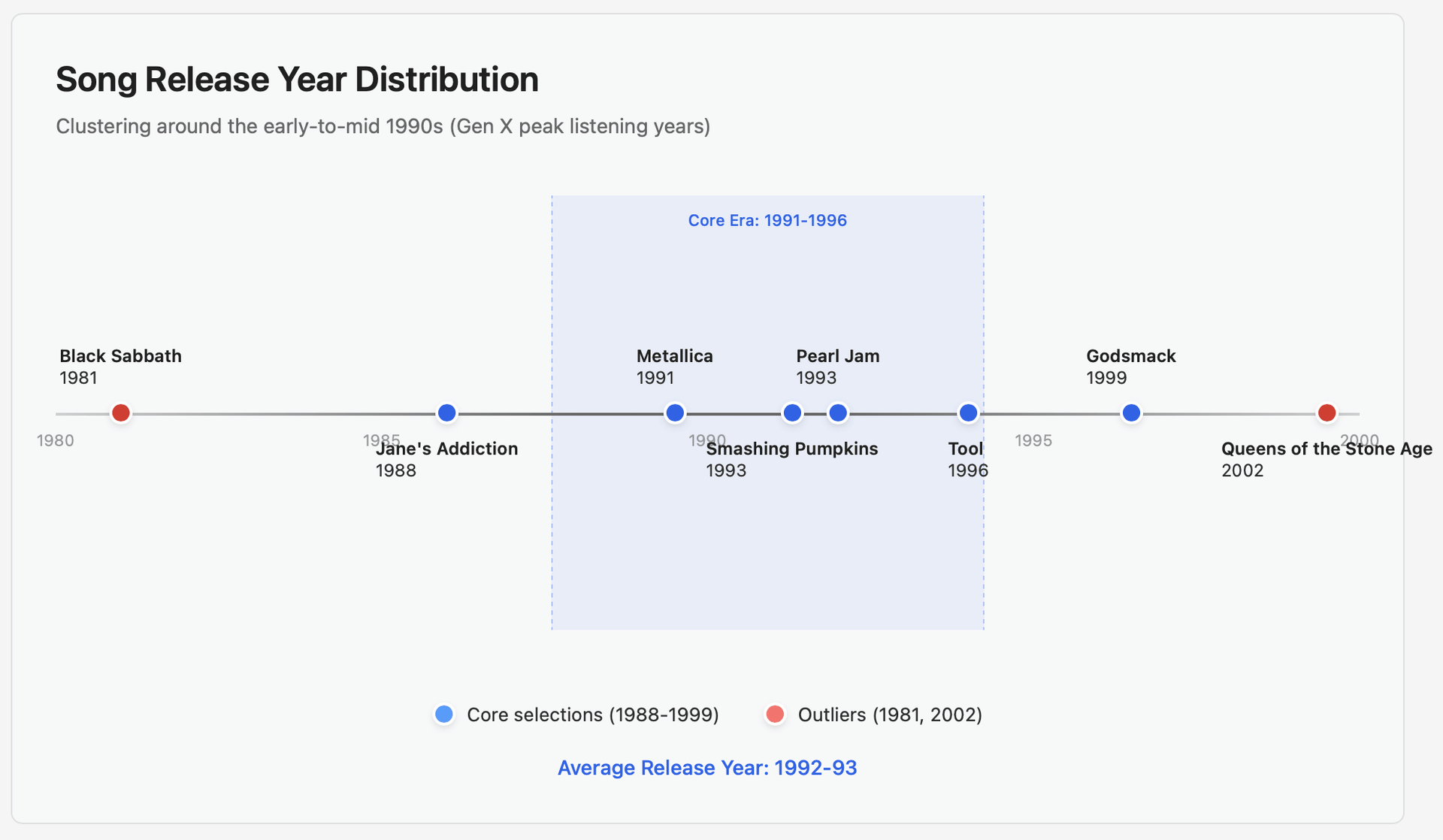
The songs average 1992-93 for release year. Hawley was born in 1967, making him an elder Gen X—these are songs from his twenties and thirties. Phillips herself cited personal connections to some selections, noting that Jane's Addiction's Nothing's Shocking was "one of my favorite CDs in high school."
Phillips emphasized that lyrics drove many choices: "It was the lyrics. The lyrics really worked," she said about "The Mob Rules," connecting it to themes of corporations and mob mentality. For "Cherub Rock," she noted it's "actually about an industry... how corrupt the music industry is. There's a little layer about the lyrics that color and flavor the story we just told."
The Musical Formula: What the Data Reveals
Mark's systematic examination documented specific parameters across all eight songs. Here's what the patterns show:
Era and Selection
Year range: 1981-2002
Average release year: 1992-93 (tight clustering in early-to-mid 90s)
Singles: 6 of 8 songs were released as singles (recognizable to radio audiences)
Track placement: Average track 2.875 (early album cuts—statement songs, not deep cuts)
Key: The E Minor Dominance
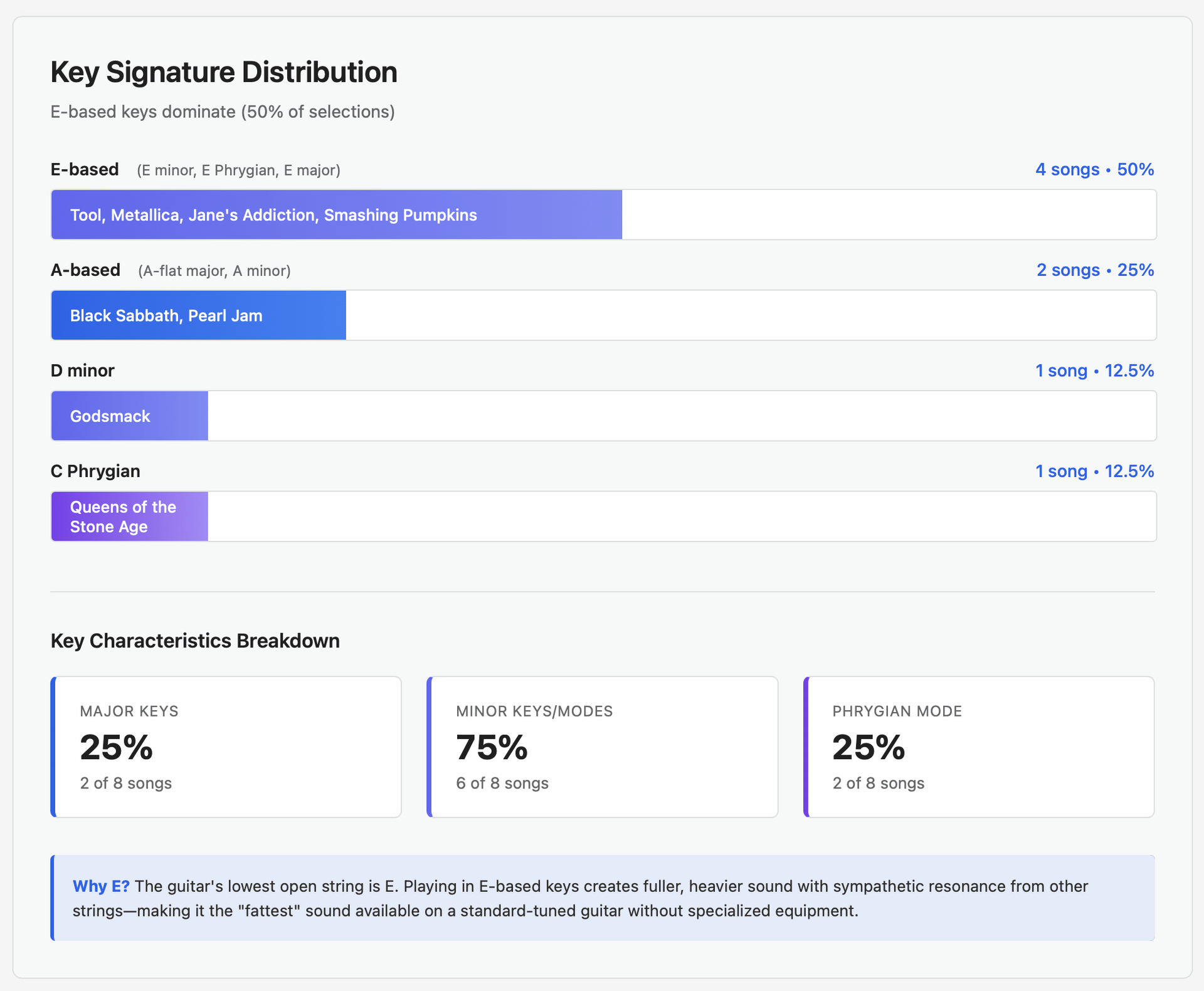
4 of 8 songs in E (50% of all selections)
2 use Phrygian mode (a minor scale with a lowered 2nd note—less common in rock, which creates a darker, more unusual sound)
Only 2 major keys (most lean toward minor tonalities)
Why E? Guitar's lowest open string is E. Playing in E allows for fuller, heavier sound with sympathetic resonance from other strings. It's the "fattest" sound you can get on a standard-tuned guitar without down-tuning or using specialized equipment. Many hard rock and metal songs default to E for this reason. The nineties represents a pivot point where artists more frequently down-tuned in the latter half of the decade and early parts of the 2000s. Had the mean year of release been later by a few years, E may have been far less ubiquitous.
Tempo: The Sweet Spot
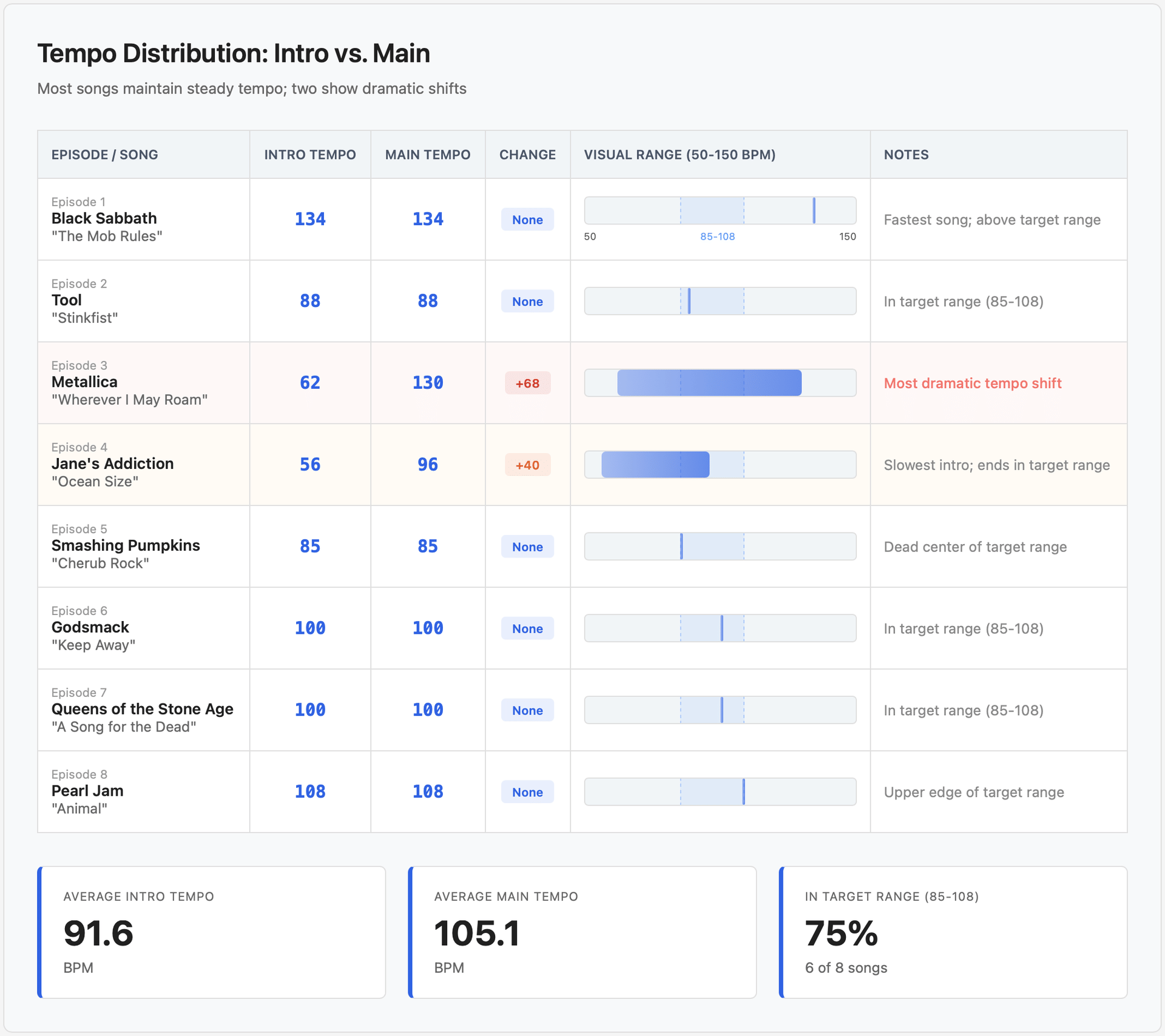
Intro tempos average: 91.6 BPM
Main song tempos average: 105.1 BPM
6 of 8 songs fall in 85-108 BPM range
This is "head-nodding" territory—energetic but not frantic. It's slower than punk or speed metal, faster than doom metal or slow ballads. It's the pace that makes you want to bang your head but doesn't exhaust you.
Structure: The Drop
7 of 8 songs begin with guitar alone or guitar with minimal elements (drums, feedback, unusual sounds)
All songs quickly build to full band (guitar, bass, drums) before vocals enter
Creates consistent anticipation → release pattern
This structure mirrors TV's need to "punctuate and finish an episode, but then... keep the momentum going for the next one," as Phillips described it. The quiet-to-loud dynamic creates a transition space—permission to leave the world of the episode while still feeling energized about what's coming.
Extreme contrast in dynamics and intensity, as in these selections, is a staple of alternative rock, and might be observed in most of the most popular songs by bands such as Nirvana. Given the era of these selections - openings such as these are to some degree to be expected.
Harmony: The "Dark Notes"
Frequent use of flat-7 chords (3 songs prominently feature this)
Flat-2 scale degrees (2 songs use this extensively)
Flat-5 scale degrees (2 songs feature this in main riffs)
These chords and pitches contribute to an overall “edgy” sound that is common in rock music. The flat-7 chord is a common yet somewhat ambiguous chord in minor keys, but is not naturally present in major keys at all, offering a bright yet striking sound. Its use in the two major-key selections on this list (“The Mob Rules” and “Cherub Rock”) follows a long tradition in rock music that descends directly from the blues. In the Phrygian mode songs, the flat-2 scale degree is a defining characteristic, which creates a pull to the home note of the key, the tonic, that is a bit unsettling given the much more common pull up towards that note from below. The flat-5 scale degree stands apart as being genuinely dissonant - it forms the “devil’s interval,” or tritone, when paired with the tonic, and has been used for centuries to evoke unease and tension.
Style Consistency
3 metal songs (Black Sabbath, Metallica, Tool)
3 grunge/post-grunge (Jane's Addiction, Smashing Pumpkins, Godsmack)
2 hard rock (Queens of the Stone Age, Pearl Jam—though categories blur and Pearl Jam is also grunge)
All guitar-forward, rock-band instrumentation
No pop-punk, nu-metal, industrial, electronic, or other contemporary alternatives
Phillips and Hawley built a specific aesthetic within 90s hard rock, allowing variety within those parameters rather than sampling across multiple genres.
What the Patterns Reveal
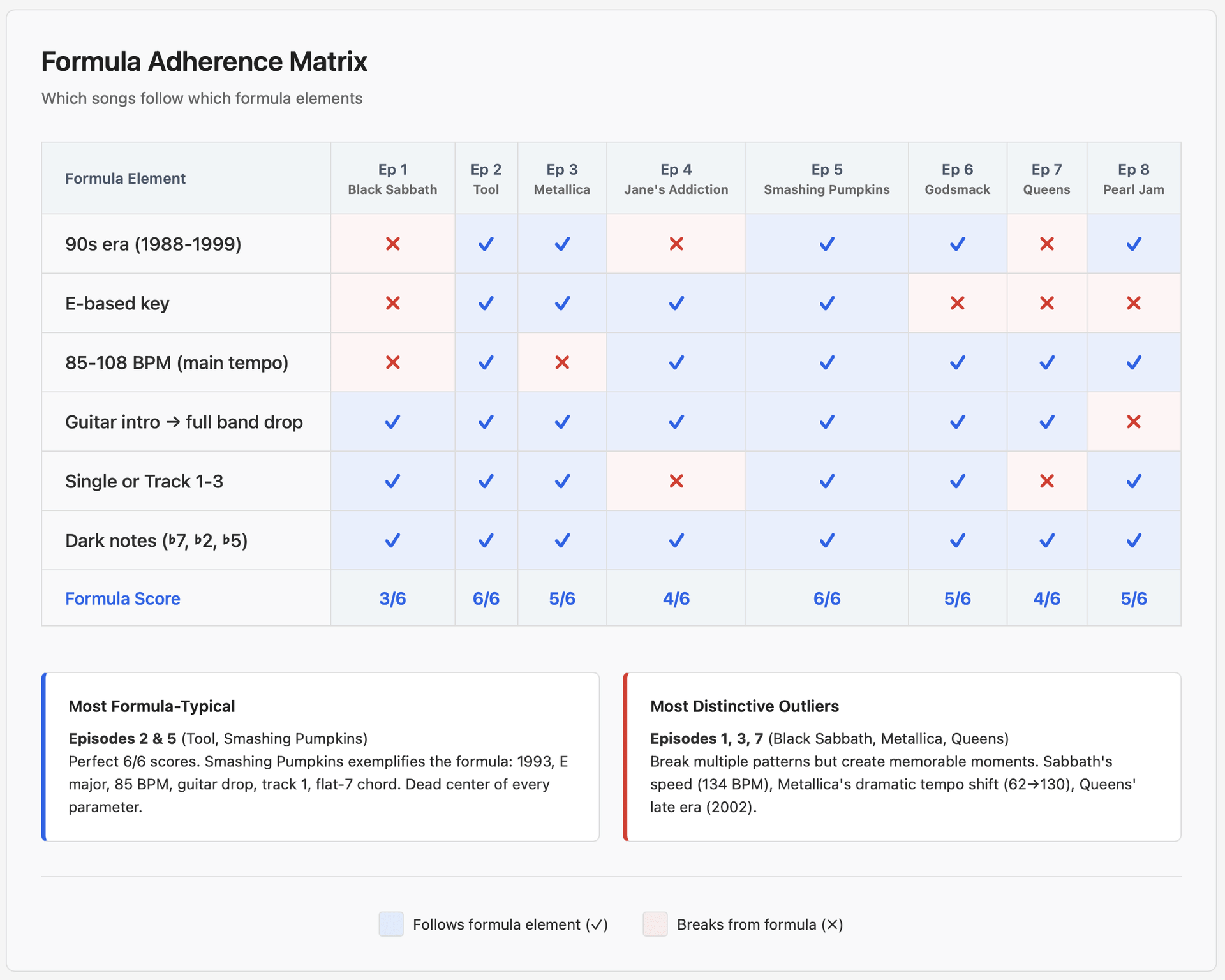
The consistency suggests Phillips worked within defined boundaries rather than selecting eight unrelated songs. The result is a clear template:
Core Parameters:
Early-to-mid 90s hard rock, metal, or grunge
E minor preference (or related keys)
85-108 BPM tempo range
Guitar intro building to full-band explosion
"Dark" harmonic elements (flat-7, flat-2, flat-5)
Radio-recognizable (mostly singles or track 1-3 album cuts)
Variable Elements:
Lyrical specificity ranges from precise thematic connections to atmospheric mood-setting
Musical complexity varies from technically sophisticated (Tool, Queens of the Stone Age) to more straightforward approaches (Godsmack, Pearl Jam)
Tempo dynamics shift from dramatic jumps (Metallica's 62→130 BPM) to steady builds
Instrumentation details include unique touches (Metallica's sitar, Jane's Addiction's acoustic opening)
Whether these parameters came from Hawley as directives or emerged organically from Phillips' selection process, they created a formula.
Lyrical Connections: Precision to Atmosphere
Phillips emphasized lyrics as a primary selection criterion, but the analysis reveals a spectrum of connection strength:
Precise Thematic Alignment:
Episode 3: "My body lies, but still I roam" directly mirrors Wendy's unconscious state during mind-connection
Episode 5: Industry corruption themes in "Cherub Rock" match Morrow's corporate betrayal
Episode 7: "Time to emerge" explicitly connects to transformation and the chestburster
Episode 8: "Five against one" and "I'd rather be with an animal" fit the Lost Boys and Wendy's choice
Atmospheric Mood-Setting:
Episode 2: Overstimulation themes loosely connect to Joe's numbness and awakening
Episode 4: Expansiveness creates atmosphere more than plot connection
Episode 1: Mob violence and approaching death match Xenomorph threat but remain fairly generic
Episode 6: "Keep away" boundary themes are tenuous
What's notable is that even weaker lyrical connections work on a vibrational level. Phillips described the finale: "Oh, fun. Pure fun, right? Even though you've been through some trauma, the fact they're all together and you see the alien crawling on the cage—it is just pure fun. Everyone smiles and it fits."
Sometimes the connection is precise. Sometimes it's about how the music makes you feel in that moment.
The Open Questions
This analysis documents what choices were made and what patterns exist, but several questions remain:
Process Questions:
Were specific musical parameters (keys, tempos, harmonic elements) discussed with Hawley, or did patterns emerge from your selections?
The E minor dominance—intentional for guitar resonance, or coincidence?
Why specific deep cuts (Ocean Size, A Song for the Dead) over bigger hits from those artists?
How did rights/clearances affect final choices?
What songs didn't make it, and why?
Design Questions:
How much weight did lyrical themes carry versus sonic/emotional fit?
Did the formula evolve across the season, or was the template established from Episode 1?
How much coordination and connection exists between these songs and the music heard within the episodes’ interiors?
Does the Formula Work?
The data shows consistent parameters across eight songs: 90s hard rock, E minor preference, 85-108 BPM range, guitar-to-full-band structure, "dark" harmonic elements, and recognizable singles or early album tracks. These weren't accidents—they were architectural choices. Phillips worked within defined aesthetic boundaries, finding variety within those parameters. The lyrical connections range from precise to atmospheric. The formula creates consistency while allowing for individual song characteristics.
What this analysis can't answer is whether this approach serves the Alien franchise well. The film franchise has never been cliffhanger-heavy while the TV series plays heavily with structure and form. These songs call attention to themselves in ways that pull viewers out of the world—they mark a transition, yes, but they also announce their presence.
Phillips framed this as evolution: "It needs to evolve." The counter-argument is that evolution should grow from the franchise's DNA rather than grafting on elements from elsewhere. Both positions are defensible, and whether the formula works for you probably depends on whether you were the right age in 1993.
What's not debatable is that these choices were systematic, not random. Phillips and Hawley committed to a formula and executed it consistently across all eight episodes. The formula exists. Whether it works is up to you.
For detailed analysis of each individual song, including production details, sonic profiles, and lyrical connections, see the companion Song-by-Song Breakdown.
AI Writing Disclosure
This article was developed using Claude AI as a research and writing tool. The core musical analysis was conducted by Mark from Nevermind the Music podcast through systematic examination of all eight songs. David engaged in a detailed podcast conversation with Mark exploring these findings, which forms the intellectual foundation of this article. Claude assisted with organizing the conversation transcript and Mark's detailed notes into a coherent structure, and transforming those discussions into polished prose while maintaining David's established voice. David and Mark engaged in a lengthy revision process and reviewed every draft closely to ensure it accurately reflects the thoughts, opinions, and analytical insights from their conversation. While Claude helped expand and refine the presentation, the core analytical insights, interpretations, and critical perspectives presented here originated from David and Mark's collaborative exploration of the music.